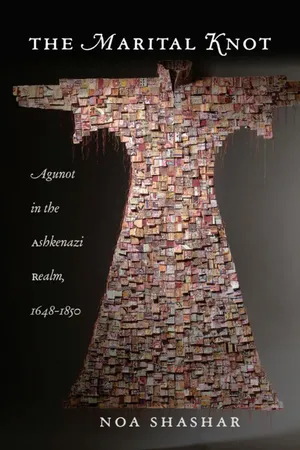
A long overdue study of agunot based on exhaustive research in rabbinic sources, memoirs, and communal records.
Noa Shashar sheds light on Jewish family life in the early modern era and on the activity of rabbis whose Jewish legal rulings determined the fate of agunot, literally "chained women," who were often considered a marginal group. Who were these men and women? How did Jewish society deal with the danger of a woman's becoming an agunah? What kind of reality was imposed on women who found themselves agunot, and what could they do to extricate themselves from their plight? How did rabbinic decisors discharge their task during this period, and what were the outcomes given the fact that the agunot were dependent on the male rabbinic establishment?
This study describes the lives of agunot, and by reexamining the halakhic activity concerning agunot in this period, proposes a new assessment of the attitude that decisors displayed toward the freeing of agunot.
- English
- ePUB (mobile friendly)
- Available on iOS & Android
eBook - ePub
About this book
Information
Publisher
Brandeis University PressYear
2024Print ISBN
9781684582402
9781684582419
eBook ISBN
9781684582396
Table of contents
- Cover Page
- Title Page
- Copyright Page
- Dedication
- Contents
- Preface and Acknowledgments
- Introduction
- Part I. Widows and Yevamot in the Ashkenazic World in the Early Modern Age
- Chapter 1: Widows in the Ashkenazic World, 1648–1850
- Chapter 2: Yibum and Halitzah: The Halakhic Basis for Freeing an Agunah Awaiting Halitzah 41
- Chapter 3: The Halitzah Trap
- Part II. Dead Men, Chained Women
- Chapter 4: Bitterly She Wails: Agunot in Times of Persecution and War
- Chapter 5: Two Tales of Murder
- Chapter 6: Identifying the Dead in the Interest of Freeing the Agunah and Taking Revenge
- Chapter 7: “Nothing of Him Was Ever Found Save a Shoe and Belt”: Freeing an Agunah When the Corpse Is Missing
- Chapter 8: The Agunah Wife of Lemli Wimpe of Metz
- Chapter 9: Death of a Merchant: Gutta and Avraham Heckscher of Hamburg
- Part III. Troubled Marriages
- Chapter 10: Scenes from Marriages in Conflict
- Chapter 11: “Concerning the Agunah Whose Husband Left for Distant Parts”
- Part IV. The Riddle of the Sources
- Chapter 12: Heterei Agunah in Beit Din Records and Responsa Literature
- Afterword: The Agunah, the Decisor, and the Suffering
- Glossary
- Notes
- Bibliography
- Index
Trusted by 375,005 students
Access to over 1.5 million titles for a fair monthly price.
Study more efficiently using our study tools.
Frequently asked questions
Yes, you can cancel anytime from the Subscription tab in your account settings on the Perlego website. Your subscription will stay active until the end of your current billing period. Learn how to cancel your subscription
No, books cannot be downloaded as external files, such as PDFs, for use outside of Perlego. However, you can download books within the Perlego app for offline reading on mobile or tablet. Learn how to download books offline
Perlego offers two plans: Essential and Complete
- Essential is ideal for learners and professionals who enjoy exploring a wide range of subjects. Access the Essential Library with 800,000+ trusted titles and best-sellers across business, personal growth, and the humanities. Includes unlimited reading time and Standard Read Aloud voice.
- Complete: Perfect for advanced learners and researchers needing full, unrestricted access. Unlock 1.5M+ books across hundreds of subjects, including academic and specialized titles. The Complete Plan also includes advanced features like Premium Read Aloud and Research Assistant.
We are an online textbook subscription service, where you can get access to an entire online library for less than the price of a single book per month. With over 1.5 million books across 990+ topics, we’ve got you covered! Learn about our mission
Look out for the read-aloud symbol on your next book to see if you can listen to it. The read-aloud tool reads text aloud for you, highlighting the text as it is being read. You can pause it, speed it up and slow it down. Learn more about Read Aloud
Yes! You can use the Perlego app on both iOS and Android devices to read anytime, anywhere — even offline. Perfect for commutes or when you’re on the go.
Please note we cannot support devices running on iOS 13 and Android 7 or earlier. Learn more about using the app
Please note we cannot support devices running on iOS 13 and Android 7 or earlier. Learn more about using the app
Yes, you can access The Marital Knot by Noa Shashar in PDF and/or ePUB format, as well as other popular books in History & Jewish History. We have over 1.5 million books available in our catalogue for you to explore.