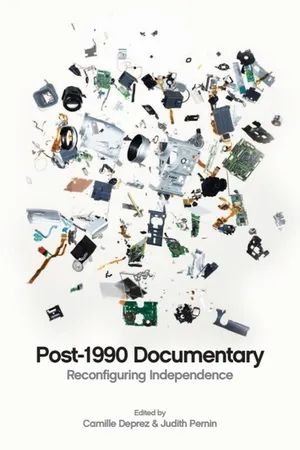
This book questions the meanings of 'independence' for documentaries made in the post-1990 context, a period of unrivalled disruption and creativity in the field. Based upon a reasoned selection of contributions, it is the first collection of in-depth case studies cutting across formats, media, subject matters, purposes and national divides. Writing from a wide range of academic perspectives, the contributors shed new light on historical, theoretical and empirical issues pertaining to the independent documentary, in order to better comprehend the radical transformations of the form over the past twenty-five years. Compared to existing studies, this volume focuses on works and practitioners existing at the margins of the traditional media, the mainstream film industry and the prevailing economic and socio-political systems; yet greatly contributing to changing our perception of documentaries. And in doing so, it addresses an important gap in the global understanding of documentary practices and styles.
- 280 pages
- English
- PDF
- Available on iOS & Android
eBook - PDF
About this book
Information
Subtopic
Film & VideoTable of contents
- Title page
- Copyright
- Contents
- Figures
- Acknowledgements
- Introduction
- PART I History and Spaces of Resistance
- Chapter 1 Post-unification (East) German Documentary and the Contradictions of Identity
- Chapter 2 No Going Back: Continuity and Change in Australian Documentary
- Chapter 3 A Space in Between: The Legacy of the Activist Documentary Film in India
- Chapter 4 Languages, Speech and Voice: The Heritage of Jean Rouch and Pier Paolo Pasolini in Convention: Black Wall/White Holes
- Chapter 5 Chris Marker: Interactive Screen and Memory
- PART II The Personal Experience
- Chapter 6 The Survivor-Perpetrator Encounter and the Truth Archive in Rithy Panh’s Documentaries
- Chapter 7 Contesting Consensual Memory: The Work of Remembering in Chilean Autobiographical Documentaries
- Chapter 8 ‘We All Invented Our Own Algeria’:1 Habiba Djahnine’s Letter to My Sister as Memory-Narrative
- Chapter 9 From the Ashes: The Fall of Apartheid and the Rise of the Lone Documentary Filmmaker in South Africa
- Chapter 10 A Personal Vision of the Hong Kong Cityscape in Anson Mak’s Essayistic Documentary Films One Way Street on a Turntable and On the Edge of a Floating City, We Sing
- PART III Displacement, Participation and Spectatorship
- Chapter 11 Documentary Filmmakers on the Circuit: A Festival Career from Czech Dream to Czech Peace
- Chapter 12 Material Traces of Lebanon: A Documentary Aesthetics of Feeling in the Art Gallery
- Chapter 13 Autonomous Navigation? Multiplicity and Self-reflexive Aesthetics in Sergio Basso’s Documentary Film Giallo a Milano and Web Documentary Made in Chinatown
- Chapter 14 Fukushima and the Shifting Conventions of Documentary: From Broadcast to Social Media Netizenship
- Chapter 15 Independent Documentaries and Online Uses in China: From Cinephilia to Activism
- Conclusion
- Notes on the Contributors
- Index
Trusted by 375,005 students
Access to over 1.5 million titles for a fair monthly price.
Study more efficiently using our study tools.
Frequently asked questions
Yes, you can cancel anytime from the Subscription tab in your account settings on the Perlego website. Your subscription will stay active until the end of your current billing period. Learn how to cancel your subscription
No, books cannot be downloaded as external files, such as PDFs, for use outside of Perlego. However, you can download books within the Perlego app for offline reading on mobile or tablet. Learn how to download books offline
Perlego offers two plans: Essential and Complete
- Essential is ideal for learners and professionals who enjoy exploring a wide range of subjects. Access the Essential Library with 800,000+ trusted titles and best-sellers across business, personal growth, and the humanities. Includes unlimited reading time and Standard Read Aloud voice.
- Complete: Perfect for advanced learners and researchers needing full, unrestricted access. Unlock 1.5M+ books across hundreds of subjects, including academic and specialized titles. The Complete Plan also includes advanced features like Premium Read Aloud and Research Assistant.
We are an online textbook subscription service, where you can get access to an entire online library for less than the price of a single book per month. With over 1.5 million books across 990+ topics, we’ve got you covered! Learn about our mission
Look out for the read-aloud symbol on your next book to see if you can listen to it. The read-aloud tool reads text aloud for you, highlighting the text as it is being read. You can pause it, speed it up and slow it down. Learn more about Read Aloud
Yes! You can use the Perlego app on both iOS and Android devices to read anytime, anywhere — even offline. Perfect for commutes or when you’re on the go.
Please note we cannot support devices running on iOS 13 and Android 7 or earlier. Learn more about using the app
Please note we cannot support devices running on iOS 13 and Android 7 or earlier. Learn more about using the app
Yes, you can access Post-1990 Documentary by Camille Deprez,Judith Pernin in PDF and/or ePUB format, as well as other popular books in Media & Performing Arts & Film & Video. We have over 1.5 million books available in our catalogue for you to explore.