- English
- ePUB (mobile friendly)
- Available on iOS & Android
eBook - ePub
Hadron Physics
About this book
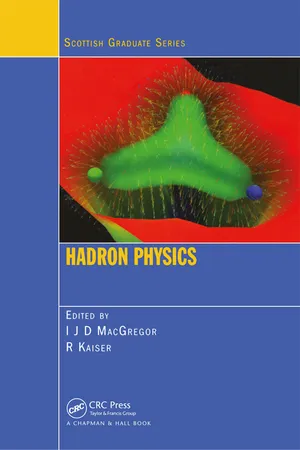
Straddling the traditional disciplines of nuclear and particle physics, hadron physics is a vital and extremely active research area, as evidenced by a 2004 Nobel prize and new research facilities, such as that scheduled to open at CERN. Through detailed, pedagogical chapters contributed by key international experts, Hadron Physics maps out contemporary knowledge of the subject. It covers both the theoretical and experimental aspects of hadron structure and properties along with a wide range of specific research topics, results, and applications. Providing a full picture of activity in the field, the book highlights three particular areas of current research: computational lattice hadron physics, the structure and dynamics of hadrons, and generalized parton distributions. It provides a solid introduction, includes background theory, and presents the current state of understanding of the subject.
Information
Table of contents
- Cover Page
- Halftitle Page
- Cover image
- Title Page
- Copyright Page
- SUSSP proceedings
- Lecturers
- Organising committee
- Directors’ preface
- Editors’ note
- Contents
- Nucleon electromagnetic form factors
- Hard scattering processes
- Selected topics in baryon spectroscopy and structure
- Hadrons in the nuclear medium: recent results and perspectives
- Topical aspects of hyperon physics
- Light-front QCD
- States beyond qq‾ in QCD: diquarks, tetraquarks, pentaquarks and no quarks
- The QCD vacuum and its hadronic excitations
- Lattice QCD - A guide for people who want results
- Resonances from coupled channel chiral unitarity
- Chiral extrapolations
- Chiral phase transition in hadronic matter: The influence of baryon density
- A covariant quark model
- The lattice calculation of moments of structure functions
- Hadron tomography
- Dynamics of hard diffraction
- Deeply virtual Compton scattering: results & future
- The HERMES Recoil Detector
- Prospects for GPD measurements with COMPASS at CERN
- The magnetic moment of the Δ+
- Measurement of the neutron electric form factor at MAMI
- Single π0 and η photoproduction off protons at CB-ELSA
- Inclusive photoproduction of light mesons at HERA
- Hadron physics at the CELSIUS/WASA facility
- The generalised GDH sum rule
- ΔG/G at COMPASS
- Relativistic Glauber theory for Ae,e"p reactions
- Hybrid mesons in the flux-tube model
- What can lattice QCD say about pentaquarks?
- Quantum weights of quasiparticles in QCD at finite temperature
- Vacuum condensates of dimension two in pure gluodynamics
- Matching Regge theory to the operator product expansion (OPE)
- Strangeness production in a coupled channels framework
- Nucleon properties in the perturbative chiral quark model
- Gauge-invariance in hadronic scattering processes
- Baryon observables in a covariant Faddeev approach
- Direct observation of ππ-scattering in π Xe-interactions at 2.3 and 3.5GeV/c
- Capability computing for computational hadron physics
- Finite-size effects in Lattice QCD with dynamical Wilson fermions
- N to Δ transition in lattice QCD
- Dynamical overlap
- Recent overlap results
- Generalised parton distributions from lattice QCD
- Mass storage capacity for computational hadron physics
- Non-perturbative versus perturbative effects in generalised parton distributions
- Neutron spin structure measurements in JLab Hall A
- Simulation of the DVCS-TOF detector for COMPASS
- The ALICE transition radiation detector readout electronics
- A fibre tracker with particle identification for the HERMES Recoil Detector
- Track reconstruction for the HERMES Recoil Detector
- Test beams used in the HERMES Recoil Detector project
- Hadron physics summer school and workshop
- Hadron physics
Trusted by 375,005 students
Access to over 1.5 million titles for a fair monthly price.
Study more efficiently using our study tools.
Frequently asked questions
Yes, you can cancel anytime from the Subscription tab in your account settings on the Perlego website. Your subscription will stay active until the end of your current billing period. Learn how to cancel your subscription
No, books cannot be downloaded as external files, such as PDFs, for use outside of Perlego. However, you can download books within the Perlego app for offline reading on mobile or tablet. Learn how to download books offline
Perlego offers two plans: Essential and Complete
- Essential is ideal for learners and professionals who enjoy exploring a wide range of subjects. Access the Essential Library with 800,000+ trusted titles and best-sellers across business, personal growth, and the humanities. Includes unlimited reading time and Standard Read Aloud voice.
- Complete: Perfect for advanced learners and researchers needing full, unrestricted access. Unlock 1.5M+ books across hundreds of subjects, including academic and specialized titles. The Complete Plan also includes advanced features like Premium Read Aloud and Research Assistant.
We are an online textbook subscription service, where you can get access to an entire online library for less than the price of a single book per month. With over 1.5 million books across 990+ topics, we’ve got you covered! Learn about our mission
Look out for the read-aloud symbol on your next book to see if you can listen to it. The read-aloud tool reads text aloud for you, highlighting the text as it is being read. You can pause it, speed it up and slow it down. Learn more about Read Aloud
Yes! You can use the Perlego app on both iOS and Android devices to read anytime, anywhere — even offline. Perfect for commutes or when you’re on the go.
Please note we cannot support devices running on iOS 13 and Android 7 or earlier. Learn more about using the app
Please note we cannot support devices running on iOS 13 and Android 7 or earlier. Learn more about using the app
Yes, you can access Hadron Physics by I.J. Douglas MacGregor,Ralf Kaiser in PDF and/or ePUB format, as well as other popular books in Physical Sciences & Physics. We have over 1.5 million books available in our catalogue for you to explore.