Focussing on late medieval and early modern philosophy and medicine, this edited collection explores the replacement of hylomorphism—the dominant theory of bodies in the Middle Ages—with new theories of matter such as corpuscularianism and atomism at the dawn of the Modern period. Together, the contributions offer a comprehensive overview of a crucial historical moment for the history of philosophy and science: the rise of a new conception of matter against declining scholastic theories. They highlight the key aspects of this historical transition by investigating precise concepts that were central to this shift, namely the notions of elements, atoms, and corpuscles. Shedding light on the gradual process by which hylomorphism was eventually replaced by a more positive conception of matter and natural processes, the book demonstrates how many thinkers of the late medieval period were willing to integrate new theories into the conceptual framework of Aristotelian natural philosophy, and tried to harmonise them with the traditional concepts and axioms of scholastic doctrines. Showing how these conceptual innovations resulted from a complex interaction between different fields of late medieval and early modern knowledge, the authors bring together research from the disciplines of metaphysics, medieval philosophy, and medical science. Providing an overview of an important theoretical shift in the transition from the Middle Ages to the Modern Era, this book is essential reading for scholars of philosophy, and historians of medieval and early modern science and medicine.
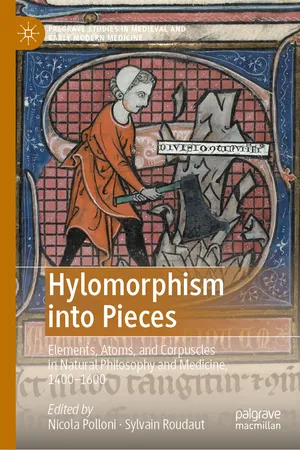
eBook - ePub
Hylomorphism into Pieces
Elements, Atoms, and Corpuscles in Natural Philosophy and Medicine, 1400–1600
- English
- ePUB (mobile friendly)
- Available on iOS & Android
eBook - ePub
Hylomorphism into Pieces
Elements, Atoms, and Corpuscles in Natural Philosophy and Medicine, 1400–1600
About this book
Information
Table of contents
- Cover
- Front Matter
- Hylomorphism into Pieces? Introductory Remarks
- Atoms, Minima and Points: Democritean Corpuscularism in the Thirteenth Century
- The ‘No-Frills’ Doctrine of Minima naturalia in the Latin Middle Ages and in the Renaissance: A First Exploration
- The Changing View of Successive Entities in the Fourteenth Century: Peter of Mantua on Matter and Form
- Unity Out of Multiplicity: Nicholas of Cusa’s Theory of the Elements
- Pietro Pomponazzi and the Debate on the Four Elements
- Points of Form and Other Minima: Hylomorphism and Indivisibles in the Circle of John Mair
- Late Scholastic Thomism into Pieces. Hylomorphism and Indeterminate Dimensions in Domingo Báñez’s Commentary on De generatione et corruptione
- Francisco de Toledo on Elemental Mixtures
- Prime Matter Is Three-Dimensionality. The Debate on the Extension of Prime Matter from Zabarella to Galileo
- Jacob Schegk, Simplicius and “Anaxagoras the Atomist”: Aristotelian Commentaries and Renaissance Corpuscularism
- Rodrigo de Arriaga’s Substance Trialism
- Back Matter
Trusted by 375,005 students
Access to over 1.5 million titles for a fair monthly price.
Study more efficiently using our study tools.
Frequently asked questions
Yes, you can cancel anytime from the Subscription tab in your account settings on the Perlego website. Your subscription will stay active until the end of your current billing period. Learn how to cancel your subscription
No, books cannot be downloaded as external files, such as PDFs, for use outside of Perlego. However, you can download books within the Perlego app for offline reading on mobile or tablet. Learn how to download books offline
Perlego offers two plans: Essential and Complete
- Essential is ideal for learners and professionals who enjoy exploring a wide range of subjects. Access the Essential Library with 800,000+ trusted titles and best-sellers across business, personal growth, and the humanities. Includes unlimited reading time and Standard Read Aloud voice.
- Complete: Perfect for advanced learners and researchers needing full, unrestricted access. Unlock 1.5M+ books across hundreds of subjects, including academic and specialized titles. The Complete Plan also includes advanced features like Premium Read Aloud and Research Assistant.
We are an online textbook subscription service, where you can get access to an entire online library for less than the price of a single book per month. With over 1.5 million books across 990+ topics, we’ve got you covered! Learn about our mission
Look out for the read-aloud symbol on your next book to see if you can listen to it. The read-aloud tool reads text aloud for you, highlighting the text as it is being read. You can pause it, speed it up and slow it down. Learn more about Read Aloud
Yes! You can use the Perlego app on both iOS and Android devices to read anytime, anywhere — even offline. Perfect for commutes or when you’re on the go.
Please note we cannot support devices running on iOS 13 and Android 7 or earlier. Learn more about using the app
Please note we cannot support devices running on iOS 13 and Android 7 or earlier. Learn more about using the app
Yes, you can access Hylomorphism into Pieces by Nicola Polloni,Sylvain Roudaut in PDF and/or ePUB format, as well as other popular books in History & European History. We have over 1.5 million books available in our catalogue for you to explore.