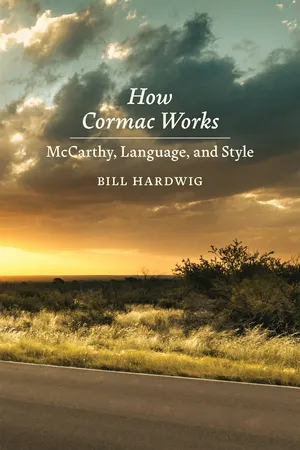
Throughout a career that spanned six decades, Cormac McCarthy produced twelve novels that, while often quite different from one another, show a consistent commitment to formal experimentation motivated by a love of language and the possibilities therein. While it is McCarthy's grim depiction of violence and his texts' complex philosophical perspectives that receive the most attention from scholars, readers who admire the author's work are often drawn to it initially, as Bill Hardwig was, at the level of language, attracted by the breathtakingly original way McCarthy strings together words and paints images in the minds of readers.
In How Cormac Works, Hardwig suggests that McCarthy's defining attribute as an author falls not in the realm of psychology, philosophy, or history but in his experimentation with language—in the style that gives his books their atmosphere, mood, and tone. Hardwig's analysis foregrounds the ways in which McCarthy utilizes and manipulates language, how he uses it to simultaneously create and withhold meaning, draw clear images, and resist this clarity. How Cormac Works focuses less on the what—what McCarthy writes or what the characters say—and more on the how—how McCarthy structures his fiction and how that structure contributes to his literary style and meaning.
- English
- ePUB (mobile friendly)
- Available on iOS & Android
eBook - ePub
About this book
Information
Topic
LiteraturaTable of contents
- Cover
- Title Page
- Copyright Page
- Dedication
- Contents
- ACKNOWLEDGMENTS
- LIST OF ABBREVIATIONS
- INTRODUCTION
- I. Modes
- ONE Unexpected Registers: McCarthy’s Narrative Modes
- TWO “Large Loose Baggy Monsters”: McCarthy’s Epic Mode
- II. Moods
- THREE “Little More Than a Childhood Enthusiasm”: Thick Description and the Taxonomic Mood
- FOUR The Precarious Mood: The Passenger, Stella Maris, and the Fragile Twentieth Century
- EPILOGUE “Them Old Dreams”
- NOTES
- BIBLIOGRAPHY
- INDEX
Trusted by 375,005 students
Access to over 1.5 million titles for a fair monthly price.
Study more efficiently using our study tools.
Frequently asked questions
Yes, you can cancel anytime from the Subscription tab in your account settings on the Perlego website. Your subscription will stay active until the end of your current billing period. Learn how to cancel your subscription
No, books cannot be downloaded as external files, such as PDFs, for use outside of Perlego. However, you can download books within the Perlego app for offline reading on mobile or tablet. Learn how to download books offline
Perlego offers two plans: Essential and Complete
- Essential is ideal for learners and professionals who enjoy exploring a wide range of subjects. Access the Essential Library with 800,000+ trusted titles and best-sellers across business, personal growth, and the humanities. Includes unlimited reading time and Standard Read Aloud voice.
- Complete: Perfect for advanced learners and researchers needing full, unrestricted access. Unlock 1.5M+ books across hundreds of subjects, including academic and specialized titles. The Complete Plan also includes advanced features like Premium Read Aloud and Research Assistant.
We are an online textbook subscription service, where you can get access to an entire online library for less than the price of a single book per month. With over 1.5 million books across 990+ topics, we’ve got you covered! Learn about our mission
Look out for the read-aloud symbol on your next book to see if you can listen to it. The read-aloud tool reads text aloud for you, highlighting the text as it is being read. You can pause it, speed it up and slow it down. Learn more about Read Aloud
Yes! You can use the Perlego app on both iOS and Android devices to read anytime, anywhere — even offline. Perfect for commutes or when you’re on the go.
Please note we cannot support devices running on iOS 13 and Android 7 or earlier. Learn more about using the app
Please note we cannot support devices running on iOS 13 and Android 7 or earlier. Learn more about using the app
Yes, you can access How Cormac Works by Bill Hardwig in PDF and/or ePUB format, as well as other popular books in Literatura & Historia y teoría de la crítica literaria. We have over 1.5 million books available in our catalogue for you to explore.