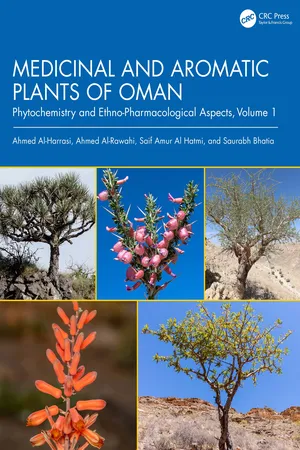
Medicinal and Aromatic Plants of Oman
eBook - ePub

Medicinal and Aromatic Plants of Oman

Phytochemistry and Ethno-Pharmacological Aspects, Volume 1

  1. English
  2. ePUB (mobile friendly)
  3. Available on iOS & Android
eBook - ePub

Medicinal and Aromatic Plants of Oman

Phytochemistry and Ethno-Pharmacological Aspects, Volume 1

About this book

Medicinal plants have received an impetus recently due to the revival of attention to natural products in the form of herbal medicines, demanding convincing knowledge on their phytochemistry, status, cultivation, and utilization. Medicinal plants in the Sultanate of Oman have tremendous potential in terms of ethnomedicinal and food applications. However, these treasures of Oman have not been fully explored until recently. Several medicinal plants indigenous to Oman have been used for several centuries in the form of traditional medicine for the prevention and treatment of diseases. The first volume of this book covers information about sustainable use of selected medicinal plants, their phytochemistry, and efforts made to conserve them to ensure continued supply. This volume reveals systematic information about 104 to 151 promising medicinal plants in Oman with botanical names, common names, synonyms, local names, family, habitat and distribution, chemical constituents, pharmacological activity, uses (common uses, traditional uses and therapeutic uses), toxicity and clinical data, patents, and their marketed products or industrial application. Each of the 151 plants has a high-resolution color photograph (where available), plant description, and location. The chapters are written by well-experienced authors in the field. A uniform chapter structure throughout this book has been designed to maintain consistency. This book is especially valuable to academicians, phytochemists, pharmacologists, herbalists, agriculturists, biotechnologists, natural product researchers and industrialists involved in the production of herbal drugs. Salient features of this book are as follows:

  • ?t provides common uses, traditional uses, and therapeutic uses of 132 medicinal plants
  • It covers the detailed phytochemistry of each medicinal plant
  • It offers systematic information about the geographical distribution of these plants
  • Updated information about the pharmacology, mechanisms of action, and toxicity of these plants is covered in detail

Overall, this book provides an overview of botanical description, geographical distribution, chemical composition and uses of the medicinal plants native to the Sultanate of Oman.

Many of the plants listed in this book—particularly in Volume One—are endemic, near?endemic, or regionally endemic medicinal and aromatic species of Oman, which remain largely unexplored and are supported by limited scientific literature. Due to this scarcity of information, the authors have included relevant data from closely related species within the same genus. This approach enables readers to better understand the chemistry, taxonomy, and potential uses of the respective species in the context of their taxonomic relatives.

Trusted by 375,005 students

Access to over 1.5 million titles for a fair monthly price.

Study more efficiently using our study tools.

Information

Publisher
CRC Press
Year
2025
eBook ISBN
9781040394663

Table of contents

  1. Cover
  2. Half Title
  3. Title Page
  4. Copyright Page
  5. Table of Contents
  6. About the Authors
  7. Acknowledgments
  8. Chapter 1 Genus Abelmoschus
  9. Chapter 2 Genus Abutilon
  10. Chapter 3 Genus Acacia (Senegalia and Vachellia)
  11. Chapter 4 Genus Acalypha
  12. Chapter 5 Genus Achyranthens
  13. Chapter 6 Genus Acridocarpus
  14. Chapter 7 Genus Adansonia
  15. Chapter 8 Genus Adesnociadium
  16. Chapter 9 Genus Adenium
  17. Chapter 10 Genus Aerva
  18. Chapter 11 Genus Aizoon
  19. Chapter 12 Genus Alectra
  20. Chapter 13 Genus Aloe
  21. Chapter 14 Genus Allophylus
  22. Chapter 15 Genus Alternanthera
  23. Chapter 16 Genus Amaranthus
  24. Chapter 17 Genus Anagallis
  25. Chapter 18 Genus Ammi
  26. Chapter 19 Genus Anastatica
  27. Chapter 20 Genus Andrachne
  28. Chapter 21 Genus Argemone
  29. Chapter 22 Genus Anthemis
  30. Chapter 23 Genus Anticharis
  31. Chapter 24 Genus Anogeissus (Terminalia)
  32. Chapter 25 Genus Apium
  33. Chapter 26 Genus Ageratum
  34. Chapter 27 Genus Arnebia
  35. Chapter 28 Genus Azima
  36. Chapter 29 Genus Aristolochia
  37. Chapter 30 Genus Artemisia
  38. Chapter 31 Genus Arthrocaulon
  39. Chapter 32 Genus Asperugo
  40. Chapter 33 Genus Asplenium
  41. Chapter 34 Genus Asphodelus
  42. Chapter 35 Genus Asteriscus (Pallenis)
  43. Chapter 36 Genus Astragalus
  44. Chapter 37 Genus Atractylis
  45. Chapter 38 Genus Atriplex
  46. Chapter 39 Genus Bacopa
  47. Chapter 40 Genus Balanites
  48. Chapter 41 Genus Basananthe
  49. Chapter 42 Genus Berberis
  50. Chapter 43 Genus Bergia
  51. Chapter 44 Genus Bidens
  52. Chapter 45 Genus Blepharis
  53. Chapter 46 Genus Blumea
  54. Chapter 47 Genus Boerhavia
  55. Chapter 48 Genus Boscia
  56. Chapter 49 Genus Boswellia
  57. Chapter 50 Genus Cadaba
  58. Chapter 51 Genus Cadia
  59. Chapter 52 Genus Calligonum
  60. Chapter 53 Genus Calendula
  61. Chapter 54 Genus Calotropis
  62. Chapter 55 Genus Capparis
  63. Chapter 56 Genus Caralluma (Desmidorchis)
  64. Chapter 57 Genus Cardiospermum
  65. Chapter 58 Genus Chenopodium
  66. Chapter 59 Genus Carduus
  67. Chapter 60 Genus Carissa
  68. Chapter 61 Genus Caudanthera
  69. Chapter 62 Genus Carthamus
  70. Chapter 63 Genus Centaurea
  71. Chapter 64 Genus Centaurium
  72. Chapter 65 Genus Ceratonia
  73. Chapter 66 Genus Chlorophytum
  74. Chapter 67 Genus Chrozophora
  75. Chapter 68 Genus Cichorium
  76. Chapter 69 Genus Cissus
  77. Chapter 70 Genus Cistanche
  78. Chapter 71 Genus Citrullus
  79. Chapter 72 Genus Citrus
  80. Chapter 73 Genus Clematis
  81. Chapter 74 Genus Cleome
  82. Chapter 75 Genus Corbichonia
  83. Chapter 76 Genus Commiphora
  84. Chapter 77 Genus Convolvulus
  85. Chapter 78 Genus Corchorus
  86. Chapter 79 Genus Cordia
  87. Chapter 80 Genus Cornulaca
  88. Chapter 81 Genus Corallocarpus
  89. Chapter 82 Genus Ceropegia
  90. Chapter 83 Genus Cressa
  91. Chapter 84 Genus Crotalaria
  92. Chapter 85 Genus Croton
  93. Chapter 86 Genus Cucumis
  94. Chapter 87 Genus Cuscuta
  95. Chapter 88 Genus Cymbopogon
  96. Chapter 89 Genus Cyphostemma
  97. Chapter 90 Genus Cyperus
  98. Chapter 91 Genus Dalbergia
  99. Chapter 92 Genus Dalechampia
  100. Chapter 93 Genus Daphne
  101. Chapter 94 Genus Datura
  102. Chapter 95 Genus Delonix
  103. Chapter 96 Genus Dionysia
  104. Chapter 97 Genus Dipcadi
  105. Chapter 98 Genus Diplotaxis
  106. Chapter 99 Genus Dipterygium (Cleome)
  107. Chapter 100 Genus Dodonaea
  108. Chapter 101 Genus Dorstenia
  109. Chapter 102 Genus Dracaena
  110. Chapter 103 Genus Ducrosia
  111. Chapter 104 Genus Plumbago (formally know as Dyerophytum)
  112. Appendix
  113. Miscellaneous medicinal plants
  114. Supplementary figures
  115. References
  116. Index

Frequently asked questions

Yes, you can cancel anytime from the Subscription tab in your account settings on the Perlego website. Your subscription will stay active until the end of your current billing period. Learn how to cancel your subscription
No, books cannot be downloaded as external files, such as PDFs, for use outside of Perlego. However, you can download books within the Perlego app for offline reading on mobile or tablet. Learn how to download books offline
We are an online textbook subscription service, where you can get access to an entire online library for less than the price of a single book per month. With over 1.5 million books across 990+ topics, we’ve got you covered! Learn about our mission
Look out for the read-aloud symbol on your next book to see if you can listen to it. The read-aloud tool reads text aloud for you, highlighting the text as it is being read. You can pause it, speed it up and slow it down. Learn more about Read Aloud
Yes! You can use the Perlego app on both iOS and Android devices to read anytime, anywhere — even offline. Perfect for commutes or when you’re on the go.
Please note we cannot support devices running on iOS 13 and Android 7 or earlier. Learn more about using the app
Yes, you can access Medicinal and Aromatic Plants of Oman by Ahmed Al-Harrasi,Ahmed Al-Rawahi,Saif Amur Al Hatmi,Saurabh Bhatia in PDF and/or ePUB format, as well as other popular books in Medicine & Pharmacology. We have over 1.5 million books available in our catalogue for you to explore.