eBook - PDF
Wool Economy in the Ancient Near East
- 473 pages
- English
- PDF
- Available on iOS & Android
eBook - PDF
Wool Economy in the Ancient Near East
About this book
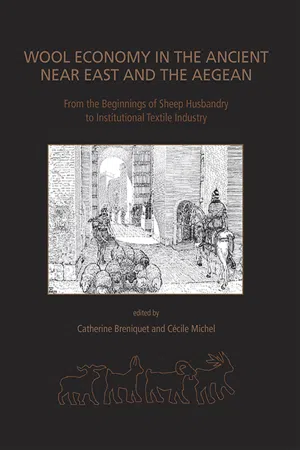
The history of the Ancient Near East covers a huge chronological frame, from the first pictographic texts of the late 4th millennium to the conquest of Alexander the Great in 333 BC. During these millennia, different societies developed in a changing landscape where sheep (and their wool) always played an important economic role. The 22 papers presented here explore the place of wool in the ancient economy of the region, where large-scale textile production began during the second half of the 3rd millennium. By placing emphasis on the development of multi-disciplinary methodologies, experimentation and use of archaeological evidence combined with ancient textual sources, the wide-ranging contributions explore a number of key themes. These include: the first uses of wool in textile manufacture and organization of weaving; trade and exchange; the role of wool in institutionalized economies; and the reconstruction of the processes that led to this first form of industry in Antiquity. The numerous archaeological and written sources provide an enormous amount of data on wool, textile crafts, and clothing and these inter-disciplinary studies are beginning to present a comprehensive picture of the economic and cultural impact of woollen textiles and textile manufacturing on formative ancient societies.
Information
Subtopic
Ancient HistoryIndex
HistoryTable of contents
- Cover
- Title Page
- Copyright Page
- Contents
- Foreword
- Acknowledgements
- Wool Economy in the Ancient Near East and the Aegean
- Chapter 1: Bronze and Iron Age Wools in Europe
- Chapter 2: The Expansion of Sheep Herding and the Development of Wool Production in the Ancient Near East: An Archaeozoological and Iconographical Approach
- Chapter 3: Sheep, Wool and Textile Production. An Interdisciplinary Approach to the Complexity of Wool Working
- Chapter 4: The Archaeology of Wool in Early Mesopotamia: Sources, Methods, Perspectives
- Chapter 5: Lambs of the Gods. The Beginnings of the Wool Economy in Proto-Cuneiform Texts
- Chapter 6: The Value of Wool in Early Bronze Age Mesopotamia. On the Control of Sheep and the Handling of Wool in the Presargonic to the Ur III Periods (c. 2400–2000 BC)
- Chapter 7: Wool in the Economy of Sargonic Mesopotamia
- Chapter 8: From Weighing Wool to Weaving Tools. Textile Manufacture at Ebla during the Early Syrian Period in the Light of Archaeological Evidence
- Chapter 9: Some Aspects of the Wool Economy at Ebla (Syria, 24th Century BC)
- Chapter 10: Making Textiles at Arslantepe, Turkey, in the 4th and 3rd Millennia BC. Archaeological Data and Experimental Archaeology
- Chapter 11: Wool Economy in the Royal Archive of Mari during the Šakkanakku Period
- Chapter 12: All Wool and a Yard Wide. Wool Production and Trade in Old Babylonian Sippar
- Chapter 13: Wool Trade in Upper Mesopotamia and Syria According to Old Babylonian and Old Assyrian Texts
- Chapter 14: Wool in Anatolia in the Old Assyrian Period
- Chapter 15: Wool Economy in Minoan Crete before Linear B. A Minimalist Position
- Chapter 16: Wool in the Nuzi Texts
- Chapter 17: Wool Production and Economy at Ugarit
- Chapter 18: Sheep Rearing, Wool Production and Management in Mycenaean Written Documents
- Chapter 19: Mycenaean Wool Economies in the Latter Part of the 2nd Millennium BC Aegean
- Chapter 20: Wool, Hair and Textiles in Assyria
- Chapter 21: “If you have sheep, you have all you need”. Sheep Husbandry and Wool in the Economy of the Neo-Babylonian Ebabbar Temple at Sippar
- Chapter 22: Fabrics and Clothes from Mesopotamia during the Achaemenid and Seleucid Periods: The Textual References
Trusted by 375,005 students
Access to over 1.5 million titles for a fair monthly price.
Study more efficiently using our study tools.
Frequently asked questions
Yes, you can cancel anytime from the Subscription tab in your account settings on the Perlego website. Your subscription will stay active until the end of your current billing period. Learn how to cancel your subscription
No, books cannot be downloaded as external files, such as PDFs, for use outside of Perlego. However, you can download books within the Perlego app for offline reading on mobile or tablet. Learn how to download books offline
Perlego offers two plans: Essential and Complete
- Essential is ideal for learners and professionals who enjoy exploring a wide range of subjects. Access the Essential Library with 800,000+ trusted titles and best-sellers across business, personal growth, and the humanities. Includes unlimited reading time and Standard Read Aloud voice.
- Complete: Perfect for advanced learners and researchers needing full, unrestricted access. Unlock 1.5M+ books across hundreds of subjects, including academic and specialized titles. The Complete Plan also includes advanced features like Premium Read Aloud and Research Assistant.
We are an online textbook subscription service, where you can get access to an entire online library for less than the price of a single book per month. With over 1.5 million books across 990+ topics, we’ve got you covered! Learn about our mission
Look out for the read-aloud symbol on your next book to see if you can listen to it. The read-aloud tool reads text aloud for you, highlighting the text as it is being read. You can pause it, speed it up and slow it down. Learn more about Read Aloud
Yes! You can use the Perlego app on both iOS and Android devices to read anytime, anywhere — even offline. Perfect for commutes or when you’re on the go.
Please note we cannot support devices running on iOS 13 and Android 7 or earlier. Learn more about using the app
Please note we cannot support devices running on iOS 13 and Android 7 or earlier. Learn more about using the app
Yes, you can access Wool Economy in the Ancient Near East by Catherine Breniquet, Cécile Michel, Catherine Breniquet,Cécile Michel in PDF and/or ePUB format, as well as other popular books in History & Ancient History. We have over 1.5 million books available in our catalogue for you to explore.