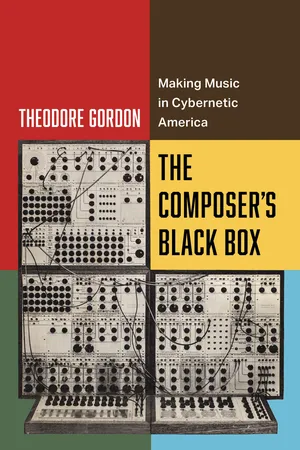
Stories about new musical instruments are often told as quests for new kinds of sounds. The Composer's Black Box asks, What happens when new musical instruments produce not only new sounds but also new dynamics of musical agency and control? And what consequences do those new dynamics have for musicality beyond sound? With a focus on five key figures—Morton Subotnick, Pauline Oliveros, Donald Buchla, Alvin Lucier, and Sun Ra—this book explores how scientific and technological developments in mid-twentieth-century America galvanized musicians to reconfigure their conceptions of sociality, freedom, and the creative self. Theodore Gordon shows how cybernetic thinking in a range of disciplines, from experimental music to jazz and electrical engineering, has shaped musical techniques and technologies and changed what it means to be a composer—or, more broadly, a music-making human—in an increasingly informational world.
- 274 pages
- English
- ePUB (mobile friendly)
- Available on iOS & Android
eBook - ePub
About this book
Information
Subtopic
MusicTable of contents
- Imprint
- Subvention
- Series Page
- Title Page
- Copyright
- Contents
- Acknowledgments
- Introduction: What Can a Black Box Do?
- 1. Morton Subotnick and the Composer’s Black Box
- 2. Opening Buchla’s Box: Manifesting the Musical Mind
- 3. The Patchwork Girl: Pauline Oliveros and the Cybernetic Body
- 4. Alvin Lucier and the Ambiguity of Sound and Signal
- 5. Sun Ra and the Minimoog: Freedom, Discipline, and Opacity
- Afterword: What Can a Composer Do?
- Notes
- Sources Cited
- Index
Trusted by 375,005 students
Access to over 1.5 million titles for a fair monthly price.
Study more efficiently using our study tools.
Frequently asked questions
Yes, you can cancel anytime from the Subscription tab in your account settings on the Perlego website. Your subscription will stay active until the end of your current billing period. Learn how to cancel your subscription
No, books cannot be downloaded as external files, such as PDFs, for use outside of Perlego. However, you can download books within the Perlego app for offline reading on mobile or tablet. Learn how to download books offline
We are an online textbook subscription service, where you can get access to an entire online library for less than the price of a single book per month. With over 1.5 million books across 990+ topics, we’ve got you covered! Learn about our mission
Look out for the read-aloud symbol on your next book to see if you can listen to it. The read-aloud tool reads text aloud for you, highlighting the text as it is being read. You can pause it, speed it up and slow it down. Learn more about Read Aloud
Yes! You can use the Perlego app on both iOS and Android devices to read anytime, anywhere — even offline. Perfect for commutes or when you’re on the go.
Please note we cannot support devices running on iOS 13 and Android 7 or earlier. Learn more about using the app
Please note we cannot support devices running on iOS 13 and Android 7 or earlier. Learn more about using the app
Yes, you can access The Composer's Black Box by Theodore Gordon in PDF and/or ePUB format, as well as other popular books in Media & Performing Arts & Music. We have over 1.5 million books available in our catalogue for you to explore.