eBook - PDF
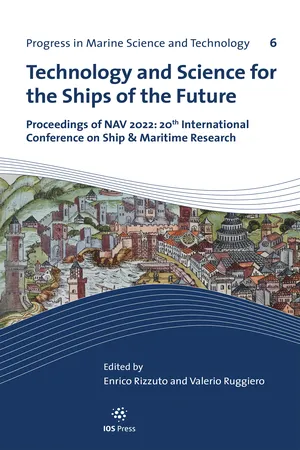
Technology and Science for the Ships of the Future
Proceedings of NAV 2022: 20th International Conference on Ship & Maritime Research
- 788 pages
- English
- PDF
- Available on iOS & Android
eBook - PDF
Technology and Science for the Ships of the Future
Proceedings of NAV 2022: 20th International Conference on Ship & Maritime Research
About this book
The oceans are a key resource for transportation, energy and material extraction, and food production, representing one of the most important environments on the planet. Technological developments enabling us to exploit marine resources in a sustainable way are therefore of the greatest importance.
This book presents the proceedings of the NAV 2022 conference, held in Genoa and La Spezia, Italy, from 15 to 17 June 2022. The conference is held every 3 years, attracting specialists in marine technology from all over the world. NAV 2022 was the 20th edition of the conference, and covered a full spectrum of maritime technology themes, all related to the exploitation of sea resources. The book contains 87 scientific papers, covering subjects ranging from comfort on board; to conceptual and practical ship design; deep sea mining and marine robotics; protection of the environment; renewable marine energy; design and engineering of offshore vessels; digitalization and cyber security; unmanned vehicles; yacht and pleasure craft design, and inland-waterway vessels.
Providing a comprehensive coverage of the latest scientific and technical maritime issues, the book will be of interest to all those involved in this vital global industry.
Trusted by 375,005 students
Access to over 1.5 million titles for a fair monthly price.
Study more efficiently using our study tools.
Information
Table of contents
- Title Page
- Preface
- About the Conference
- Contents
- A Combined CFD-FEM Approach to Evaluate Acoustic Performances of an Integrated Scrubber-Silencer for Marine Applications
- Wind-Assisted Ship Propulsion Feasibility Study
- A Numerical Method to Fit the Need of a Straightforward Characterization of Viscoelastic Materials for Marine Applications
- Industry 4.0 in Shipbuilding. Application in Autonomous Ships
- ARGOS: A Solution to Increase Security and Safety of Ships
- Dynamic Instability of Ships in Stern-Quartering Seas Within the SGISC
- Intact Stability Assessment of RO-RO Pax Vessel in the Framework of Second Generation Intact Stability Criteria with a Specific Focus on the Operational Profile
- A Systematic Ferry Series
- Fully-Recyclable Epoxy Fibres Reinforced Composites (FRCs) for Maritime Field: Chemical Recycling and Re-Use Routes
- Study of the Corrosion Behaviour of Welded Systems for Marine Industry Applications
- Naval Fleet Integrated Logistic Design Optimization: The Italian Navy Experience in Enhancing Feedback from the Field
- Deep Neural Network (DNN) Method to Predict the Displacement Behavior of Neutral Axis for Ships in Vertical Bending
- Innovative and Sustainable Materials for Naval Applications Through National Cooperative Research: The Experience of the THALASSA Project
- Numerical Modelling of the Hydrodynamic Response of a Fixed Dual-Chamber Oscillating Water Column Wave Energy Converter Through the Meshless DualSPHysics Method
- A Roadmap Towards the Autonomous Ship: The Marin R&D Project
- SKIN: The Use of External Surface in Yacht Design
- Ammonia as an Alternative Fuel for Large Passenger Ships: Benefits and Challenges
- Hydrodynamic Assessment of Double-Ended Ferry for Operation in Venice
- BESS-Based Hybrid Propulsion: An Application to a Front Line Naval Vessel Preliminary Design
- A Zero-Emission Ferry for Inland Waterways
- Experimental Investigation on a Lightweight Ship Balcony Overhang with Bimetallic Welded Joints
- CFD Prediction of the Asymmetrical Shaft Unbalance During Ship Maneuvers
- On the Structural Response of Bio-Based Adhesives for Wooden Hulls
- A Digital Twin Approach to the Diagnostic Analysis of a Marine Diesel Engine
- Sensitivity Analysis of a Marine Gasoline Engine: From Power to Emissions
- Cyber Resilience of Automated and Autonomous Ships
- Regulatory Measures to Tackle Climate Changes
- A Swappable Battery to Reduce Emissions of Ships
- Environmental Protection: Underwater Noise and Noise in Port
- Noise and Vibration: Comparison Between Prediction and Measurements on Yachts
- Experimental Analysis of Cavitation Erosion on Blade Root of Controllable Pitch Propeller
- Classifying the Innovation: The Certification of New Designs for Power Generation, Conversion and Energy Storage Focusing on the Reduction of Ships Emissions
- Free Surface Hydrodynamics of Submarine Masts Configurations
- Numerical Approaches for Submarine Hydrodynamic Design and Performance Analysis
- Remote Passive Acoustic Barrier with Maritime Unmanned Systems: Preliminary Tests During REPMUS-21
- Surfing Green, Saving Money
- On the Development of a Ship Simulation Model for Maneuvering Tasks in Waves
- Hybrid System Virtualisation for Predicting Performance and Eliminating Risks and Uncertainties
- Weather Routing Model for Ship Motions Reduction and Fuel Saving
- The Evolution of Large Pleasure Vessel Towards a Green Future
- Systems Engineering and Ship Design: A Synergy for Getting the Right Design and the Design Right
- An Innovative Cruise-Ship Onshore Power Supply Facility in the Port of Marseille
- A Multipurpose Simulation Framework for Ship Design and Operational Assessment
- Assessment of Shipboard Sound Insulation in the Low Frequency Range Through a Laboratory Experimental Methodology Based on a Modal Approach
- Airborne Sound Propagation Induced by a Cruise Ship Through Simulation and Correlation with Real Measurements
- Application of Transfer Path Analysis Technique to Cruise Ships
- Shock Characterization of Fiberglass Composite Laminates: Numerical and Experimental Comparison
- Technical Feasibility Study of an Ammonia-Fuelled Mega-Yacht Powered by PEM Fuel Cells
- Visual Languages Effectiveness in the Context of Communications for Safety and On-Board Orientation
- Experiments for the Definition of Communication Models: The Visual Identity of Navigation Companies in Relation to On-Board Services
- Road to Maritime Sector Decarbonization
- Environmentally Friendly Composites and Surface Treatments for Metal-to-Composite Hybrid Joints for Marine Application
- "One digit" Estimation of Navigation Area Parameters for a Monohull Fast Ferry
- A Smart Mockup for an Innovative Interior Yacht Design Approach
- Proposal of a Coastal Ferry Using Last Hybrid Technology for Green Transportation in Touristic Areas
- Alternative Assessment of Passenger Ship Safety - Early Results from the EU Project FLARE
- Fluid Structure Interaction in Marine Applications Using Open-Source Tools
- The Study of an Innovative Propulsion Plant for a High-Speed Catamaran Ferry for Decarbonisation in the Marine Industry
- Near Future Submarine: Development of a Combined Air Independent and Lithium Battery Propulsion System (AI-LiB Propulsion System)
- SHIP URN: UNIGE Activities in the Context of LIFE-PIAQUO Project
- Surface Unmanned Multipurpose Research Marine Vehicle: SUNMARE Project
- A Numerical Investigation of the Effect of Spatial and Temporal Resolution Together with Turbulence Modelling on the Hydrodynamic Forces of a Cavitating Foil
- A DIS-Based Air Cavity Concept for Planing Hull
- A Methodology for the Hull Forms Design of a Passenger Catamaran for the Venice Lagoon
- Fast Estimation of the Time-to-Flood on Simple Geometries
- Life Cycle Assessment in the Naval Sector: Between Certification and New Materials
- Numerical and Physical Modeling of Ship Impacts on Fenders
- Safety System for Ships in Harbours
- Decarbonization and Efficiency: The Potential of Digital Fleet Management
- The Inside Story of COVID-19 Pandemic on the Diamond Princess as the prime mover of Present and Future Ship Design
- How COVID-19 Has Been Affecting the Overall Cruise Ship Design Paradigm
- Innovative Solutions for the Integration of Medical Facilities on dual-use Naval Ships
- Strategies for Ship Decarbonisation: Technical Measure for Reducing Energy Efficiency Existing Ship Index
- Rapid Prototyping for Enhanced Dynamic Positioning Systems
- New Generation Mine CounterMeasures Vessels (NG-MCMV)
- SDO-SuRS Deployable Assets Program
- Drag Based Shape Optimization of Submarines and AUVs Using CFD Analysis
- On the Application of a Vortex Lattice Method to Lifting Bodies Close to a Free Surface
- Investigations on Ultimate Strength for a Container Vessel Under Combined Loads
- The REShiP Project: Renewable Energy for Ship Propulsion
- Energy-Saving Devices: A Retrofit Stern Flap Solution on the "De La Penne" Destroyer Class (Numerical Analysis and Experimental Tests)
- Italian Navy Green Fleet - Energy Saving Measures: A Solution to Increase Overall Efficiency of a Military Ship of "Bergamini" FREMM Class
- Definition and Development of "Modularity and Operational Flexibility" with Pros and Cons of the Concepts in the Italian Navy PPA Experience
- Optimal Conceptual Design Using NSGA-II Algorithm for Galapagos Interisland Service Small Craft Including Flaps
- Fracture Mechanics Properties of Al/Steel Structural Transition Joints for Shipbuilding
- Data Driven Digital Twins for the Maritime Domain
- Numerical Estimation of Pre-Swirl Stator Efficiency
- Subject Index
- Author Index
Frequently asked questions
Yes, you can cancel anytime from the Subscription tab in your account settings on the Perlego website. Your subscription will stay active until the end of your current billing period. Learn how to cancel your subscription
No, books cannot be downloaded as external files, such as PDFs, for use outside of Perlego. However, you can download books within the Perlego app for offline reading on mobile or tablet. Learn how to download books offline
Perlego offers two plans: Essential and Complete
- Essential is ideal for learners and professionals who enjoy exploring a wide range of subjects. Access the Essential Library with 800,000+ trusted titles and best-sellers across business, personal growth, and the humanities. Includes unlimited reading time and Standard Read Aloud voice.
- Complete: Perfect for advanced learners and researchers needing full, unrestricted access. Unlock 1.5M+ books across hundreds of subjects, including academic and specialized titles. The Complete Plan also includes advanced features like Premium Read Aloud and Research Assistant.
We are an online textbook subscription service, where you can get access to an entire online library for less than the price of a single book per month. With over 1.5 million books across 990+ topics, we’ve got you covered! Learn about our mission
Look out for the read-aloud symbol on your next book to see if you can listen to it. The read-aloud tool reads text aloud for you, highlighting the text as it is being read. You can pause it, speed it up and slow it down. Learn more about Read Aloud
Yes! You can use the Perlego app on both iOS and Android devices to read anytime, anywhere — even offline. Perfect for commutes or when you’re on the go.
Please note we cannot support devices running on iOS 13 and Android 7 or earlier. Learn more about using the app
Please note we cannot support devices running on iOS 13 and Android 7 or earlier. Learn more about using the app
Yes, you can access Technology and Science for the Ships of the Future by E. Rizzuto,V. Ruggiero,Enrico Rizzuto,Valerio Ruggiero in PDF and/or ePUB format, as well as other popular books in Technology & Engineering & Military Science & Technology. We have over 1.5 million books available in our catalogue for you to explore.