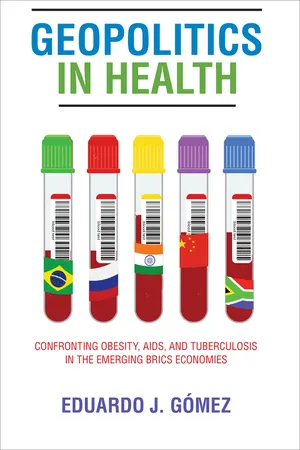
An in-depth analysis of why leaders from the BRICS respond to public health emergencies the way they do.
In recent years, political leaders in Brazil, Russia, India, China, and South Africa, collectively known as the BRICS, have worked to reformulate international discussions and policies on issues ranging from fair and free trade to human rights. When it comes to health epidemics, however, the BRICS have differed greatly in terms of how—and when—they respond, highlighting important differences in their political commitment to meeting healthcare needs.
In Geopolitics in Health, Eduardo J. Gómez takes a critical look at how the emerging BRICS economies dealt with the obesity, AIDS, and tuberculosis epidemics. Despite the countries having similar international political and economic ambitions, Gómez finds that domestic policy responses were driven mainly by international, as opposed to domestic, pressures and interests. Using a theoretical framework called geopolitical positioning, Gómez explores how nations respond to international pressures and policy criticisms, as well as offers of financial and technical assistance; countries then utilize domestic policy innovations and ultimately engage in global health diplomacy in order to bolster their international reputation.
Gómez draws on extensive data and case studies and argues that leaders aspiring to build their reputations among elite nations have a ready way to demonstrate their status through quick and effective public health responses; those who scorn the international community tend to react slowly and ineffectively to the same type of crises. The first book of its kind to conduct an in-depth comparative historical analysis of how the BRICS deal with public health threats, this pathbreaking text demonstrates the value of positive geopolitical positioning and strong partnerships with other governments, nongovernmental organizations, and social health movements.