The social, economic and technological developments of the late modern society have radically changed policing approaches both at national and supranational levels. With the anti-terrorism discourse and the global crises of mobilities, the security needs of citizens is now at the pinnacle of government priorities. At the same time, traditional law enforcement faces an epistemological crisis through the digitalisation and privatization of security. Governments, and especially the police, are expected to either prevent or respond to security threats, and if necessary, to ensure order through rigorous measures. The traditional means of policing, however, is met with increasing difficulties to sustain their legitimacy on all fronts.
Regarding the current subject of public security, several challenges can be identified. The shifting relationship between organizational and management rules between the state and other governing bodies, the use of new technologies, and the fusion of different security units, such as intelligence services, the military, and the police, all contribute to new tensions in policing practices. These changes urge the need of a reflective policing science and the adaptation of existing theoretical approaches. Although several conceptual differentiations are made between policing practices, hardly any theoretical studies discuss the implication of current contextual differences between traditional welfare states and post-transitional societies.
This book provides a critical interdisciplinary approach through contextualized thematic analyses of policing practices after the digital turn. All topics are discussed from different conceptual perspectives, and will assess how digitalization, global threats and privatization have changed traditional policing approaches.
While challenging existing theoretical approaches in Anglo-Saxon policing studies, this editorial volume aims to promote critical law enforcement studies and the need for more empirical research and new conceptual methodologies in a digitized society.
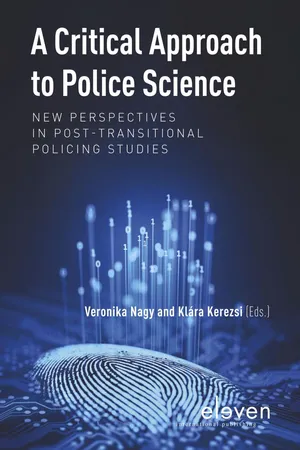
eBook - PDF
A Critical Approach to Police Science
New Perspectives in Post-Transitional Policing Studies
- 406 pages
- English
- PDF
- Available on iOS & Android
eBook - PDF
A Critical Approach to Police Science
New Perspectives in Post-Transitional Policing Studies
About this book
Information
Subtopic
Forensic ScienceIndex
LawTable of contents
- Preface
- Table of Contents
- List of Contributors
- Introduction – Critical Reflections in Policing Studies
- 1 Policing Diversity in Germany and Its Consequences for Professional Development
- 2 Policing Transition in a Violent Democracy: A South African Narrative
- 3 Contemporary Indian Policing
- 4 The Transformation of Policing in Turkey: A Critical Assessment
- 5 The Emergence of Proactive Intelligence-Led Counterterrorism Policing and Surveillance in Post-Suharto Indonesia
- 6 Predictive Policing in The Netherlands: A Critical Data Studies Approach
- 7 Digital Media and Policing: ID Theft and ID Misuse in Cyberspace
- 8 The Surveillance Myth: (In)securitization of Internal Migration in Post-hukou China
- 9 Policing in Times of Globalization. Counterterrorism Legislation as a Platform for the Militarization of Policing in Argentina
- 10 Critical Perspectives on the (Post) 'Refugee Crisis' – Policing of Migration in Slovenia
- 11 From Exception to the Rule: Prevention and the New French Antiterrorist Law
- 12 Digital Media and Public Accountability in the Policing of Brazil's Favelas
- 13 Policing the Eastern Bloc Other in Northwestern European Port Zones
- 14 The Colourful World of Dutch Policing – Why Striving for a Diverse Police Force is Important
Trusted by 375,005 students
Access to over 1.5 million titles for a fair monthly price.
Study more efficiently using our study tools.
Frequently asked questions
Yes, you can cancel anytime from the Subscription tab in your account settings on the Perlego website. Your subscription will stay active until the end of your current billing period. Learn how to cancel your subscription
No, books cannot be downloaded as external files, such as PDFs, for use outside of Perlego. However, you can download books within the Perlego app for offline reading on mobile or tablet. Learn how to download books offline
Perlego offers two plans: Essential and Complete
- Essential is ideal for learners and professionals who enjoy exploring a wide range of subjects. Access the Essential Library with 800,000+ trusted titles and best-sellers across business, personal growth, and the humanities. Includes unlimited reading time and Standard Read Aloud voice.
- Complete: Perfect for advanced learners and researchers needing full, unrestricted access. Unlock 1.5M+ books across hundreds of subjects, including academic and specialized titles. The Complete Plan also includes advanced features like Premium Read Aloud and Research Assistant.
We are an online textbook subscription service, where you can get access to an entire online library for less than the price of a single book per month. With over 1.5 million books across 990+ topics, we’ve got you covered! Learn about our mission
Look out for the read-aloud symbol on your next book to see if you can listen to it. The read-aloud tool reads text aloud for you, highlighting the text as it is being read. You can pause it, speed it up and slow it down. Learn more about Read Aloud
Yes! You can use the Perlego app on both iOS and Android devices to read anytime, anywhere — even offline. Perfect for commutes or when you’re on the go.
Please note we cannot support devices running on iOS 13 and Android 7 or earlier. Learn more about using the app
Please note we cannot support devices running on iOS 13 and Android 7 or earlier. Learn more about using the app
Yes, you can access A Critical Approach to Police Science by Veronika Nagy,Klára Kerezsi in PDF and/or ePUB format, as well as other popular books in Law & Forensic Science. We have over 1.5 million books available in our catalogue for you to explore.