eBook - ePub
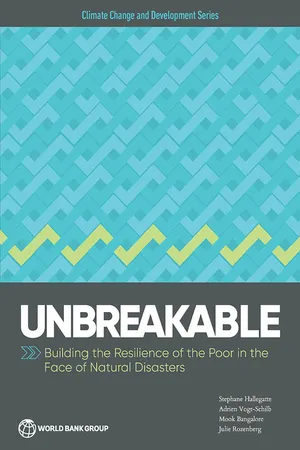
Unbreakable
Building the Resilience of the Poor in the Face of Natural Disasters
- 187 pages
- English
- ePUB (mobile friendly)
- Available on iOS & Android
eBook - ePub
Unbreakable
Building the Resilience of the Poor in the Face of Natural Disasters
About this book
'Economic losses from natural disasters totaled $92 billion in 2015.' Such statements, all too commonplace, assess the severity of disasters by no other measure than the damage inflicted on buildings, infrastructure, and agricultural production. But $1 in losses does not mean the same thing to a rich person that it does to a poor person; the gravity of a $92 billion loss depends on who experiences it. By focusing on aggregate losses—the traditional approach to disaster risk—we restrict our consideration to how disasters affect those wealthy enough to have assets to lose in the first place, and largely ignore the plight of poor people. This report moves beyond asset and production losses and shifts its attention to how natural disasters affect people's well-being. Disasters are far greater threats to well-being than traditional estimates suggest. This approach provides a more nuanced view of natural disasters than usual reporting, and a perspective that takes fuller account of poor people's vulnerabilities. As climate change magnifies natural hazards, and because protection infrastructure alone cannot eliminate risk, a more resilient population has never been more critical to breaking the cycle of disaster-induced poverty.
Information
Subtopic
Development EconomicsTable of contents
- Cover
- Title Page
- Copyright Page
- Contents
- Acknowledgments
- Overview
- 1. Introduction: Natural hazards and poverty
- 2. On the front line: Poor people suffer disproportionately from natural hazards
- 3. Vicious circles: Natural disasters keep people in poverty
- 4. A diagnosis: The global impacts of natural disasters on well-being are underestimated
- 5. Avoiding disasters: Well-being losses can be mitigated by reducing asset losses
- 6. Managing what cannot be avoided: Risk can be reduced by improving resilience
- 7. Tailor-made: Policy priorities can be identified at the country level
- Appendix: Study results for 117 countries
- Backcover
Trusted by 375,005 students
Access to over 1.5 million titles for a fair monthly price.
Study more efficiently using our study tools.
Frequently asked questions
Yes, you can cancel anytime from the Subscription tab in your account settings on the Perlego website. Your subscription will stay active until the end of your current billing period. Learn how to cancel your subscription
No, books cannot be downloaded as external files, such as PDFs, for use outside of Perlego. However, you can download books within the Perlego app for offline reading on mobile or tablet. Learn how to download books offline
Perlego offers two plans: Essential and Complete
- Essential is ideal for learners and professionals who enjoy exploring a wide range of subjects. Access the Essential Library with 800,000+ trusted titles and best-sellers across business, personal growth, and the humanities. Includes unlimited reading time and Standard Read Aloud voice.
- Complete: Perfect for advanced learners and researchers needing full, unrestricted access. Unlock 1.5M+ books across hundreds of subjects, including academic and specialized titles. The Complete Plan also includes advanced features like Premium Read Aloud and Research Assistant.
We are an online textbook subscription service, where you can get access to an entire online library for less than the price of a single book per month. With over 1.5 million books across 990+ topics, we’ve got you covered! Learn about our mission
Look out for the read-aloud symbol on your next book to see if you can listen to it. The read-aloud tool reads text aloud for you, highlighting the text as it is being read. You can pause it, speed it up and slow it down. Learn more about Read Aloud
Yes! You can use the Perlego app on both iOS and Android devices to read anytime, anywhere — even offline. Perfect for commutes or when you’re on the go.
Please note we cannot support devices running on iOS 13 and Android 7 or earlier. Learn more about using the app
Please note we cannot support devices running on iOS 13 and Android 7 or earlier. Learn more about using the app
Yes, you can access Unbreakable by Stephane Hallegatte,Adrien Vogt-Schilb,Mook Bangalore,Julie Rozenberg in PDF and/or ePUB format. We have over 1.5 million books available in our catalogue for you to explore.