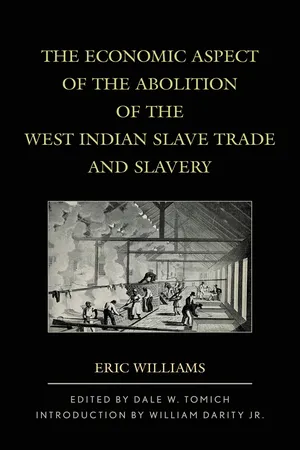
eBook - ePub
The Economic Aspect of the Abolition of the West Indian Slave Trade and Slavery
- English
- ePUB (mobile friendly)
- Available on iOS & Android
eBook - ePub
The Economic Aspect of the Abolition of the West Indian Slave Trade and Slavery
About this book
In his influential and widely debated Capitalism and Slavery, Eric Williams examined the relation of capitalism and slavery in the British West Indies. Binding an economic view of history with strong moral argument, his study of the role of slavery in financing the Industrial Revolution refuted traditional ideas of economic and moral progress and firmly established the centrality of the African slave trade in European economic development. He also showed that mature industrial capitalism in turn helped destroy the slave system. Establishing the exploitation of commercial capitalism and its link to racial attitudes, Williams employed a historicist vision that has set the tone for an entire field. Williams's profound critique became the foundation for studies of imperialism and economic development and has been widely debated since the book's initial publication in 1944. The Economic Aspect of the Abolition of the West Indian Slave Trade and Slavery now makes available in book form for the first time his dissertation, on which Capitalism and Slavery was based. The significant differences between his two works allow us to rethink questions that were considered resolved and to develop fresh problems and hypotheses. It offers the possibility of a much deeper reconsideration of issues that have lost none of their urgency—indeed, whose importance has increased.
Information
Table of contents
- Contents
- Preface
- Introduction
- THE ECONOMIC ASPECT of the ABOLITION of the WEST INDIAN SLAVE TRADE AND SLAVERY by Eric Williams, B.A.
- Introduction
- Part I: The Abolition of the Slave Trade
- Chapter 1: The Impolicy of the Slave System
- Chapter 2: The Superiority of the French West Indies
- Chapter 3: East India Sugar
- Chapter 4: The Attempt to Secure an International Abolition
- Chapter 5: The West Indian Expeditions
- Chapter 6: The Significance of the West Indian Expeditions
- Chapter 7: The Abolition of the Slave Trade
- Part II: The Abolition of Slavery
- Chapter 8: The Abolitionists and Emancipation
- Chapter 9: The Foreign Slave Trade
- Chapter 10: East India Sugar
- Chapter 11: The Distressed Areas
- Chapter 12: The Industrialists and Emancipation
- Epilogue
- Appendix One: The “Influential Men”
- Appendix Two: Ramsay as an Authority
- Appendix Three: Select Documents Illustrating the Inter-Colonial Slave Trade
- Bibliography
- About the Authors
Trusted by 375,005 students
Access to over 1.5 million titles for a fair monthly price.
Study more efficiently using our study tools.
Frequently asked questions
Yes, you can cancel anytime from the Subscription tab in your account settings on the Perlego website. Your subscription will stay active until the end of your current billing period. Learn how to cancel your subscription
No, books cannot be downloaded as external files, such as PDFs, for use outside of Perlego. However, you can download books within the Perlego app for offline reading on mobile or tablet. Learn how to download books offline
Perlego offers two plans: Essential and Complete
- Essential is ideal for learners and professionals who enjoy exploring a wide range of subjects. Access the Essential Library with 800,000+ trusted titles and best-sellers across business, personal growth, and the humanities. Includes unlimited reading time and Standard Read Aloud voice.
- Complete: Perfect for advanced learners and researchers needing full, unrestricted access. Unlock 1.5M+ books across hundreds of subjects, including academic and specialized titles. The Complete Plan also includes advanced features like Premium Read Aloud and Research Assistant.
We are an online textbook subscription service, where you can get access to an entire online library for less than the price of a single book per month. With over 1.5 million books across 990+ topics, we’ve got you covered! Learn about our mission
Look out for the read-aloud symbol on your next book to see if you can listen to it. The read-aloud tool reads text aloud for you, highlighting the text as it is being read. You can pause it, speed it up and slow it down. Learn more about Read Aloud
Yes! You can use the Perlego app on both iOS and Android devices to read anytime, anywhere — even offline. Perfect for commutes or when you’re on the go.
Please note we cannot support devices running on iOS 13 and Android 7 or earlier. Learn more about using the app
Please note we cannot support devices running on iOS 13 and Android 7 or earlier. Learn more about using the app
Yes, you can access The Economic Aspect of the Abolition of the West Indian Slave Trade and Slavery by Eric Williams, Dale W. Tomich in PDF and/or ePUB format, as well as other popular books in History & Latin American & Caribbean History. We have over 1.5 million books available in our catalogue for you to explore.