In Part One, the uses of divine revelation in the Western world are reviewed by recalling authors that include Euripides, Sophocles, Aristophanes, Plato, Maimonides, Cervantes, Hobbes, and Milton. The challenges posed by such monstrosities as Aztec human sacrifices and the Second World War Holocaust are recalled.
In Part Two, the challenges of religion for and by Americans are examined. Documents such as the Declaration of Independence, the Constitution of 1787, and Presidential Farewell Addresses are recalled. The lives and thought of eminent Americans are also recalled (including George Washington, Benjamin Franklin, Thomas Jefferson, and Abraham Lincoln). Recalled as well are such movements as that of the Mormons and that of the "I Am" sect. The implications both for religious developments and for religious orthodox of modern science are investigated.
The Appendices reinforce these inquiries by providing reminders of how distinguished commentators and others have tried to deal with critical questions noticed in the Essays of this book.
- English
- ePUB (mobile friendly)
- Available on iOS & Android
eBook - ePub
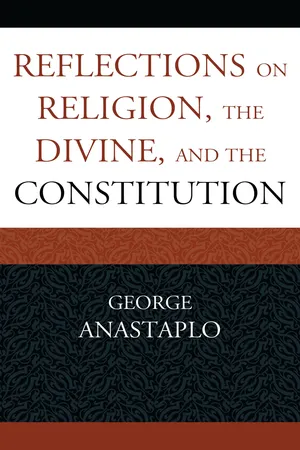
Reflections on Religion, the Divine, and the Constitution
About this book
Information
Table of contents
- Contents
- Preface
- 1. Euripides on the Use and Abuse of Revelation in the Service of the Political Order
- 2. The Divine, an Unsettling Duality, and the Conduct of One’s Life: Sophocles’ Oedipus Tyrannos Revisited
- 3. On Aristophanes’ Clouds
- 4. Socrates’ Dangerous Piety
- 5. Plato on the Divine in Human Affairs
- 6. Maimonides and Others on Faith, Philosophy, and Governing Principles
- 7. Conscience and Citizenship
- 8. El Greco and His Successors
- 9. Miguel de Cervantes on Death, the Divine, and the Proper Ordering of Human Affairs
- 10. Thomas Hobbes on “Church” and State
- 11. John Milton’s Paradise Epics and the Divinely Ordained Redemption of the Human Race
- 12. Challenges Posed by the Aztecs
- 13. The Holocaust and the Divine Ordering of Human Affairs
- 1. Nature and the Divine in the Declaration of Independence
- 2. Benedict Arnold, Providence, and the Fates of Citizens and of Nations
- 3. Benjamin Franklin and the Workings of the Divine—At Least in America
- 4. “In the Year of [What] Lord?”
- 5. Political Symbols and the Sacred in the United States
- 6. Thomas Jefferson and Religious Liberty
- 7. Abraham Lincoln and the Almighty
- 8. Presidential Invocations of the Divine
- 9. Presidential Farewell Addresses
- 10. Revelation, Human Understanding, and the Ordering of the Good Life: The “Mormon” Movement
- 11. Revelation and the Use of the U.S. Postal System: The “I Am” Movement
- 12. An Earth Elsewhere?
- 13. Yearnings for the Divine and the Natural Animation of Matter
- Appendix A: The Declaration of Independence (1776)
- Appendix B: The United States Constitution (1787)
- Appendix C: The Amendments to the United States Constitution (1791–1992)
- Appendix D: On the “Destiny” of the Jews in Eastern Europe (1939–1945)
- Appendix D(1): God, Please Choose Somebody Else
- Appendix D(2): In Eastern Europe, Anti-Semitism Is a Kind of Religion
- Appendix E: George Anastaplo on the Christian Heritage
- Appendix F: On the Human Soul and Eternity
- Appendix G: George Anastaplo’s Appeal to Nature
- Appendix H: Reflections upon Any Trial for Impiety Not Only of Socrates But Also of Us
- Appendix I: Life and Death in Abraham Lincoln’s Gettysburg Address
- Appendix J: Foreword for George Anastaplo’s Further Thoughts on Abraham Lincoln: A Discourse on Chance and Public Life (February 2013)
- Appendix K: On the Use by Physicists of Life-Like Words
- Appendix L: Glimpses of Delphi
- Appendix M: Roster of Cases Drawn On
- About the Author
Trusted by 375,005 students
Access to over 1.5 million titles for a fair monthly price.
Study more efficiently using our study tools.
Frequently asked questions
Yes, you can cancel anytime from the Subscription tab in your account settings on the Perlego website. Your subscription will stay active until the end of your current billing period. Learn how to cancel your subscription
No, books cannot be downloaded as external files, such as PDFs, for use outside of Perlego. However, you can download books within the Perlego app for offline reading on mobile or tablet. Learn how to download books offline
Perlego offers two plans: Essential and Complete
- Essential is ideal for learners and professionals who enjoy exploring a wide range of subjects. Access the Essential Library with 800,000+ trusted titles and best-sellers across business, personal growth, and the humanities. Includes unlimited reading time and Standard Read Aloud voice.
- Complete: Perfect for advanced learners and researchers needing full, unrestricted access. Unlock 1.5M+ books across hundreds of subjects, including academic and specialized titles. The Complete Plan also includes advanced features like Premium Read Aloud and Research Assistant.
We are an online textbook subscription service, where you can get access to an entire online library for less than the price of a single book per month. With over 1.5 million books across 990+ topics, we’ve got you covered! Learn about our mission
Look out for the read-aloud symbol on your next book to see if you can listen to it. The read-aloud tool reads text aloud for you, highlighting the text as it is being read. You can pause it, speed it up and slow it down. Learn more about Read Aloud
Yes! You can use the Perlego app on both iOS and Android devices to read anytime, anywhere — even offline. Perfect for commutes or when you’re on the go.
Please note we cannot support devices running on iOS 13 and Android 7 or earlier. Learn more about using the app
Please note we cannot support devices running on iOS 13 and Android 7 or earlier. Learn more about using the app
Yes, you can access Reflections on Religion, the Divine, and the Constitution by George Anastaplo in PDF and/or ePUB format, as well as other popular books in Politics & International Relations & American Government. We have over 1.5 million books available in our catalogue for you to explore.