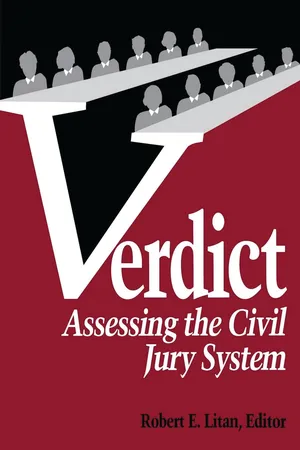
The right to a jury trial is a fundamental feature of the American justice system. In recent years, however, aspects of the civil jury system have increasingly come under attack. Many question the ability of lay jurors to decide complex scientific and technical questions that often arise in civil suits. Others debate the high and rising costs of litigation, the staggering delay in resolving disputes, and the quality of justice. Federal and state courts, crowded with growing numbers of criminal cases, complain about handling difficult civil matters. As a result, the jury trial is effectively being challenged as a means for resolving disputes in America. Juries have been reduced in size, their selection procedures altered, and the unanimity requirement suspended. For many this development is viewed as necessary. For others, it arouses deep concern.
In this book, a distinguished group of scholars, attorneys, and judges examine the civil jury system and discuss whether certain features should be modified or reformed. The book features papers presented at a conference cosponsored by the Brookings Institution and the Litigation Section of the American Bar Association, together with an introductory chapter by Robert E. Litan. While the authors present competing views of the objectives of the civil jury system, all agree that the jury still has and will continue to have an important role in the American system of civil justice.
The book begins with a brief history of the jury system and explains how juries have become increasingly responsible for decisions of great difficulty. Contributors then provide an overview of the system's objectives and discuss whether, and to what extent, actual practice meets those objectives. They summarize how juries function and what attitudes lawyers, judges, litigants, former jurors, and the public at large hold about the current system.
The second half of the book is devoted to a wide range of recommendations that will both improve citizens' access to jury determinations and help resolve disputes in a more effective and efficient manner. Among their many suggestions, the authors call for changes in trial procedures and techniques that would improve the ability of jurors to understand the lay and evidence, a reduction in administrative costs and delays, and a change in they way juries are chosen. The authors also recommend shorter hours and more pay for jurors, greater flexibility in court schedules, and elimination of alternate jurors. In the final chapter the civil jury is considered in the broader context of how society resolves or manages civil disputes.
- English
- ePUB (mobile friendly)
- Available on iOS & Android
eBook - ePub
About this book
Information
Table of contents
- 1. Introduction
- 2. The History and Objectives of the Civil Jury System
- 3. The Regulatory Function of the Civil Jury
- 4. Justifying the Civil Jury
- 5. Inside the Black Box: What Empirical Research Tells Us about Decisionmaking by Civil Juries
- 6. Civil Juries and Complex Cases: Taking Stock after Twelve Years
- 7. Attitudes toward the Civil Jury: A Crisis of Confidence?
- 8. What Jurors Think: Expectations and Reactions of Citizens Who Serve as Jurors
- 9. Mapping the Debate on Jury Reform
- 10. Improving the Quality of Jury Decisionmaking
- 11. Recent Innovations in Civil Jury Trial Procedures
- 12. The Modern American Jury: Reflections on Veneration and Distrust
- 13. Restructuring the Traditional Civil Jury: The Effects of Changes in Composition and Procedures
- 14. Jury Service and Community Representation
- 15. Finding the Factfinders
- Contributors
Trusted by 375,005 students
Access to over 1.5 million titles for a fair monthly price.
Study more efficiently using our study tools.
Frequently asked questions
Yes, you can cancel anytime from the Subscription tab in your account settings on the Perlego website. Your subscription will stay active until the end of your current billing period. Learn how to cancel your subscription
No, books cannot be downloaded as external files, such as PDFs, for use outside of Perlego. However, you can download books within the Perlego app for offline reading on mobile or tablet. Learn how to download books offline
Perlego offers two plans: Essential and Complete
- Essential is ideal for learners and professionals who enjoy exploring a wide range of subjects. Access the Essential Library with 800,000+ trusted titles and best-sellers across business, personal growth, and the humanities. Includes unlimited reading time and Standard Read Aloud voice.
- Complete: Perfect for advanced learners and researchers needing full, unrestricted access. Unlock 1.5M+ books across hundreds of subjects, including academic and specialized titles. The Complete Plan also includes advanced features like Premium Read Aloud and Research Assistant.
We are an online textbook subscription service, where you can get access to an entire online library for less than the price of a single book per month. With over 1.5 million books across 990+ topics, we’ve got you covered! Learn about our mission
Look out for the read-aloud symbol on your next book to see if you can listen to it. The read-aloud tool reads text aloud for you, highlighting the text as it is being read. You can pause it, speed it up and slow it down. Learn more about Read Aloud
Yes! You can use the Perlego app on both iOS and Android devices to read anytime, anywhere — even offline. Perfect for commutes or when you’re on the go.
Please note we cannot support devices running on iOS 13 and Android 7 or earlier. Learn more about using the app
Please note we cannot support devices running on iOS 13 and Android 7 or earlier. Learn more about using the app
Yes, you can access Verdict by Robert E. Litan in PDF and/or ePUB format, as well as other popular books in Law & Law Theory & Practice. We have over 1.5 million books available in our catalogue for you to explore.