This publication provides a wide range of characteristics profiling the demographic, social, and economic status of the Millennial generation. While the Baby Boom generation occupies much of our social and political dialogue, the Millennial generation is actually a larger generation. As the Boomers age, their numbers will decrease while the Millennials will be the driving social and political force in the coming decades. Millennials in America focuses on the those born between 1982–2001.
Millennials in America is an invaluable source for helping people understand what the census data tells us about who we are, what we do, and where we live.
Benefits of this publication include:
It will fill an information gap due to the difficulty in extracting comparative data from the Census Bureau's American FactFinder dissemination system.Users will have comparative data in a single reference volume.It will eliminate the need for the data user to understand and manipulate detailed census data files and consolidate disparate tables in AFF.This publication utilizes the PUMS data which is the ONLY source of data that can be used to define precise age ranges for the Millennial generation. The age detail available for census summary data simply aren't adequate for defining the Millennials and therefore prohibit compilation of characteristics specific to this important generation.
Features of this publication include:
Detailed data on 11 subject areas including race, educational attainment, field of study, income, mobility status, employment status, housing, and moreEach subject area includes data for the United States, the 50 states and the District of Columbia, 622 counties, 331 cities, 381 metropolitan areas and 34 micropolitan areas.Each part is preceded by highlights, maps, and figures illustrating how areas diverge from the national norm as well as differences among areas.
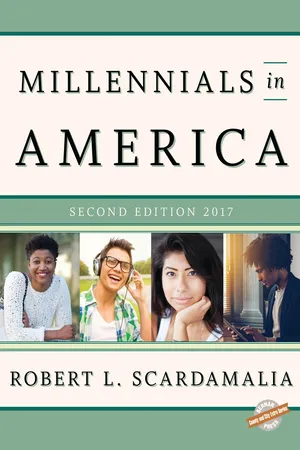
- 443 pages
- English
- PDF
- Available on iOS & Android
eBook - PDF
Millennials in America 2017
About this book
Information
Table of contents
- Cover
- MILLENNIALS in AMERICA
- MILLENNIALS in AMERICA
- Contents
- Preface
- Introduction
- Defining the Millennials
- Understanding the American Community Survey
- Using the ACS
- Accessing ACS Data Online
- More ACS Resources
- Part A
- Population Sumary
- Part A. Population Sumary
- Part B
- RACE AND ETHNICITY
- Part B. RACE AND ETHNICITY
- Part C
- Nativit y and World Region of Birt h
- Part C. Nativit y and World Region of Birt h
- Part D
- Household Relations hip
- Part D. Household Relations hip
- Part E
- Educational Attainment
- Part E. Educational Attainment
- Part F
- Field of Degre
- Part F. Field of Degre
- Part G
- Language Spoken at Home
- Part G. Language Spoken at Home
- Part H
- Employment and Labor Force Status
- Part H. Employment and Labor Force Status
- Part I
- INCOME AND POVERTY
- Part I. INCOME AND POVERTY
- Part J
- Mobility and Migration
- Part J. Mobility and Migration
- Part K
- Housing Sumary
- Part K. Housing Sumary
- APPENDIXES
- APPENDIX A. Metropolitan and Micropolitan Areas and Components (as defined February 2013)
- APPENDIX B. CITIES BY COUNTY
- INDEX
- INDEX
Trusted by 375,005 students
Access to over 1.5 million titles for a fair monthly price.
Study more efficiently using our study tools.
Frequently asked questions
Yes, you can cancel anytime from the Subscription tab in your account settings on the Perlego website. Your subscription will stay active until the end of your current billing period. Learn how to cancel your subscription
No, books cannot be downloaded as external files, such as PDFs, for use outside of Perlego. However, you can download books within the Perlego app for offline reading on mobile or tablet. Learn how to download books offline
Perlego offers two plans: Essential and Complete
- Essential is ideal for learners and professionals who enjoy exploring a wide range of subjects. Access the Essential Library with 800,000+ trusted titles and best-sellers across business, personal growth, and the humanities. Includes unlimited reading time and Standard Read Aloud voice.
- Complete: Perfect for advanced learners and researchers needing full, unrestricted access. Unlock 1.5M+ books across hundreds of subjects, including academic and specialized titles. The Complete Plan also includes advanced features like Premium Read Aloud and Research Assistant.
We are an online textbook subscription service, where you can get access to an entire online library for less than the price of a single book per month. With over 1.5 million books across 990+ topics, we’ve got you covered! Learn about our mission
Look out for the read-aloud symbol on your next book to see if you can listen to it. The read-aloud tool reads text aloud for you, highlighting the text as it is being read. You can pause it, speed it up and slow it down. Learn more about Read Aloud
Yes! You can use the Perlego app on both iOS and Android devices to read anytime, anywhere — even offline. Perfect for commutes or when you’re on the go.
Please note we cannot support devices running on iOS 13 and Android 7 or earlier. Learn more about using the app
Please note we cannot support devices running on iOS 13 and Android 7 or earlier. Learn more about using the app
Yes, you can access Millennials in America 2017 by Robert L. Scardamalia in PDF and/or ePUB format, as well as other popular books in Social Sciences & Demography. We have over 1.5 million books available in our catalogue for you to explore.