- 239 pages
- English
- PDF
- Available on iOS & Android
eBook - PDF
About this book
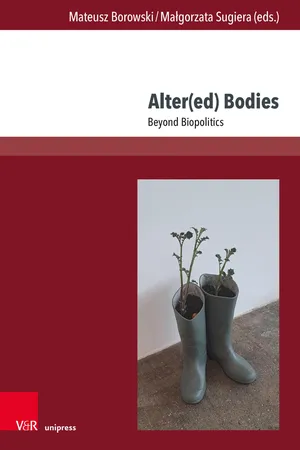
The fundamental assumption behind the volume is that the current civilizational crisis, manifested in such phenomena as climate change, environmental catastrophes, pandemics and wars, puts into question the biopolitical means of optimizing the life of populations and individuals. To narrow down the thematic concerns of the volume, the chapters are centered around the notion of body, fundamental for the majority of theoretical takes on biopolitics. The volume shows that in the current age of catastrophes bodies are not only shaped and individualized through procedures of institutionalized discipline, but by an entanglement of environmental and planetary factors, typically omitted in extant accounts of biopolitics. The chapters go beyond biopolitics, because they show bodies as sites of operation of non-human or more-than-human agencies that work on scales inaccessible to human sensorium.
Information
Topic
PhilosophySubtopic
History & Theory of PhilosophyTable of contents
- Title Page
- Copyright
- Table of Contents
- Mateusz Borowski / Malgorzata Sugiera: Introduction: More-Than-Human Bodies in Times of Polycrises
- Body
- Section I: Futurities of Entanglements
- Mateusz Borowski: Survival through Entanglement: Alter(ed) Bodies, Earthly Forces and Geologic Subjects in N. K. Jemisin’s Broken Earth Trilogy (2015–2017)
- Mateusz Chaberski: Alter(ed) Species: Human–Neanderthal Kinships Across Deep Time
- Sylwia Mieczkowska: Plastic as a New Material Force: On Plastic–Body Entanglements and Their Possible Future Coexistence
- Malgorzata Sugiera: Haunted by Master Narratives: Terraformings and Other Worlds Worth Making
- Section II: Body(ing) Politics
- Arkadiusz Póltorak: “Unsettled Bodies of Knowledge:” Biopolitical Capture of the Participatory Museum in Marysia Lewandowska and Neil Cummings' Museum Futures
- Wojciech Baluch: Subversive Bodies in Theatre
- Lucja Iwanczewska: Postpornographic Bodily Practices in Contemporary Visual and Literary Arts
- Section III: (Dis)Integrating Bodies
- Ewa Bal: Reconnecting (De)Fragmented Bodies: Decolonising Practices of Ethnic Minorities in Central Eastern Europe
- Filip Ryba: A Monster's Promise, a Terrorist's Promise: About a Certain Body from Baghdad and Biopolitical Attempts to Identify It
- Piotr Urbanowicz: Flying Cows, Frozen Alive Mammoths, and Other Indeterminate Bodies: On the Politics Beyond Biopower in Disaster Movies
- Martyna Dziadek: Plant Hybrids: Beyond More-Than-Human Biopolitics
- Notes on Contributors
- Index
Trusted by 375,005 students
Access to over 1.5 million titles for a fair monthly price.
Study more efficiently using our study tools.
Frequently asked questions
Yes, you can cancel anytime from the Subscription tab in your account settings on the Perlego website. Your subscription will stay active until the end of your current billing period. Learn how to cancel your subscription
No, books cannot be downloaded as external files, such as PDFs, for use outside of Perlego. However, you can download books within the Perlego app for offline reading on mobile or tablet. Learn how to download books offline
Perlego offers two plans: Essential and Complete
- Essential is ideal for learners and professionals who enjoy exploring a wide range of subjects. Access the Essential Library with 800,000+ trusted titles and best-sellers across business, personal growth, and the humanities. Includes unlimited reading time and Standard Read Aloud voice.
- Complete: Perfect for advanced learners and researchers needing full, unrestricted access. Unlock 1.5M+ books across hundreds of subjects, including academic and specialized titles. The Complete Plan also includes advanced features like Premium Read Aloud and Research Assistant.
We are an online textbook subscription service, where you can get access to an entire online library for less than the price of a single book per month. With over 1.5 million books across 990+ topics, we’ve got you covered! Learn about our mission
Look out for the read-aloud symbol on your next book to see if you can listen to it. The read-aloud tool reads text aloud for you, highlighting the text as it is being read. You can pause it, speed it up and slow it down. Learn more about Read Aloud
Yes! You can use the Perlego app on both iOS and Android devices to read anytime, anywhere — even offline. Perfect for commutes or when you’re on the go.
Please note we cannot support devices running on iOS 13 and Android 7 or earlier. Learn more about using the app
Please note we cannot support devices running on iOS 13 and Android 7 or earlier. Learn more about using the app
Yes, you can access Alter(ed) Bodies by Mateusz Borowski,Małgorzata Sugiera in PDF and/or ePUB format, as well as other popular books in Philosophy & History & Theory of Philosophy. We have over 1.5 million books available in our catalogue for you to explore.