ABSTRACT
Changes are inevitable and immanent elements of the contemporary world. The study in this subject matter was carried out in 30 cities all over the world. It has been discovered that the pace of life is 10% faster now than it was in the early 1990s. In addition, the ‘pace of life’ has a cultural value today. Speed means both progress and success. Deceleration means failure and loss.1 Organisation’s ability to adopt to changes as well as stay agile may be perceived as the source of relatively sustainable competitive advantage. Based on this ability, four kinds of organisations (adaptive, visionary, opportunistic and passive) as well as three levels of companies’ ability to compete were indicated. Companies of the highest level are ready to compete by its broader competences on market knowledge. Business metrics and market measurement systems are the key elements of building market knowledge and creating sustainable competitive advantage. Here the reader can find the presentations of marketing audit, benchmarking, activity-based costing, Balanced Scorecard, performance pyramid, EFQM excellence model, marketing ROI, performance prism along with the key tips and hints for selecting business metrics and building measurement systems. Development of business measurement systems is a sophisticated process, more chess then checkers. For every organisation which is ready to make informed decisions and increase its ability to compete with a long-term perspective, development of an efficient measurement system is a starting point.
1.1. IN THE WORLD OF CHAOS AND UNCERTAINTY
A paradigm shift is a symbol of the contemporary world and – to be more precise – the market or management. Modern technologies are constantly becoming part of our everyday life. Ideas, concepts and new solutions are spread with the speed of the Internet. Social media enable individuals, groups and entire communities to organise themselves in a completely unfamiliar manner. Striving to possess and consume is marked by economic uncertainty and market volatility.2 Tens of thousands of companies go bankrupt each year. They are replaced by new enterprises and businesses. Owners of the companies which failed look back and wonder where they went wrong and what mistakes they made. Or perhaps it was just a coincidental occurrence of unfavourable external business circumstances?
Changes are determined by macro trends as well as numerous micro factors which affect customers, organisations and markets. Bioengineering, artificial intelligence, nanotechnologies, and robotics on the one hand3 and the erosion of business models based on the economy of scale, the shortening of product life cycles, the disaggregation of market sectors, the free flow of information and self-organising customers on the other hand have led to a situation4 where new methods and ways of operating in the market are mentioned and discussed. Crowdsourcing,5 sharing economy,6 design thinking,7 business analytics and marketing automation8 and open innovation9 are just some of them.
A question about the general methods used by organisations to cope with such changes arises in these circumstances. From the perspective of an organisation’s reactions to the changes taking place as well as to the consequences these reactions bring to the organisation, we can identify four types of organisations or market behaviours:
- Adaptive organisations – such an approach is unquestionably accepted as the main and most disseminated method of operation. Observing the changes taking place in the business environment leads to a situation where companies are trying to adapt to the identified changes. The emphasis on a healthy lifestyle results in the appearance of healthy food or fitness centres on a large scale. Longing for tradition and attachment to national values results in the launch of regional beer brands.
- Visionary organisations – according to P. Drucker, the best way to predict the future is to create it. Such behaviour in an organisation is accompanied by a certain risk. It is not about adapting to changes, but rather foreseeing them and acting faster. Such an activity refers to what the companies and leaders usually called precursors. Their decisions are often the subject of laudatory paeans. Unfortunately, it often happens that before the proverbial ‘needle in a haystack’ is found, one needs to get burned many times. The emphasis on the aesthetics and ease of operation of Apple products 40 years ago, when a computer was designed for a narrow group of specialists, was considered back then a sign of madness, or perhaps this was just an example of predicting the future?
- Opportunistic organisations – such behaviour is linked with the conscious selection of a path different from the commonly accepted path. This is an alternative form of activity in relation to an adaptive organisation. Adaptive organisations observe changes and adjust their operations to the most visible and widely acceptable ones, while opportunistic organisations also search for trends, but to a much smaller extent, accepted or expressed by a much smaller group of customers. Usually, these are trends which are opposite to mass trends. For example, the common fascination with Facebook has led to the formation of a group of the so-called logged out.
- Passive organisations – this type of behaviour inevitably leads to failure after a certain amount of time. The previously described types of behaviour have been associated with market observations, seeking an answer to the changes taking place and had a proactive character. In the case of the fourth type of behaviour, organisations do not observe changes in the business environment or do not react to the changes taking place. Sometimes it may be surprising as such an approach leads directly to bankruptcy. Nokia and Kodak are prime examples of operations being a result of the lack of knowledge and skills, which resulted from business ignorance, a conviction that if something worked well in the past it will be equally effective in the future, or simply organisational and strategic complacency.
The changes taking place in contemporary markets reinforce the need to initiate adaptation processes. According to Ph. Kotler and J. A. Caslione, never before have there been so many internal ties and interdependencies in the world than at present. Globalisation and technology are conducive to the formation of a ‘new normality’. Turbulence creates and will continue creating market chaos as well as increasing the risk and uncertainty of competing.10 This leads to the acceptance of one of three (adaptive, visionary, opportunistic organisation) methods of operation (adopting the model of passive organisation leads to failure), among which adaptability is the most common approach. Observing market changes and adjusting to them may involve changes in the tools and methods of action employed, strategies and system of organisational functioning, as well as the way of thinking and the philosophy of action.
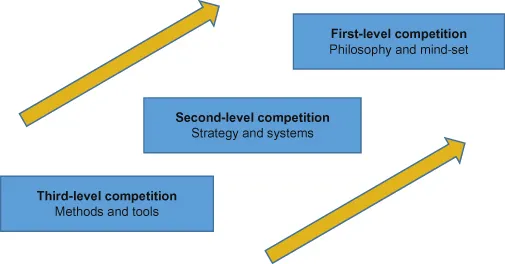
Taking the above into consideration, an organisation’s adaptability, and therefore its sources of competitive advantage, may be classified at three levels (Figure 1).
Figure 1. Three Levels of Competition. Source: Kozielski, Mardosz, and Matuszewska (2017).
Third-level competition is the easiest way to achieve market success. It involves the application of various methods and tools which enable a reduction in costs and an improvement in value for customers. The organisations employing this approach will search for new methods and tools which will not be an element of the overall operating system of the company, but will be disassembled and used in a piecemeal way. Organisations will rather concentrate on the tools and not on the modification of the method of operation. This applies, for example, to the implementation of solutions regarding customer service standards: Total Quality Management, Customer Relationship Management or Enterprise Resource Planning, but without any changes in the functioning of the organisation itself. Such an approach may bring about positive effects in the short term; however, it does not allow for the keeping of the market advantage in the longer term as it is easily imitated and often has a vast number of substitutable solutions. As a consequence, the organisations which compete in this manner quickly lose their advantage and begin looking for more effective tools and methods.
Second-level competition is linked with a change in the formula and manner of functioning of an organisation. The approach to the market game is more complex and based on a system change within the organisation itself. Tools and methods will no longer suffice; creating a coherent system, usually unique for the entire organisation which puts the approach to the market game in order, is required. The method of competing, hence the stability of the market advantage, is not based on one resource or skill, but on the ability to create a short-term combination of methods and tools or resources and skills that is unique and hard to follow. A specific corporate strategy or concept of actions is created. Loss of advantage is not connected with the takeover by competitors of one tool or method, but the entire system. Naturally, it is possible, but requires a lot more time and resources. Such examples may include the KAIZEN system used by Japanese companies or the four-leaf clover model.11
First-level competition is the highest of the presented methods of playing the marketing game. It is associated with the philosophy and mindset of an organisation as well as its ability to adapt and change. It is not only a set of methods and tools or a unique system of company operations, but an ability to observe the market and understand changes, and a high level of responsiveness. Such an approach is compatible with the conviction that an organisation’s ability to learn the market may be the only permanent source of competitive advantage, hence market success.
The three levels of competition enable the evaluation of a given organisation’s ability to achieve success. The third level is the easiest to reach but also the simplest to copy. Reaching the first one is hardest, but at the same time it is characterised by the features of a permanent competitive advantage. Nowadays it is emphasised that these simple sources of third-level competitive advantage have been virtually exhausted.12
From the perspective of adaptability, each level requires market knowledge. A knowledge that is built based on measurement systems and market indices. What makes these approaches different from one another is the role and manner of their application. The least significant with simultaneous concentration on tactical aspects at the third level is essential at the first level with a holistic approach to measurements. Either way measurements have played and will play a significant role in the process of managing and building competitive advantage.