How can design shine a light on humanity's relationship with the planet, its ecosystems and inhabitants, now and in the future?
Global challenges like climate change and ecosystem degradation are proving that a singular disciplinary approach is inadequate to respond to issues where societal behaviours, individual choices, political decisions, economic, technological and scientific developments are so densely entangled - not least in design. But what happens when we turn things around and decentre "the human" to look at our relationship with the planet, its ecosystems and inhabitants beyond the capitalist human-nature binary worldview?
Design Beyond the Human is a collection of essays by international scholars, designers and engaged citizens traversing activism, anthropology, conservation, creative writing, design practice, design theory, economics, education, environmental humanities, ethics, history, indigenous knowledge, law, philosophy, poetry, politics, regenerative agriculture, science, sociology and technology. Divided into three sections - We Are Not Alone, Design Beyond the Human, and Mediating Human–Non-Human Relations Through Design - the text generates conversations capable of thinking about life on planet Earth, challenging the Anglo-European anthropocentric conceptualisation of design that dominates practice, education, and academic discourse. Each section is unique: charting the transdisciplinary cultural perspective that is required to comprehend our predicament, the critique of human-centred design and its interdependence with capitalism, and the nascent practices and projects that are attempting to reconcile humanity's possible relationship with the planet, its ecosystems and inhabitants.
The book offers the reader an opportunity to engage with expertise, knowledge, methodologies and lived experiences from across disciplines shaped by shared concerns and provides an opportunity to question if design in a more-than-human way might reimagine design's relationship to capitalism and contemporary lifestyles. Will our planetary future be merely an ecologically aware version of today, or, in going beyond the human, might we develop a transdisciplinary perspective capable of imagining an alternative vision of life on Earth?
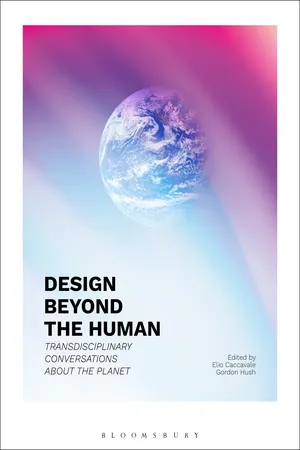
eBook - PDF
Design Beyond the Human
Transdisciplinary Conversations about the Planet
- 345 pages
- English
- PDF
- Available on iOS & Android
eBook - PDF
Design Beyond the Human
Transdisciplinary Conversations about the Planet
About this book
Information
Topic
DesignSubtopic
Design History & CriticismTable of contents
- Cover
- Half Title
- Title Page
- Copyright Page
- Contents
- Figures
- Foreword
- Acknowledgements
- Introduction
- Preface: Parts I, II and III
- Part I: We are not alone
- INTRODUCTION: We are not alone
- Chapter 1: A political economy of structural anthropocentrism
- Chapter 2: Co-creating multispecies worlds
- Chapter 3: Global trajectories of oil palm: From African communal groves to Asian plantation frontiers
- Chapter 4: The call of the cricket
- Chapter 5: Design, education and the moulding of alternative futures in the Anthropocene
- Part II: Design beyond the human
- INTRODUCTION: Design beyond the human
- Chapter 6: Design and the invention of the modern human
- Chapter 7: Ecological design thinking in the Anthropocene/Ecocene
- Chapter 8: Indigenous design: A relational practice between people and place
- Chapter 9: Life-centred design: A sub-Saharan perspective
- Chapter 10: Design and deep time
- Chapter 11: Orbital debris: Design and its extra-terrestrial aftermath
- Part III: Mediating human-non-human relations through design
- INTRODUCTION: Mediating human-non-human relations through design
- Chapter 12: Consider everything: A new kind of design for a computationally irreducible world
- Chapter 13: Planetarity: Designing for coexistence
- Chapter 14: Indigenous futures: Epistemologies of care for a world in crisis
- Chapter 15: A bottom-up approach to conservation: The Vertical University, Nepal
- Chapter 16: Design that thinks like a mountain
- Chapter 17: A larger, less humanized design community
- Chapter 18: Talking materials : A discursive design practice for a design beyond the human
- Chapter 19: Towards a culture of life: A new synthesis for the living world
- Chapter 20: Designing the future of agriculture
- Afterword
- Contributors
- Index
Trusted by 375,005 students
Access to over 1.5 million titles for a fair monthly price.
Study more efficiently using our study tools.
Frequently asked questions
Yes, you can cancel anytime from the Subscription tab in your account settings on the Perlego website. Your subscription will stay active until the end of your current billing period. Learn how to cancel your subscription
No, books cannot be downloaded as external files, such as PDFs, for use outside of Perlego. However, you can download books within the Perlego app for offline reading on mobile or tablet. Learn how to download books offline
Perlego offers two plans: Essential and Complete
- Essential is ideal for learners and professionals who enjoy exploring a wide range of subjects. Access the Essential Library with 800,000+ trusted titles and best-sellers across business, personal growth, and the humanities. Includes unlimited reading time and Standard Read Aloud voice.
- Complete: Perfect for advanced learners and researchers needing full, unrestricted access. Unlock 1.5M+ books across hundreds of subjects, including academic and specialized titles. The Complete Plan also includes advanced features like Premium Read Aloud and Research Assistant.
We are an online textbook subscription service, where you can get access to an entire online library for less than the price of a single book per month. With over 1.5 million books across 990+ topics, we’ve got you covered! Learn about our mission
Look out for the read-aloud symbol on your next book to see if you can listen to it. The read-aloud tool reads text aloud for you, highlighting the text as it is being read. You can pause it, speed it up and slow it down. Learn more about Read Aloud
Yes! You can use the Perlego app on both iOS and Android devices to read anytime, anywhere — even offline. Perfect for commutes or when you’re on the go.
Please note we cannot support devices running on iOS 13 and Android 7 or earlier. Learn more about using the app
Please note we cannot support devices running on iOS 13 and Android 7 or earlier. Learn more about using the app
Yes, you can access Design Beyond the Human by Gordon Hush,Elio Caccavale, Elio Caccavale,Gordon Hush in PDF and/or ePUB format, as well as other popular books in Design & Design History & Criticism. We have over 1.5 million books available in our catalogue for you to explore.