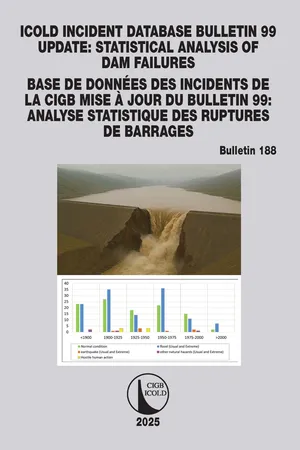
In all hazardous industries, incident analysis is an important tool to improve safety. Understanding the causes of incidents makes it possible to change what was identified as a weakness, either in the design, the construction or the operation of any industrial plant. Dams obey the same rules, and it is the reason why ICOLD has always been involved in dam incidents collection and analysis.
Since 2005 the Committee on Dam Safety has been collecting additional information on dam incidents and considered that it was time to update this last publication (Bulletin 99) which listed the cases of failures up to 1991. It was therefore up to ICOLD, and to its Committee on Dam Safety, to carry out this survey and analysis with the objective of meeting the needs of the dam professionals.
For this update other important attributes have been added, such as the context of failures (normal operation, flood, earthquakes, etc.), the failure mode, and the failure causes. Current concepts allow us to better define these notions and have been used to qualify these parameters.
Dans toutes les industries à risques, l'analyse des incidents est un outil important pour améliorer la sécurité. Comprendre les causes des incidents permet de modifier ce qui a été identifié comme une faiblesse, que ce soit dans la conception, la construction ou l'exploitation de toute installation industrielle. Les barrages obéissent aux mêmes règles, et c'est la raison pour laquelle la CIGB a toujours été active pour la collecte et l'analyse des incidents de barrage.
Depuis 2005, le Comité pour la sécurité des barrages a collecté des informations supplémentaires sur les incidents de barrages et a estimé qu'il était temps de mettre à jour cette dernière publication qui répertoriait les cas de ruptures jusqu'en 1991. Il revenait donc à la CIGB, et à son Comité sur la sécurité des barrages, de réaliser cette enquête et cette analyse dans le but de répondre aux besoins des professionnels des barrages.
Pour cette mise à jour, d'autres attributs importants ont été ajoutés, tels que le contexte des ruptures (fonctionnement normal, inondation, séismes, etc.), le mode de défaillance et les causes de la rupture. Les concepts actuels permettent de mieux définir ces notions et ont été utilisées pour qualifier ces paramètres.