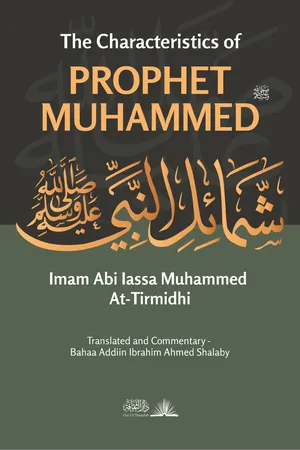
An Intimate Portrait of Islam's Final Prophet Through Authenticated Historical Sources
The Characteristics of Prophet Muhammed stands as one of the most remarkable works of biographical literature in human history—a meticulously documented portrait of a religious figure compiled from eyewitness testimony and subjected to the most rigorous verification standards ever developed. Authored by Imam Tirmidhi (209–279 AH), one of Islam's greatest hadith scholars, this work preserves the living memory of Prophet Muhammad ﷺ as witnessed by those who knew him personally.
The Historical Context and Scholarly Achievement
By the third Islamic century, when Imam Tirmidhi undertook this compilation, Muslim scholars faced an urgent challenge: preserving authentic prophetic traditions as the generation of direct witnesses passed into history. The stakes were immense—the Prophet's example (sunnah) provided Muslims their primary model for implementing Qur'anic teachings in daily life. Any corruption of this historical record would undermine Islamic practice for all subsequent generations.
Muslim scholars responded by developing hadith sciences ('ulum al-hadith)—a sophisticated methodology for authenticating historical reports. They created the biographical science ('ilm ar-rijal) that catalogued the lives, character, and memorization abilities of approximately 50,000 hadith transmitters. They established classification systems distinguishing reliable from unreliable narrations. They instituted the isnad system, requiring unbroken chains of transmission for any accepted report. No other pre-modern civilization developed historical methodology approaching this rigor.
Imam Tirmidhi mastered these sciences under luminaries including Imam Bukhari and Imam Muslim, then applied them to create Ash-Shamaa'il al-Muhammadiyya—the definitive work on the Prophet's physical and moral characteristics.
The Prophet's Physical Appearance
The work opens with detailed descriptions of the Prophet's appearance, compiled from multiple companion testimonies. We learn he possessed medium stature—neither exceptionally tall nor short. His complexion was wheat-colored with luminous brightness—described by one companion as "bright as if molded in silver." His hair was slightly wavy, falling to his earlobes or shoulders depending on when it was last cut.
His face was slightly round with a wide forehead. His eyes were described as "extremely black" with long lashes. Between his shoulder blades lay the Seal of Prophethood—described variously as a raised area or cluster of moles. His hands and feet were fully fleshed, his fingers moderately long. When he walked, he moved with vigor, "as if descending from a high place."
These physical descriptions, while historically valuable, served a deeper purpose: enabling Muslims who never met the Prophet to recognize him in dreams—considered spiritually significant encounters. The hadith tradition holds that Satan cannot assume the Prophet's form; thus authenticated dream sightings carry theological weight.
Daily Life and Habits
Subsequent chapters detail every aspect of the Prophet's daily routine. His clothing typically consisted of simple garments—he favored the qamis (long shirt) and sometimes wore a red-striped Yemeni cloak. He owned few outfits, often mended and faded. His ring was silver with an inscription reading "Muhammad Rasul Allah" (Muhammad, Messenger of Allah), used for sealing correspondence to foreign rulers.
His food preferences leaned toward simplicity. He loved pumpkin, dates, honey, and meat (especially the foreleg portion). Yet he often went days without adequate food, once fastening stones to his stomach to ease hunger. His family rarely enjoyed two consecutive meals of bread and meat. When asked why he accepted such poverty despite being Allah's messenger, he replied: "Should I not be a grateful servant?"
Regarding personal hygiene, he used kuhl (antimony-based eye ointment), combed his hair and beard regularly, applied perfume, and trimmed his mustache. He taught companions to trim nails, remove armpit hair, and maintain cleanliness as acts of prophetic tradition.
Worship and Spiritual Practices
Chapters on the Prophet's worship reveal extraordinary devotion. He performed night prayers (tahajjud) so prolonged that his feet swelled. Companions described him standing in prayer until morning, sometimes repeating a single verse throughout the night. During Ramadan, his worship intensified when Angel Gabriel would visit to review the Qur'an with him.
His fasting extended beyond Ramadan's obligatory days. He frequently fasted Mondays and Thursdays, explaining these were days when deeds are presented to Allah. He observed three days monthly and encouraged fasting the Day of 'Ashura. Yet he cautioned against excessive austerity, teaching moderation: "The most beloved deeds to Allah are those practiced regularly, even if small."
His recitation of the Qur'an was melodious and measured—he articulated each verse distinctly, pausing between them. Companions described his voice as beautiful, and he encouraged Muslims to beautify Qur'anic recitation.
Character and Interpersonal Conduct
The Prophet's moral character forms the heart of the work. Companions testify unanimously to his extraordinary generosity—he never refused a request and distributed everything in his possession. Once he gave away an entire flock of sheep filling a valley, stunning the recipient.
His humility contradicted every expectation of prophetic grandeur. He mended his own clothes, milked his goats, and swept his house. In gatherings, he sat wherever space was available. He accepted invitations from slaves and the poor. When asked to reserve special seating befitting his station, he refused.
His mercy extended universally. With children, he played with them, carried them, and allowed them to climb on his back during prayer. His servant Anas served him for ten years, during which the Prophet never once expressed annoyance. Toward animals, he forbade mistreatment and once delayed prayer when a cat slept on his cloak.
Most remarkably, his forgiveness encompassed even enemies. When Makkans who had persecuted him fell under his authority, he declared a general amnesty. When asked why he did not retaliate, he replied: "I was not sent as a curser but as a mercy."
The Final Days
Later chapters chronicle the Prophet's final illness and death at age sixty-three. Accounts describe his fever, his final sermon, his concern for his community, and his death while resting against his wife 'A'ishah's chest. The work includes poignant details: Abu Bakr kissing his forehead after death, companions' shock and grief, and debates about his burial place—resolved by Abu Bakr's narration that prophets should be buried where they die.
The book concludes with traditions about the Prophet's legacy—he left no material wealth, only his knowledge, example, and the Qur'an. This voluntary poverty underscored his message: he sought no worldly kingdom but called humanity to ethical monotheism and social justice.
Contemporary Significance
For modern readers, The Characteristics of Prophet Muhammed offers multiple layers of value. Historians find unparalleled primary source material on seventh-century Arabia, compiled using methodologies that anticipated modern historical-critical methods by centuries. Students of Islamic studies encounter foundational texts of hadith sciences. Muslims worldwide find their primary model for prophetic emulation—detailed enough to guide worship, ethics, and family life.
Most profoundly, the work demonstrates that Islam's founder was not a distant mythological figure but a fully documented historical person whose appearance, habits, humor, and character were meticulously preserved by those who knew him best. This preservation underscores Islam's foundational claim: Muhammad was Allah's final messenger, and his message too important to be lost to myth or legend.