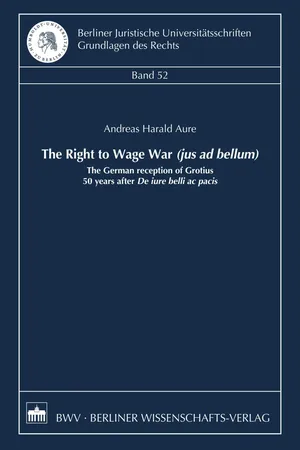
eBook - PDF
The Right to Wage War (jus ad bellum)
The German reception of Grotius 50 years after De iure belli ac pacis
- 222 pages
- English
- PDF
- Available on iOS & Android
eBook - PDF
The Right to Wage War (jus ad bellum)
The German reception of Grotius 50 years after De iure belli ac pacis
About this book
With De iure belli ac pacis libri tres (1625), the Dutch humanist and natural law philosopher Hugo Grotius (1583–1645) quickly became the greatest authority on international law (jus gentium) and on just war (bellum justum) in Europe for the next hundred years or so. By examining the theories of three largely unknown German scholars, Konrad Friedlieb, Valentin Alberti and Johann Wolfgang Textor, Andreas Harald Aure discusses dominant visions of international law and the right to go to war (jus ad bellum) in the Protestant parts of the Holy Roman Empire, two generations after Grotius wrote his magnum opus.°°°°The authors struggled with questions such as:°°°°– What may serve as right justification (cause) for war?°°– Can an offensive war be just?°°– Can a war be just on both sides?°°– Has a belligerent the right to pass through third-party territory?°°– Is there a right to wage war on behalf of people in foreign countries?°°°°Two chapters discuss the conceptual development of jus gentium (the law of nations). As an adherent of Thomas Hobbes' systematic approach to law, Samuel Pufendorf (1632–1694) realigned jus gentium as natural law (jus naturale). The main topic of this book is a detailed account of the just conditions for war (jus ad bellum) among leading German scholars in the 17th Century, based on in-depth research of primary sources.°°---------------------------------------------°°Die Veröffentlichung von De iure belli ac pacis libri tres (1625) machte den holländischen Humanisten und Naturrechtsphilosophen Hugo Grotius (1583–1645) innerhalb kurzer Zeit zur führenden Autorität in Europa auf dem Gebiet des Völkerrechts (jus gentium) und des gerechten Krieges (bellum justum), woran sich in den folgenden hundert Jahren nichts ändern sollte.°°Andreas Harald Aure untersucht die Theorien von drei weitgehend unbekannten deutschen Wissenschaftlern, Konrad Friedlieb, Valentin Alberti und Johann Wolfgang Textor, und erörtert auf diese Weise die zwei Generationen nach der Veröffentlichung von Grotius' magnum opus in den protestantischen Teilen des Heiligen Römischen Reichs dominierenden Ansichten zu Völkerrecht und dem Recht zum Krieg (jus ad bellum). °°Diese Autoren befassten sich u. a. mit folgenden Fragen:°°–Was kann als angemessene Rechtfertigung (Grund) für Krieg betrachtet werden?°°–Kann ein Angriffskrieg gerecht sein?°°–Kann ein Krieg auf beiden Seiten gerecht sein?°°–Hat ein kriegführendes Land das Recht, durch Hoheitsgebiete einer dritten Partei zu marschieren?°°–Gibt es ein Recht darauf, im Namen der Bevölkerung fremder Länder Krieg zu führen?°°In zwei Kapiteln wird die Entwicklung des Begriffs jus gentium (das Recht der Völker) erörtert. Als Anhänger von Thomas Hobbes systematischer Rechtsauffassung ordnete Samuel Pufendorf (1632–1694) das jus gentium dem Naturrecht (jus naturale) zu. °°Der Fokus dieses Buchs liegt auf der detaillierten Darstellung der von führenden deutschen Gelehrten des 17. Jahrhunderts vertretenen gerechten Kriegsbedingungen (jus ad bellum), gestützt auf eine umfassende Erforschung der Primärliteratur. °°°°About the author:°°°°Dr. Andreas Harald Aure, born 1970, holds law degrees from the University of Oslo, Cand.jur. 2000, and the Humboldt University in Berlin, LL.M. 2001. He was an associate professor of legal science at the University of Agder (Kristiansand, Norway), 2011-2014. He currently works as a teacher and translator in Oslo.°°
Information
Table of contents
- Acknowledgments
- Contents
- 1 Introduction
- 2 Grotius’ ideas on law and war
- 3 Samuel Pufendorf
- 4 Konrad Friedlieb (1613–1713), Greifswald
- 5 Valentin Alberti (1635–1697), Leipzig
- 6 Johann Wolfgang Textor (1637–1701), Heidelberg
- 7 Comparison by way of three examples
- 8 Jus gentium – from a source of law to a field of law
- 9 Conclusion
- Epilogue: The destruction of modern natural law and the problems of current international law
- Appendix: Konrad Friedlieb’s rocky road to Greifswald’s law faculty
- Bibliography
- Index
Trusted by 375,005 students
Access to over 1.5 million titles for a fair monthly price.
Study more efficiently using our study tools.
Frequently asked questions
Yes, you can cancel anytime from the Subscription tab in your account settings on the Perlego website. Your subscription will stay active until the end of your current billing period. Learn how to cancel your subscription
No, books cannot be downloaded as external files, such as PDFs, for use outside of Perlego. However, you can download books within the Perlego app for offline reading on mobile or tablet. Learn how to download books offline
Perlego offers two plans: Essential and Complete
- Essential is ideal for learners and professionals who enjoy exploring a wide range of subjects. Access the Essential Library with 800,000+ trusted titles and best-sellers across business, personal growth, and the humanities. Includes unlimited reading time and Standard Read Aloud voice.
- Complete: Perfect for advanced learners and researchers needing full, unrestricted access. Unlock 1.5M+ books across hundreds of subjects, including academic and specialized titles. The Complete Plan also includes advanced features like Premium Read Aloud and Research Assistant.
We are an online textbook subscription service, where you can get access to an entire online library for less than the price of a single book per month. With over 1.5 million books across 990+ topics, we’ve got you covered! Learn about our mission
Look out for the read-aloud symbol on your next book to see if you can listen to it. The read-aloud tool reads text aloud for you, highlighting the text as it is being read. You can pause it, speed it up and slow it down. Learn more about Read Aloud
Yes! You can use the Perlego app on both iOS and Android devices to read anytime, anywhere — even offline. Perfect for commutes or when you’re on the go.
Please note we cannot support devices running on iOS 13 and Android 7 or earlier. Learn more about using the app
Please note we cannot support devices running on iOS 13 and Android 7 or earlier. Learn more about using the app
Yes, you can access The Right to Wage War (jus ad bellum) by Andreas Aure in PDF and/or ePUB format, as well as other popular books in Law & Law Theory & Practice. We have over 1.5 million books available in our catalogue for you to explore.