![]()
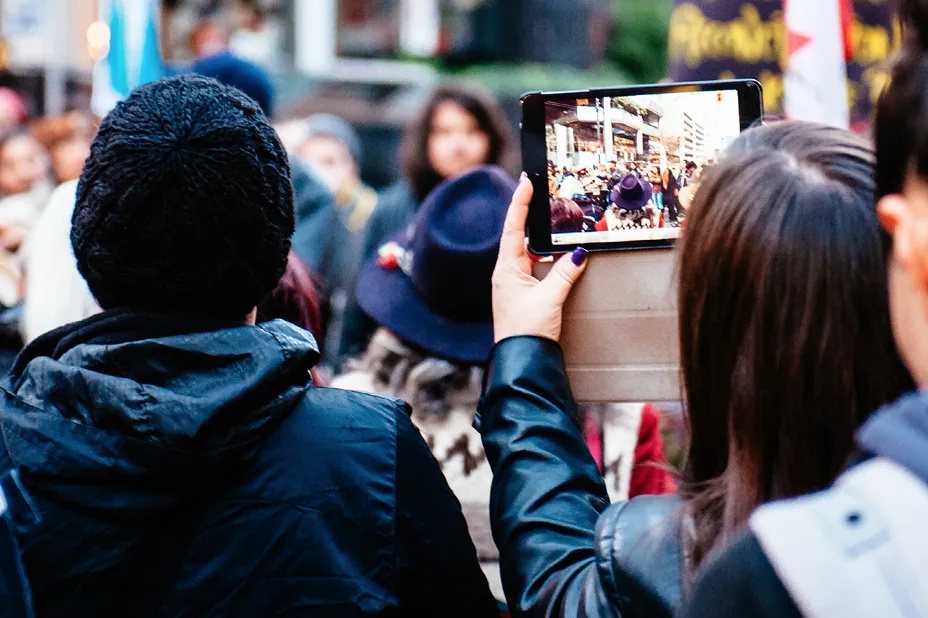
Idle No More event: Elsipogtog Solidarity rally in Vancouver on October 18, 2013. Photograph by Lukasz Szczepanski
Seven
Idle No More and the Technologies
of Mass Mobilization
“There’s certain ways that we can do this peacefully in trying to raise awareness. We could call upon younger people and we could do it through social media, blogs, Twitter, Facebook, writing letters to Harper, senators and the Queen. We can sign the petition, [which] is what we’re doing today.” —Idle No More coordinator, Prince Albert, Saskatchewan, December 10, 2012
Politics and protest just aren’t what they used to be, or so the story goes. The narrative is very simple. The advent of personal digital devices—smartphones, pagers, tablets, and the like—combined with software tools, like Facebook, Twitter, YouTube, and Spreecast, have changed the fundamentals of political organizing, mass mobilization, protest, and dissent. Being wary of technological determinism or of attributing social change to the introduction of new technologies seems to make sense here. Technology is not a simple driving force; technology produces tools that social groups, mobilized to act for a complex set of reasons, utilize to expand their reach and impact. By itself, technology is a damp squib, something without soul, purpose, or real effect. Technology mobilized to serve social forces, values, community passions, and historical grievances, however, can ignite and deliver exponential impact.
Social factors, the collective memory of historical experiences, and the interplay of politics and technology create social change. Some may think that putting smartphones in the hands of young people is far more likely to produce tweets about the Kardashians than a broad-based social movement. Technology does not change people; people change people. And yet, social media allows individuals and groups to go around government, avoid the mass media, hide from censors, make instant contact, reach out to supporters, share ideas with millions of people in seconds, and manage connections between followers and founders. The speed, affordability, and reach of social media trump all previously available means of political mobilization and public protest.
The latter part of the twentieth century was defined by the technological transformation of politics and social mobilization. Over the past two decades, however, the trend has run in the opposite direction: corporate concentration of the media, the decline of independent outlets, sophisticated use of polling and other systems that transformed organized politics into new-age, political machines, and the homogenization of Western society that is best captured in Robert Putnam’s Bowling Alone: The Collapse and Revival of American Community (2000). Putnam’s book, an impressive work of social science, documents the collapse of community, the rise of the individual, and the atomization of modern society. From the advent of the Internet, and the emergence of The Well (the first major online community, launched in 1985), the digital world has offered an alternative to a collapsing traditional world.
Digitally enabled politics changed things quickly: connecting people with shared interests and concerns; allowing groups to mobilize around, behind, and between political parties, governments, and social interests; and giving political power to the poor and dispossessed. The new technologies, which capitalize on Moore’s Law (the exponential growth of computing power), improved steadily. Launched to mass effect in the industrial world in the 1990s, social media quickly spread, principally through BlackBerry and the iPhone, to the developing world. By the 2010s, smartphones had become ubiquitous, present in the profoundly poor villages of sub-Saharan Africa as well as every Aboriginal community in Canada, in authoritarian states in the Middle East and small towns in Canada’s North.
Aboriginal people in Canada have embraced the Internet, social media, and smartphones. Facebook is commonplace in First Nations, Métis, and Inuit communities and is particularly well-suited for maintaining contact between families and friends stretched between home communities, kids away at college and university, and relations who have relocated to distant towns and cities. Aboriginal people have been like other Canadians: all ages—youth, adults, and the elderly alike—are enthusiastic about smartphone and social media technologies. These new tools have facilitated social relationships, connected bands with members, provided dissenters with a tool for organizing against official leaders, and otherwise transformed communications between and among community members. It is too early f...