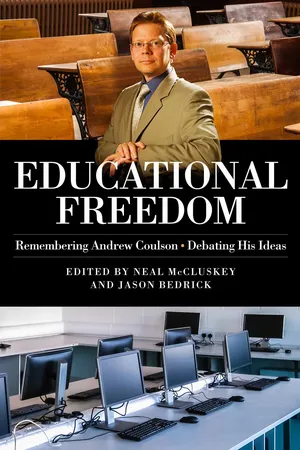
Although his life was cut tragically short in 2016, Andrew Coulson had a remarkable impact on education policy. As director of the Cato Institute's Center for Educational Freedom from 2005 to 2015, Coulson was committed to excellence in education and consistently advocated for free-market reforms that would make schools more flexible, innovative, and responsive to the needs of parents and students. In this volume, prominent education researchers and thinkers who knew Andrew and his ideas well commemorate his legacy with articles that explore and expand the vitality and urgency of his ideas.
eBook - ePub
Educational Freedom
Remembering Andrew Coulson - Debating His Ideas
- 144 pages
- English
- ePUB (mobile friendly)
- Available on iOS & Android
eBook - ePub
About this book
Trusted by 375,005 students
Access to over 1.5 million titles for a fair monthly price.
Study more efficiently using our study tools.
Information
Topic
EducationSubtopic
Educational Policy1. Getting to Know Andrew Coulson
Bob Bowdon
In 1994, a Microsoft software programmer with four and a half years on the job arranged a meeting with his manager. At the appointed time, without much small talk, Andrew Coulson offered a letter of resignation. Surprised, the manager asked why he was quitting. Equally surprising was Coulson’s answer (as retold later by Andrew’s wife, Kay). Andrew said to his boss, “I’m leaving because of you.”
Many managers might gird themselves at such a moment, anticipating an unseemly string of critiques and complaints that could flow from the mouth of a departing employee suddenly free from the need to keep up appearances. But that was not about to happen. Instead, Andrew said, “I can see that you love your work. It brings you joy, fulfillment, and you just love what you do. I don’t have that. I want to go find something that I love.” Those who knew him can imagine the earnest, naked, forthright face he must have offered at that moment.
Microsoft didn’t completely fail Andrew in the love department. Through that job, he met a young Cincinnati native named Kay Krewson, a Microsoft software tester who would become his wife. But just as he followed his heart with Kay, he wanted to follow his heart professionally.
It bears mentioning that in his resignation, Andrew didn’t quit just any job. He quit The House that Bill Built, a company that arguably defined modern technology and business dominance of the era.
Many periods in American business are associated with one juggernaut company and its killer product. In the 1910s, it was Ford Motor Company and the Model T. In the 1960s, it was IBM and the System/360. In the first decade of the 21st century, perhaps it was Google and its search engine. But in the 1990s, that juggernaut company was undisputedly Microsoft, and its product was a little something called Windows. This was the professional rocket ship from which Andrew Coulson voluntarily disembarked. As a developer working on the famed Windows 95, Andrew was tossing away a job that millions of people would have clung to for dear life, for both the professional prestige and the potential financial windfall it could ultimately bestow. Looking back, however, those who knew him best understand his choice. Most rugged individualists with the gift of irrepressible optimism simply aren’t cut out to be company men, and neither was this one.
In fact, the seeds of his next endeavor had already been planted. A few years earlier, Andrew had read with interest about a public referendum in neighboring Oregon to amend the state constitution. The ballot initiative called for interdistrict school choice, which would have let parents send their children across the imaginary political lines called “school districts,” and it would have let families declare private school tuition costs as credits against taxes. “Clearly, that will pass,” Andrew thought. “Slam dunk. Piece of cake. Put a fork in it.” That was, until two-thirds of Oregon voters rejected the initiative.
The result puzzled him. Why on earth would Oregonians make the oxymoronic choice against choice? What could motivate people to get in their cars and drive to a polling place to stridently reject their right to make a decision—especially one affecting the lives of their children? The conundrum stayed with Andrew, and a few years later, the newly emancipated young programmer returned to this perplexing question—thus changing the course of his professional life.

Andrew Joseph Coulson was born May 4, 1967, in the Canadian province of Quebec, the fourth child of Violet and Donald Coulson. They were an iconoclastic family from the start, as native English speakers marooned in a French-speaking province. Despite the language barrier, it didn’t take long for the neighbors to get to know Andrew. At either five or six years of age, he decided to offer a bouquet of flowers to his mom for Mothers’ Day. Driven by both generosity and a young child’s sense of creative problem solving, he promptly cut off the tops of flowers from yards all around the suburban neighborhood, assembled them to the best of his pint-sized ability, and presented the bounty to a delighted Mrs. Coulson. After thanking her son, she was immediately curious about his source of the raw material, as most mothers might be. The revelation led to a multistop floral apology tour that the neighbors understandably found charming.
Andrew’s high school years involved French horn during the school year and sailing in the summertime on the lakes of Quebec. And while anyone hoping to be accepted at the highly competitive McGill University as a math major needs absolutely superb grades, older brother Stuart says that Andrew was much more than a good student during his adolescence. He was always curious, always cheerful, and always good company.
Presumably, if your eyes are moving across these words, you already know that Andrew Coulson very much did fulfill the quest he laid out during his Microsoft resignation: to find professional work that he loved. By 1999, he had published his landmark book, Market Education: The Unknown History. It examined education through the ages and across continents and found that when families spend their own money on schooling, just as with everything else, they get better results than when someone else spends money on their behalf. The volume was hailed by no less than Nobel Prize–winner Milton Friedman as an “unusually well written and thoroughly researched book.”
Market Education was potent enough to get the attention of the Mackinac Center for Public Policy, which eventually hired Andrew as their senior fellow in education policy. He was good enough, in fact, that they hired him without requiring him to move to Michigan. A few years later, the Cato Institute hired him as director of the institute’s Center for Educational Freedom. Again, he was good enough that they hired him without requiring him to move to Cato’s Washington, D.C., home.
To begin to understand Andrew Coulson, however, is also to understand his irreverent, absurdist, and playful sense of humor. How many think tank analysts went to see the 2002 movie Jackass not once, not twice, but three times in the theater (accompanied by their wives, no less)? Andrew did. What other nationally respected policy experts developed a hobby of detonating plastic bottles, an activity that Andrew’s friend John Nesby called “the glue that bonded our relationship”? Nesby, a professional chef and neighbor of the Coulsons, said, “We would shoot BB guns; we would light firecrackers off. Then we would get a little bit more extreme. We used to make dry ice bombs out of plastic bottles, dry ice, and water, and then we’d shoot them with pellet guns and make big explosions. It was just an absolute riot for a couple of grown men to be running around in the woods after a hard day’s work, with a glass of chardonnay or a craft beer in hand and blowing stuff up.”
In 2014, a 47-year-old Andrew Coulson worked out in the gym above the garage one day and afterward came out to talk to Kay. He told her that he got a weird taste and smell in his mouth. The sensation was strange enough that he thought he should tell her about it, in case it turned out to be something important. After a couple of days, he got the weird taste and smell again. Then it started to happen more frequently. Within four weeks of the first sensation, he began to get headaches, severe enough that he would lie in bed, unable to work despite continuous dosages of Tylenol.
First, the doctor said it was allergies and suggested he treat his symptoms with nasal sprays. When he went back to the doctor, the diagnosis switched to sinus infection, and he was prescribed antibiotics. Soon the pain was bad enough that he started vomiting. Kay took him to an emergency room where they did a CAT scan. That led to the next wrong theory—a brain infection—and a prescription for an MRI at a different facility. Only then did the correct diagnosis finally emerge, a grade 4 glioblastoma. Andrew, with his wife by his side, was told that the life expectancy for a person with his type of brain tumor is 15 months. The news of a terminal prognosis came about six weeks after the first symptom, during a regular treadmill workout.
Many people, no matter what stage in life, would be understandably depressed by the ominous news. But this man was not. You can talk to Andrew’s widow, brother, and close friends. You can ask his professional colleagues. And if you knew him, you can review your own correspondences with him over the course of 2015. There’s simply no account of futility or bitterness or nihilism. There’s not even a coarsening or no-more-time-for-bullshit toughness. Andrew Coulson, as the end neared, stayed funny.
Also absent were grand gestures and end-of-life reconciliations. Andrew and Kay did talk about going back to Hawaii “one last time,” but there was no discussion of a bucket list. Such late-hour recalibrations, it seems, aren’t necessary for the people already leading the life they want.
Even his last few months of Facebook entries reveal an irrepressible spirit. The majority of the posts don’t pertain to his illness. In one, he expressed relief that he’d learned which brand of yogurt had become the official yogurt of the National Football League. In late December, when Hillary Clinton extemporaneously said that she, “Wouldn’t Keep Any School Open That Wasn’t Doing A Better Than Average Job,” Andrew, with about six weeks to live, summoned the strength to post, “Garrison Keillor please call your office.”
The posts that referred to his illness were also spirited. On December 17, 2015, he wrote, “Just had my 37 millionth blood draw and saw a sticker on a table that suggests cancer patients aren’t the only ones who get ’em. . . . It read ‘Alleged Father.’”
Two days later, Andrew had a stroke. A few days after that, he posted, “Brain tumors being so 2014 I decided to try on a stroke for size. Definitely new and different. For the time being immobilized on my left side.”
This was the Andrew Coulson that resonated with countless people who met and knew him. Thomas Shull, his colleague at Mackinac, might have summed it up best when he wrote in a blog post, “There was no one I enjoyed working with more than Andrew—a sentiment I suspect all his friends and coworkers share. . . . He was a good man, and he will be missed by virtually everyone who knew him.”
While most of us don’t like to think about it much, we’ll all have to leave this world someday, perhaps before we think it’s our time, perhaps without finishing everything that we’re working on, and perhaps leaving loved ones who’ll miss us dearly. When that day comes, may we all say goodbye with as much grace as Andrew Joseph Coulson.
2. Tax Credit–Funded Choice: Reform for “Transformationists”
Adam B. Schaeffer
Great scholars tend to have a few things in common: they tend to be inordinately productive, creative, and influential with those who follow them in their field. Andrew Coulson was all of those things and much more.
Coulson contributed to our understanding of education systems and policy in many ways, but I think his greatest contribution was his development of a comprehensive argument for the superiority of tax credits for funding educational choice and achieving the goals of the school choice movement. He promoted education tax credits because he kept in mind the most important factors in building a real, sustainable market for education: (1) locating financial responsibility at the source of the funds; (2) avoiding and overcoming legal challenges; (3) avoiding market-killing regulations; and (4) ensuring positive, short- and long-term political dynamics.
I should make an explicit note here about the purpose of this chapter. There are, very broadly speaking, two kinds of education reformers—those who seek the total transformation of the education system and “tweakers.” Coulson was in no way the latter. He was not one to spend his time considering minor adjustments to the current system. Transforming a massive industry, one woven into the fabric of our nation and its politics, is not an easy task, and it will not be accomplished without many small steps along the way. But the goal of choice advocates such as Coulson and myself has always been a broad and deep shift in how the education system functions. This chapter is written for those who want to transform the system, not tweak it. It is a review of the reasons a “transformationist” should greatly prefer the use of tax credits, rather than government money, to fund educational choice.
My first introduction to Andrew Coulson came when I was in graduate school, in 2004. I’d written an article for National Review Online on vouchers. Using a recent West Wing episode as a lead-in, I argued that conservatives and Republicans should use school choice as a wedge issue among Democrats, pushing targeted vouchers to woo minority voters. Someone working in the choice movement wrote to compliment me on the article but gently suggested I might be missing some important concerns about school choice policy. He attached a late draft of a paper Coulson had written for the Mackinac Center: “Forging Consensus.”1 I read it, and that was it. In terms of practical impact, principle, public opinion, politics, regulations, and legal barriers, he made a thoroughly convincing case for consensus on what the goal of school choice proponents should be.
Coulson’s work directly inspired my PhD dissertation, examining how school choice messages and policies interact, and I ultimately went to work for him at the Cato Institute. It is no exaggeration to say that everything I have written on education reform since then has been a recapitulation or extension of Coulson’s thinking and analysis.
Much has changed since that seminal paper was published, but the case Coulson laid out holds up remarkably well. Indeed, much of the evidence has grown stronger in support of education tax credits over vouchers or government-funded education savings accounts (ESAs) as a mechanism to fund choice in education and ultimately build a dynamic market in K–12 education.
A key point to keep in mind regarding Coulson’s work is this: he believed the goal of the school choice movement should be to build a robust, dynamic education market. The goal should not be to help just low-income kids, or children with disabilities, because the children who need help the most will be best served by a free-market education system that continually adapts and improves. A large, free, dynamic market with a wide range of choices will improve educational and life outcomes for all children, most of all those most in need.
Coulson laid out much of the rationale for his vision of the ideal educational system in his seminal book, Market Education: The Unknown History.2 In the book, he made his case not just deductively from libertarian first principles, but inductively, from a review of the history of educational systems and theories that was surprisingly broad and deep at the same time. Following Market Education, Coulson spent years making the case for education tax credits as the best policy mechanism for establishing a true market in education.
Recently, ESAs have become very popular. The idea is to establish savings accounts and use the money deposited in those accounts—and the funds that accrue over time—on education expenses. The funding mechanism has become associated almost exclusively with di...
Table of contents
- Cover Page
- Title Page
- Copyright Page
- Contents
- Introduction
- 1. Getting to Know Andrew Coulson
- 2. Tax Credit-Funded Choice: Reform for "Transformationists"
- 3. Tax Credits Can't Create a Competitive Education Marketplace
- 4. Giving Credit Where Credits Are Due: Revisiting the Voucher vs. Tax Credit Debate
- 5. On Coulson's Historical Perspective
- 6. Education, Markets, and Governments: Andrew Coulson's Global Research Agenda and Legacy
- 7. Measure Market Presence, or Few Rules and Provider Neutrality: Are the Differences Important?
- 8. Toward Education Consistent with Freedom
- Testimonials
- About the Contributors
- About the Editors
- Notes
Frequently asked questions
Yes, you can cancel anytime from the Subscription tab in your account settings on the Perlego website. Your subscription will stay active until the end of your current billing period. Learn how to cancel your subscription
No, books cannot be downloaded as external files, such as PDFs, for use outside of Perlego. However, you can download books within the Perlego app for offline reading on mobile or tablet. Learn how to download books offline
Perlego offers two plans: Essential and Complete
- Essential is ideal for learners and professionals who enjoy exploring a wide range of subjects. Access the Essential Library with 800,000+ trusted titles and best-sellers across business, personal growth, and the humanities. Includes unlimited reading time and Standard Read Aloud voice.
- Complete: Perfect for advanced learners and researchers needing full, unrestricted access. Unlock 1.5M+ books across hundreds of subjects, including academic and specialized titles. The Complete Plan also includes advanced features like Premium Read Aloud and Research Assistant.
We are an online textbook subscription service, where you can get access to an entire online library for less than the price of a single book per month. With over 1.5 million books across 990+ topics, we’ve got you covered! Learn about our mission
Look out for the read-aloud symbol on your next book to see if you can listen to it. The read-aloud tool reads text aloud for you, highlighting the text as it is being read. You can pause it, speed it up and slow it down. Learn more about Read Aloud
Yes! You can use the Perlego app on both iOS and Android devices to read anytime, anywhere — even offline. Perfect for commutes or when you’re on the go.
Please note we cannot support devices running on iOS 13 and Android 7 or earlier. Learn more about using the app
Please note we cannot support devices running on iOS 13 and Android 7 or earlier. Learn more about using the app
Yes, you can access Educational Freedom by Neal McCluskey, Jason Bedrick in PDF and/or ePUB format, as well as other popular books in Education & Educational Policy. We have over 1.5 million books available in our catalogue for you to explore.