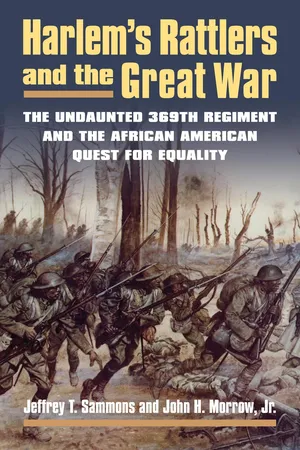
Harlem's Rattlers and the Great War
The Undaunted 369th Regiment and the African American Quest for Equality
- 528 pages
- English
- ePUB (mobile friendly)
- Available on iOS & Android
Harlem's Rattlers and the Great War
The Undaunted 369th Regiment and the African American Quest for Equality
About this book
Choice Outstanding Title
When on May 15, 1918 a French lieutenant warned Henry Johnson of the 369th to move back because of a possible enemy raid, Johnson reportedly replied: “I’m an American, and I never retreat.” The story, even if apocryphal, captures the mythic status of the Harlem Rattlers, the African-American combat unit that grew out of the 15th New York National Guard, who were said to have never lost a man to capture or a foot of ground that had been taken. It also, in its insistence on American identity, points to a truth at the heart of this book—more than fighting to make the world safe for democracy, the black men of the 369th fought to convince America to live up to its democratic promise. It is this aspect of the storied regiment’s history—its place within the larger movement of African Americans for full citizenship in the face of virulent racism—that Harlem’s Rattlers and the Great War brings to the fore.
With sweeping vision, historical precision, and unparalleled research, this book will stand as the definitive study of the 369th. Though discussed in numerous histories and featured in popular culture (most famously the film Stormy Weather and the novel Jazz), the 369th has become more a matter of mythology than grounded, factually accurate history—a situation that authors Jeffrey T. Sammons and John H. Morrow, Jr. set out to right. Their book—which eschews the regiment’s famous nickname, the “Harlem Hellfighters,” a name never embraced by the unit itself—tells the full story of the self-proclaimed Harlem Rattlers. Combining the “fighting focus” of military history with the insights of social commentary, Harlem’s Rattlers and the Great War reveals the centrality of military service and war to the quest for equality as it details the origins, evolution, combat exploits, and postwar struggles of the 369th.
The authors take up the internal dynamics of the regiment as well as external pressures, paying particular attention to the environment created by the presence of both black and white officers in the unit. They also explore the role of women—in particular, the Women’s Auxiliary of the 369th—as partners in the struggle for full citizenship. From its beginnings in the 15th New York National Guard through its training in the explosive atmosphere in the South, its singular performance in the French army during World War I, and the pathos of postwar adjustment—this book reveals as never before the details of the Harlem Rattlers’ experience, the poignant history of some of its heroes, its place in the story of both World War I and the African American campaign for equality—and its full importance in our understanding of American history.
Frequently asked questions
- Essential is ideal for learners and professionals who enjoy exploring a wide range of subjects. Access the Essential Library with 800,000+ trusted titles and best-sellers across business, personal growth, and the humanities. Includes unlimited reading time and Standard Read Aloud voice.
- Complete: Perfect for advanced learners and researchers needing full, unrestricted access. Unlock 1.4M+ books across hundreds of subjects, including academic and specialized titles. The Complete Plan also includes advanced features like Premium Read Aloud and Research Assistant.
Please note we cannot support devices running on iOS 13 and Android 7 or earlier. Learn more about using the app.
Information
Table of contents
- Front Cover
- Series Page
- Title Page
- Copyright Page
- Dedication
- Contents
- Acknowledgments
- Introduction
- 1Â Â âHe HAS a Flagâ: The Relationship of the Military to Black Identity, Community, and Citizenship and the Origins of the Black Regiment Movement
- 2Â Â âPositions of Honor and Trustâ: Charles Ward Fillmore, the Equity Congress, and the Byzantine Politics of the Black Regiment Movement
- 3Â Â âSecond Only to . . . the Emancipation Proclamationâ: The Trying Campaign from Authorization to Formation
- 4Â Â âMulliganâs Guardsâ: The (Re)-Birth and Growing Pains of the 15th New York National Guard
- 5Â Â War and Expediency: The Politics of Federal Recognition, Regimental Training, and the Presidentâs Call to Service
- 6Â Â Race War at Home or Combat Abroad? Tested in the White-Hot Crucible of Camp Life
- 7Â Â âOver Thereâ: The 15th New York/369th Regiment in France: From the AEF to the French Army, JanuaryâApril 1918
- 8Â Â Trial by Fire: In Combat with the French 16th Infantry Division, Mid-April to June 1918
- 9Â Â âThe Battle of Henry Johnsonâ and Neadom Roberts: The Night Two Ordinary Men Became War Heroes and Race Symbols
- 10Â Â A Midsummerâs Nightmare: Race Swirls above the 369th, MayâAugust 1918
- 11Â Â The Big Push: Offensives in Champagne/Meuse-Argonne and the Capture of SĂchault, September 7âOctober 4, 1918
- 12Â Â Warâs End: Final Campaign, First to the Rhine, Occupation, and Hasty Departure
- 13Â Â âWar Crossed Abroad and Double Crossed at Homeâ: Triumphant Heroes, Objects of Ridicule, or Fearsome Trained Killers?
- 14Â Â Your Services Are No Longer Needed: The War Departmentâs Postwar Decimation and Denigration of Black Soldiers and the 369thâs Fight for Survival and Recognition
- 15Â Â Winning the Battle and Losing the War: The Renewed Fight for a Black Commander and the Disfiguring Transformations of the 369th
- Conclusion: Henry Johnson and Neadom Roberts: Cautionary Tales
- Epilogue: A Brief Look at the Postwar Careers and Lives of a Few Outstanding Black and White Officers and Men
- Appendix: Deaths in the 369th Infantry during Service with the 93rd Division, AEF
- List of Acronyms
- Notes
- Bibliography
- Index
- Photo Gallery
- Back Cover