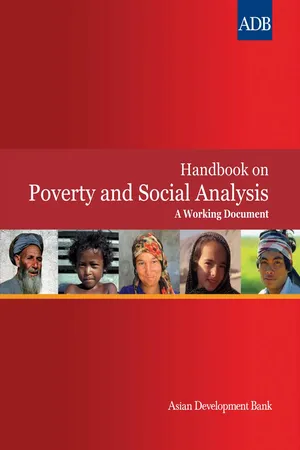
The Asian Development Bank (ADB) supports inclusive growth in the Asia and Pacific region by giving attention to the poverty impact and social dimensions of its operations. This handbook contributes to this endeavor by providing practical guidance to ADB staff, government officers, project stakeholders, and consultants involved in programming, preparing, and implementing activities for them to effectively address poverty and social dimensions in ADB-financed operations. It also provides a road map to specific ADB policies and procedures related to poverty and social analysis, with the end view of achieving inclusive, equitable, and sustainable development outcomes.
- 149 pages
- English
- ePUB (mobile friendly)
- Available on iOS & Android
eBook - ePub
About this book
Information
Appendix 1
Relevant ADB Policies, Strategies, and Procedures
A1.1 Policies, Strategies, and Procedures Related to Poverty and Social Dimensions
| Issue | Document | Summary |
| Poverty reduction | Poverty Reduction Strategy (1999) Enhanced Poverty Reduction Strategy (2004) OM C1: Poverty Reduction | Poverty reduction is ADB’s overarching goal. The EPRS requires that all ADB interventions contribute directly or indirectly to poverty reduction. However, there is no longer a target for the proportion of ADB-financed projects that support poverty reduction directly. |
| Social analysis | OM C3: Incorporation of Social Dimensions in Bank Operations Handbook on Poverty and Social Analysis (2012) Social Analysis in Private Sector Projects (2009) Technical Note on Social Analysis for Transport Projects (2008) Handbook on Social Analysis (2007) Handbook for Incorporation of Social Dimensions in Projects (1994) | Provides guidance to (i) promote proactive social development through ADB interventions; and (ii) mitigate possible adverse social effects of ADB interventions, including requirements for (a) inclusion of social analysis in country and regional programming; (b) IPSA during the predesign phase of a project; (c) in-depth poverty and/or social analysis and preparation of social development or social mitigation plans during the design phase, if needed; and (d) monitoring of the social dimensions of projects during implementation. |
| Poverty analysis | Poverty Handbook (2006) Handbook for Integrating Poverty Impact Assessments in the Economic Analysis of Projects(2001) Guidelines for the Assessment of the Impact of Program Loans on Poverty (1995) | Provides guidance on (i) conducting a country poverty analysis and integrating poverty considerations in CPSs, (ii) classifying ADB-supported projects in terms of their direct (targeted) or indirect (general) contribution to poverty reduction, (iii) targeting approaches and poverty analysis for projects intended to target individuals or households, and (iv) poverty impact analysis required for all program loans to identify potential negative effects on poor and vulnerable groups and develop mitigation measures to compensate for possible transitional social costs of adjustment. |
| Gender | Policy on GAD (1998) OM C2: GAD in ADB Operations Guidelines for Gender Mainstreaming Categories of ADB Projects Gender checklists in agriculture, education, health, water supply and sanitation, urban development, and other sectors Gender, Law, and Policy Issues in ADB Operations: A Tool Kit (2006) | Recognizes that all projects have a gender impact and do not automatically benefit men and women equally. Requires (i) preparation of a CGA and country gender strategy for each CPS; (ii) gender analysis to be included in the IPSA of each ADB-supported project; and (iii) further gender analysis and preparation of a gender plan during project design, if needed, to ensure that the project provides equal opportunities for men and women to benefit. Each checklist provides sector-specific guidelines to help address gender and development issues in project preparation effectively. |
| Involuntary resettlement | Safeguard Policy Statement (2009) OM F1: Safeguard Policy Statement Involuntary Resettlement Categorization Form Involuntary Resettlement Safeguards: A Planning and Implementation Good Practice Sourcebook (draft) | Requires the avoidance of project-related displacement of people, wherever feasible. Where loss of assets, resources, homes, or livelihoods is unavoidable, requires preparation of a resettlement plan to ensure that livelihood and quality of life are restored, at least, to prior standards. Provides guidance for preparing, implementing, and monitoring a resettlement plan. |
| Indigenous peoples | Safeguard Policy Statement (2009) OM F1: Safeguard Policy Statement Indigenous Peoples Screening Checklist Indigenous Peoples Impact Categorization Form Indigenous Peoples Safeguards Sourcebook (draft) | Recognizes that some communities are vulnerable simply because their social or cultural identity is distinct from that of the dominant or mainstream society. For all projects affecting such communities, requires preparation of an Indigenous Peoples Plan (IPP) or other measures to take account of their distinct needs and aspirations. Provides guidance for analyzing indigenous peoples’ issues during project preparation and preparing, implementing, and monitoring an IPP or other measures. |
| Social protection and labor issues | Social Protection Strategy (2001) Core Labor Standards Handbook (2006) Technical Note: Labor Issues in Enterprise Restructuring (2006) Disability Brief (2005) Social Protection Operational Plan draft (2012) | Provides criteria to design social protection interventions as stand-alone projects or components of nonsocial loans in the areas of insurance, social assistance, micro- and area-based schemes, and child protection. Requires that vulnerable groups are not negatively affected by an ADB intervention and, if so, must be adequately compensated and mitigation measures put in place. Also requires that ADB projects are designed and implemented in accordance with national labor laws and international core labor standards. |
| Information disclosure, consultation, and participation | Public Communications Policy of the Asian Development Bank: Disclosure and Exchange of Information (2011) OM L3: Public Communications Strengthening Participation for Development Results: An ADB Guide to Participation (2012) | Supports the right of people to seek, receive, and impart information and ideas about ADB-assisted activities, and requires ADB to share information with project-affected people early enough to allow them to provide meaningful inputs into project design. Provides guidance to staff on preparing and implementing participation plans in connection with country programs and projects to ensure that they reflect the actual needs of the intended clientele and enhance ownership and sustainability. |
| NGOs | Policy on Cooperation with NGOs (1998) | Recognizes that NGOs often can contribute valuable advice on the design of projects, help in ensuring active participation of intended clientele, and participate directly in implementation. Encourages involvement of appropriate NGOs and community-based organizations at all stages of the project design cycle. |
| Governance | Governance: Sound Development Management (1995) Implementation Review of the Governance and Anticorruption Policies (2006) GACAP II (2006) OM C4: Governance | Original policy defined good governance in terms of accountability, predictability, participation, and transparency. Current priority themes include (i) public financial management, (ii) procurement, and (iii) combating corruption. Governance, institutional, and corruption issues are identified through country governance assessments and as part of sector analyses. These studies gauge the implications of any governance weaknesses for achieving social development and poverty reduction objectives. |
| Capacity development | Integrating Capacity Development into Country Programs and Operations: Medium-Term Framework and Action Plan (2007) | Provides framework to support capacity development of key DMC stakeholders through country programming and specific ADB interventions, including capacity to address social dimensions in priority sectors. |
ADB = Asian Development Bank, CBO = community-based organization, CGA = country gender assessment, CPS = country partnership strategy, DMC = developing member country, EPRS = enhanced poverty reduction strategy, GACAP II = Second Governance and Anticorruption Action Plan, GAD = gender and development, IPSA = initial poverty and social analysis, NGO = nongovernment organization, OM = Operations Manual.
A1.2 Project Classification System
1. The project classification system1 was revised in 2009 to align with ADB’s new long-term Strategic Framework (LTSF II, Strategy 2020)...
Table of contents
- Front Cover
- Title Page
- Copyright Page
- Contents
- Tables, Figures, and Boxes
- Foreword
- Executive Summary
- Abbreviations
- I Overview of Poverty Reduction and Inclusive Development in ADB Operations
- II Poverty and Social Analysis in Country Partnership Strategies
- III Poverty and Social Analysis in Project Concept Stage
- IV Poverty and Social Analysis in Project Design
- V Poverty and Social Dimensions in Project Implementation
- Appendixes
- Glossary
- Selected References
- Back Cover
Trusted by 375,005 students
Access to over 1.5 million titles for a fair monthly price.
Study more efficiently using our study tools.
Frequently asked questions
Yes, you can cancel anytime from the Subscription tab in your account settings on the Perlego website. Your subscription will stay active until the end of your current billing period. Learn how to cancel your subscription
No, books cannot be downloaded as external files, such as PDFs, for use outside of Perlego. However, you can download books within the Perlego app for offline reading on mobile or tablet. Learn how to download books offline
Perlego offers two plans: Essential and Complete
- Essential is ideal for learners and professionals who enjoy exploring a wide range of subjects. Access the Essential Library with 800,000+ trusted titles and best-sellers across business, personal growth, and the humanities. Includes unlimited reading time and Standard Read Aloud voice.
- Complete: Perfect for advanced learners and researchers needing full, unrestricted access. Unlock 1.5M+ books across hundreds of subjects, including academic and specialized titles. The Complete Plan also includes advanced features like Premium Read Aloud and Research Assistant.
We are an online textbook subscription service, where you can get access to an entire online library for less than the price of a single book per month. With over 1.5 million books across 990+ topics, we’ve got you covered! Learn about our mission
Look out for the read-aloud symbol on your next book to see if you can listen to it. The read-aloud tool reads text aloud for you, highlighting the text as it is being read. You can pause it, speed it up and slow it down. Learn more about Read Aloud
Yes! You can use the Perlego app on both iOS and Android devices to read anytime, anywhere — even offline. Perfect for commutes or when you’re on the go.
Please note we cannot support devices running on iOS 13 and Android 7 or earlier. Learn more about using the app
Please note we cannot support devices running on iOS 13 and Android 7 or earlier. Learn more about using the app
Yes, you can access Handbook on Poverty and Social Analysis by in PDF and/or ePUB format, as well as other popular books in Scienze sociali & Povertà in sociologia. We have over 1.5 million books available in our catalogue for you to explore.