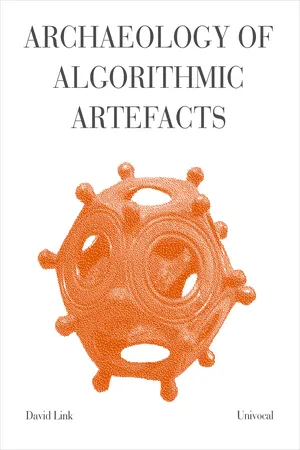
As historical processes increasingly become steeped in technology, it becomes more necessary for a discipline to emerge that is capable of comprehending these materialities to better understand the fields they inundate such as science, art, and warfare. This effort is further compromised by the inherent complexity and complete arbitrariness of technical languages—especially when they are algorithmic—along with the rapid pace in which they become obsolete, unintelligible, or simply forgotten. The Turing Machine plays a central role in the Archaeology of Algorithmic Artefacts, wherein the gradual developments of the individual components encompassed by this complex technology are placed within the context of engineering sciences and the history of inventions. This genealogy also traces the origin of the computer in mathematics, meta-mathematics, combinatorics, cryptology, philosophy, and physics. The investigations reveal that the history of apparatuses that process signs is in no way limited to the second half of the twentieth century; rather, it is possible they existed at all times and in all cultures.
- 215 pages
- English
- PDF
- Available on iOS & Android
eBook - PDF
Archaeology of Algorithmic Artefacts
About this book
Information
Topic
PhilosophySubtopic
Philosophy History & TheoryTable of contents
- Cover
- Title Page
- Copyright
- Table of Contents
- Archaeology of Algorithmic Artefacts
- Introduction
- while(true): On the Fluidity of Signs in Hegel, Gödel, and Turing
- Traces of the Mouth: Andrei Andreyevich Markov’s Mathematisation of Writing
- There Must Be an Angel: On the Beginnings of the Arithmetics of Rays
- Enigma Rebus: Prolegomena to an Archaeology of Algorithmic Artefacts
- Ressurecting the Bomba Kryptologiczna: A Reconstruction of the Polish Crypto Device
- Scrambling T-R-U-T-H: Rotating Letters as a Form of Thought
- Programming ENTER: Christopher Strachey’s Draughts Programme
- Programming Degree Zero: A Genealogy of Turing’s Machines and Algorithms
- Bibliographic References
- Picture Credits
Trusted by 375,005 students
Access to over 1.5 million titles for a fair monthly price.
Study more efficiently using our study tools.
Frequently asked questions
Yes, you can cancel anytime from the Subscription tab in your account settings on the Perlego website. Your subscription will stay active until the end of your current billing period. Learn how to cancel your subscription
No, books cannot be downloaded as external files, such as PDFs, for use outside of Perlego. However, you can download books within the Perlego app for offline reading on mobile or tablet. Learn how to download books offline
Perlego offers two plans: Essential and Complete
- Essential is ideal for learners and professionals who enjoy exploring a wide range of subjects. Access the Essential Library with 800,000+ trusted titles and best-sellers across business, personal growth, and the humanities. Includes unlimited reading time and Standard Read Aloud voice.
- Complete: Perfect for advanced learners and researchers needing full, unrestricted access. Unlock 1.5M+ books across hundreds of subjects, including academic and specialized titles. The Complete Plan also includes advanced features like Premium Read Aloud and Research Assistant.
We are an online textbook subscription service, where you can get access to an entire online library for less than the price of a single book per month. With over 1.5 million books across 990+ topics, we’ve got you covered! Learn about our mission
Look out for the read-aloud symbol on your next book to see if you can listen to it. The read-aloud tool reads text aloud for you, highlighting the text as it is being read. You can pause it, speed it up and slow it down. Learn more about Read Aloud
Yes! You can use the Perlego app on both iOS and Android devices to read anytime, anywhere — even offline. Perfect for commutes or when you’re on the go.
Please note we cannot support devices running on iOS 13 and Android 7 or earlier. Learn more about using the app
Please note we cannot support devices running on iOS 13 and Android 7 or earlier. Learn more about using the app
Yes, you can access Archaeology of Algorithmic Artefacts by David Link in PDF and/or ePUB format, as well as other popular books in Philosophy & Philosophy History & Theory. We have over 1.5 million books available in our catalogue for you to explore.