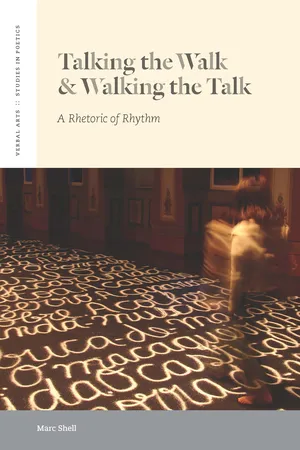
This book argues that we should regard walking and talking in a single rhythmic vision. In doing so, it contributes to the theory of prosody, our understanding of respiration and looking, and, in sum, to the particular links, across the board, between the human characteristics of bipedal walking and meaningful talk.
The author first introduces the philosophical, neurological, anthropological, and aesthetic aspects of the subject in historical perspective, then focuses on rhetoric and introduces a tension between the small and large issues of rhythm. He thereupon turns his attention to the roles of breathing in poetry—as a life-and-death matter, with attention to beats and walking poems. This opens onto technical concepts from the classical traditions of rhetoric and philology.
Turning to the relationship between prosody and motion, he considers both animals and human beings as both ostensibly able-bodied creatures and presumptively disabled ones. Finally, he looks at dancing and writing as aspects of walking and talking, with special attention to motion in Arabic and Chinese calligraphy.
The final chapters of the book provide a series of interrelated representative case studies.
- 224 pages
- English
- ePUB (mobile friendly)
- Available on iOS & Android
eBook - ePub
About this book
Trusted by 375,005 students
Access to over 1.5 million titles for a fair monthly price.
Study more efficiently using our study tools.
Information
Publisher
Fordham University PressYear
2015Print ISBN
9780823256839
9780823256822
eBook ISBN
9780823256853
1. Starting Out
Prologue and Preamble
I will . . . talk with you, walk with you . . .
—Shylock, The Merchant of Venice1
Concerning the apparent similitude of talking and walking, or voice and attitude, Ralph Waldo Emerson cites authority in his essay “The Conduct of Life” (1860). Emerson remarks that the French novelist Honoré de “Balzac left in manuscript form a chapter, which he called Theory of Walking [Théorie de la demarche]” (1833). In that essay, reports Emerson, Balzac put forth the argument that “the look, the voice, the respiration, and the attitude or walk, are identical.”2 In this work, I hope to contribute to understanding an intellectual requirement to regard walking and talking in a single rhythm vision. In so doing, I will contribute also to theory of prosody, understanding of respiration and look, and, in sum, to particular links, across the board, between the human characteristic of biped walking and meaningful talk.
The first three sections of this opening chapter introduce a few philosophical, neurological, anthropological, and aesthetic aspects of the subject in historical perspective. The following sections focus on rhetoric and introduce a tension between the small and large issues of rhythm. The fourth section considers the roles of breathing in poetry as a life-and-death matter, with attention to beats and walking poems. In this way, we begin to introduce relevant technical concepts from the classical traditions, usually originally ancient Greek and Roman, of rhetoric and philology. The fifth section involves the relationship between prosody and motion, including in its purview both animals and human beings as well as both ostensibly able-bodied creatures and presumptively disabled ones. Finally, the sixth section focuses on dancing and writing as aspects of walking and talking, with special attention to motion in Arabic and Chinese calligraphy.
Chapters 3 through 7 provide a select series of interrelated representative case studies that both expand upon problems raised in the first chapter and take off from them. The order of “case studies” is roughly chronological, as the chapter and section titles indicate. The obvious exception is the first case study, which takes place, at least according to the Bible, when worldly or fallen time has not quite begun. All chapters here group texts by theme, rhetorical terminology, or artistic medium. Each chapter deals with different issues surrounding the prosody and psychology of walking as talking: talking animals, verbally or pedally disabled creatures, dancing and singing, and what some psychiatrists call “the vertigo of walking.” The various works discussed in the latter parts of this book shed light on the issues introduced in earlier chapters, while at the same time illuminating the texts under discussion. These parts of Talking the Walk & Walking the Talk walk the talk and crisscross the paths.
As we amble toward the Postamble and Epilogue, we come to consider uniquely reduplicative aspects of the English language that inform Talking the Walk & Walking the Talk. We also return then to the neurology of walking and talking understood as a single activity, to the anthropology of people from different cultures walking as well as talking in different ways, and to the politics of crowds and herds on the march. This “rhetoric of rhythm” then moves to the question of how human thinkers have often been distracted from the question of what constitutes acceptable argumentation in rhetoric and prosody. There follows the topic of ability or disability in walking and talking and, at the finish line, a reconsideration of what remains to do.
Talking the Walk & Walking the Talk originates from two of my lately published books. One of these, Polio and Its Aftermath, is partly about the more-or-less permanently paralyzed ability to walk. The other book, Stutter, is about the more-or-less temporarily paralyzed ability to talk. “What does talking have to do with walking?” “What do the vocal and the pedal have in common?”3 In what way can we say that “Talking the walk” matches up with “Walking the talk”? Those are questions students at Harvard have asked me while attending seminars of mine on the subject of motional ability and disability. This book, in which lameness and frailty are integral aspects of the subject matter, is an elaboration of one way to answer their broad-based questions.4
Talking and Walking
Only thoughts reached by walking have value.
—Friedrich Nietzsche, Twilight of the Idols5
Let me begin with something seriously meant—that is, philosophically intending—to be funny. In the Marilyn Monroe movie called Let’s Make Love (1960)—ghostwritten by her husband, the playwright Arthur Miller—Milton Berle, the then much celebrated vaudeville and television comedian, plays himself as the funniest man in the world. Berle tries to teach the richest man in the world—played by Marilyn Monroe’s on-screen paramour and off-screen adulterous lover, Yves Montand—to walk spastically like a stumbling “dodo” while simultaneously to talk stutteringly like a real “d-duh.” The funniest man in the world (Berle) tells the richest man in the world (Montand) that that’s what cracks them up—makes people laugh—every single time he does it. The vaudeville comedian’s practiced pratfalls on a slippery banana peel (a favorite act), from this point of view, matches his careful slips of the tongue (likewise a favored act).
Like it or not, Milton Berle was no fool. The stumbling, stuttering walky-talky on stage was funny. At least in “The West.” It works every time.
Yet, at the same time, there are legendary figures who aren’t so funny when they talk or walk haltingly. Among these would be the oh-so-serious Greek, staff-bearing, crippled punster, tyrant Oedipus and the utterly foundational Jewish/Egyptian staff-bearing stutterer Prince Moses. They too walk and talk crookedly, even to the point where they are entirely stoppered. (Moses’s need for his staff, a prosthetic leg, matches his need for his brother Aaron, a prosthetic mouth.) What gives there? One seems almost to require a theory of walk-dance and/or stutter-talk.
For one thing, these presumably disabled talky-walkies at the font of Western civilization—the Jewish Moses and the Greek Oedipus—are not “orthodox” philosophers, at least not in the usual exoteric sense of philosophy. Moreover, in fact, in traditional philosophy at least, walking and talking well go together. The Western languages, at the least, often suggest as much. Consider the case of English. “To be straight,” or orthos, in English, means, among other things, both “talk the talk” and at the same time “walk the walk.” Thinkers have long insisted that talking philosophically requires walking meditatively.
Plato’s little joke is that Thales of Miletus fell down into a hole in the earth because he was meditating linguistically on the stars above while walking. The Greek Aristotle has his conversational philosophical academy in a peripatetic grove intended for walking while talking. Walking meditation (cankama) has been one of the popular methods for mind development in Buddhism ever since the Buddha’s time. The French Rousseau writes in his Confessions, “I am unable to reflect when I am not walking: the moment I stop, I think no more, and as soon as I am again in motion my head resumes its workings”; he almost proves as much, solvitur ambulando, in his Reveries of a Solitary Walker. Just as Saint John claims (in his Gospel), “In the beginning was the word [logos],” so cultural anthropologist Marvin Harris declares (in his Our Kind), “In the beginning was the foot.”6
The Huguenot-American Thoreau says that, in order to enter into oneself, or s’entrer—or to enter into the Mosaic Holy Land, or Saint Terre—one must saunter, or walk about. (The OED rejects Thoreau’s etymology of saunter as coming from s’auntrer, “to venture into oneself.”)7 It seems almost to follow for Thoreau that one born without “walking legs,” so called, cannot be a philosopher: “It requires a direct dispensation from heaven to become a walker. You must be born into the family of the Walkers. “Ambulator nascitur, non fit [The walker is born, not made].”
Wallace Stevens, who claimed to keep his insurance work and poetry writing separate, composed his poems while walking to and from work. The young German dialectician—and stutterer8—Hegel, whose first publication was a sort of tourist’s walking-guide to part of Switzerland, would have hiked with the great geologist and walker Horace-Bénédict de Saussure in the Swiss Alps in order to produce his first publications. (Saussure was the first to promote the idea of climbing Mount Blanc and of the greater “Alpine walking tour.”) The so-called Philosophers’ Path in Kyoto (Japan) derives its name because the philosopher Kitaro Nishida used to walk the path to meditate. Heidelberg (Germany) has its Philosophenweg. The twentieth-century Martin Heidegger likewise had his Black Forest walks before and during his philosophical lectures. How come this widespread coincidence of vocal and pedal?
I am hesitant to follow the lead of such writers as Rebecca Solnit in her popularizing Wanderlust: A History of Walking (2000), who suggests more than argues that “the rhythm of walking generates a kind of rhythm of thinking.”9 (Gretel Ehrlich likewise writes, “Walking is also an ambulation of mind.”)10 We will return to this notion. Maybe,...
Table of contents
- Cover
- Contents
- 1. Starting Out: Prologue and Preamble
- 2. Walking Voices
- 3. Trips of the Tongue in Hamlet (1600)
- 4. Talking Cures
- 5. Walkie Talkies
- 6. Marching and Heiling in The Great Dictator (1940)
- 7. Knock-Kneed and Tongue-Tied in The King’s Speech (2010)
- 8. Sign Languages
- 9. Postamble and Epilogue
- Notes
- Index
Frequently asked questions
Yes, you can cancel anytime from the Subscription tab in your account settings on the Perlego website. Your subscription will stay active until the end of your current billing period. Learn how to cancel your subscription
No, books cannot be downloaded as external files, such as PDFs, for use outside of Perlego. However, you can download books within the Perlego app for offline reading on mobile or tablet. Learn how to download books offline
Perlego offers two plans: Essential and Complete
- Essential is ideal for learners and professionals who enjoy exploring a wide range of subjects. Access the Essential Library with 800,000+ trusted titles and best-sellers across business, personal growth, and the humanities. Includes unlimited reading time and Standard Read Aloud voice.
- Complete: Perfect for advanced learners and researchers needing full, unrestricted access. Unlock 1.5M+ books across hundreds of subjects, including academic and specialized titles. The Complete Plan also includes advanced features like Premium Read Aloud and Research Assistant.
We are an online textbook subscription service, where you can get access to an entire online library for less than the price of a single book per month. With over 1.5 million books across 990+ topics, we’ve got you covered! Learn about our mission
Look out for the read-aloud symbol on your next book to see if you can listen to it. The read-aloud tool reads text aloud for you, highlighting the text as it is being read. You can pause it, speed it up and slow it down. Learn more about Read Aloud
Yes! You can use the Perlego app on both iOS and Android devices to read anytime, anywhere — even offline. Perfect for commutes or when you’re on the go.
Please note we cannot support devices running on iOS 13 and Android 7 or earlier. Learn more about using the app
Please note we cannot support devices running on iOS 13 and Android 7 or earlier. Learn more about using the app
Yes, you can access Talking the Walk & Walking the Talk by Marc Shell in PDF and/or ePUB format, as well as other popular books in Literature & Literary Criticism. We have over 1.5 million books available in our catalogue for you to explore.