The history of equity takes in questions of philosophy, theology, jurisprudence and legal history.
When we speak of 'equity', do we mean Aristotelian epieikeia, civilian aequitas, a theological or juridical conscience, the common law concept of the 'equity of the statute', or merely the rules applied by the Court of Chancery before 1875? The purpose of this volume is to chart the evolution of equity in English legal history from the medieval period to the present day. Whether by investigating the historical foundations of the modern law, the jurisprudential underpinnings of the equitable jurisdiction, or the socio-political context of discrete legal developments, this collection exposes the strands of thought which 'equity' comprises and the mechanisms by which its rules evolved.
- English
- ePUB (mobile friendly)
- Available on iOS & Android
eBook - ePub
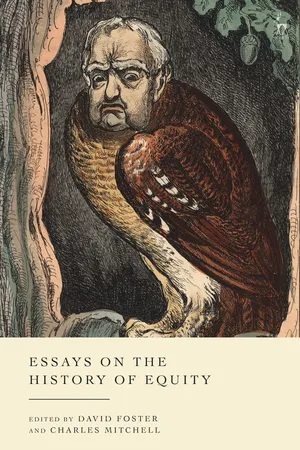
Essays on the History of Equity
About this book
Information
Table of contents
- Cover
- Dedication
- Title Page
- Contents
- List of Contributors
- 1. Historical Foundations of English Equity
- 2. Semantics of Conscience in Medieval Law
- 3. The Statute of Richard III (1484) and the Emergence of Beneficial Ownership in Freehold Land
- 4. Epieikeia and the Common Law: The Rise and Fall of Equitable Interpretation of English Statutes
- 5. Conceptualising Conscience in the Early Tudor Conciliar Courts
- 6. The Ravenstone Litigation and the Jurisdiction of Chancery
- 7. Aspects of Equity in 1600: Wills, Forfeitures and Trusts
- 8. Concepts of Equity in Hake’s Epieikeia
- 9. ‘Equitatis Causa’: ‘Equity’ in the Practice of the Court of Chancery, 1515–1615
- 10. Insolvent Debtors in Law and Equity, 1543–1624
- 11. Enforcing Equitable Rights against Non-Privies, c. 1590–1680
- 12. A Re-examination of the Expectant Heir in Seventeenth-Century Chancery
- 13. Equity Agreement Doctrine in the Early Eighteenth Century
- 14. Women, Infants and ‘Lunatics’ before the Court of Chancery in the Wake of the South Sea Bubble
- 15. Constructive Fraud in the Time of Hardwicke and Thurlow
- 16. Family Trustees and their Duties, c. 1740–1820
- 17. Public Trusts, 1750–1850
- 18. Equity and Legal Change, 1760–1875
- 19. Equity, Legal Coding, and the Foundations of Banking: Foley v Hill (1838–48)
- 20. Accounting and Breach of Trust in the Nineteenth Century
- 21. Equity after Fusion: The View from Legal Treatises
- Copyright Page
Trusted by 375,005 students
Access to over 1.5 million titles for a fair monthly price.
Study more efficiently using our study tools.
Frequently asked questions
Yes, you can cancel anytime from the Subscription tab in your account settings on the Perlego website. Your subscription will stay active until the end of your current billing period. Learn how to cancel your subscription
No, books cannot be downloaded as external files, such as PDFs, for use outside of Perlego. However, you can download books within the Perlego app for offline reading on mobile or tablet. Learn how to download books offline
Perlego offers two plans: Essential and Complete
- Essential is ideal for learners and professionals who enjoy exploring a wide range of subjects. Access the Essential Library with 800,000+ trusted titles and best-sellers across business, personal growth, and the humanities. Includes unlimited reading time and Standard Read Aloud voice.
- Complete: Perfect for advanced learners and researchers needing full, unrestricted access. Unlock 1.5M+ books across hundreds of subjects, including academic and specialized titles. The Complete Plan also includes advanced features like Premium Read Aloud and Research Assistant.
We are an online textbook subscription service, where you can get access to an entire online library for less than the price of a single book per month. With over 1.5 million books across 990+ topics, we’ve got you covered! Learn about our mission
Look out for the read-aloud symbol on your next book to see if you can listen to it. The read-aloud tool reads text aloud for you, highlighting the text as it is being read. You can pause it, speed it up and slow it down. Learn more about Read Aloud
Yes! You can use the Perlego app on both iOS and Android devices to read anytime, anywhere — even offline. Perfect for commutes or when you’re on the go.
Please note we cannot support devices running on iOS 13 and Android 7 or earlier. Learn more about using the app
Please note we cannot support devices running on iOS 13 and Android 7 or earlier. Learn more about using the app
Yes, you can access Essays on the History of Equity by David Foster,Charles Mitchell in PDF and/or ePUB format, as well as other popular books in Law & Estates & Trusts Law. We have over 1.5 million books available in our catalogue for you to explore.