eBook - ePub
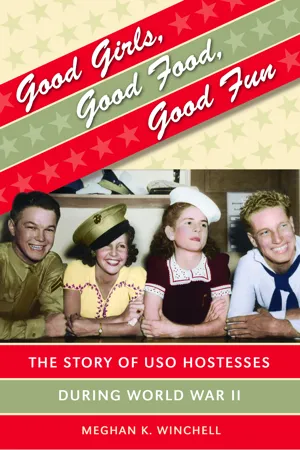
Good Girls, Good Food, Good Fun
The Story of USO Hostesses during World War II
- 272 pages
- English
- ePUB (mobile friendly)
- Available on iOS & Android
eBook - ePub
About this book
Throughout World War II, when Saturday nights came around, servicemen and hostesses happily forgot the war for a little while as they danced together in USO clubs, which served as havens of stability in a time of social, moral, and geographic upheaval. Meghan Winchell demonstrates that in addition to boosting soldier morale, the USO acted as an architect of the gender roles and sexual codes that shaped the “greatest generation.”
Combining archival research with extensive firsthand accounts from among the hundreds of thousands of female USO volunteers, Winchell shows how the organization both reflected and shaped 1940s American society at large. The USO had hoped that respectable feminine companionship would limit venereal disease rates in the military. To that end, Winchell explains, USO recruitment practices characterized white middle-class women as sexually respectable, thus implying that the sexual behavior of working-class women and women of color was suspicious. In response, women of color sought to redefine the USO’s definition of beauty and respectability, challenging the USO’s vision of a home front that was free of racial, gender, and sexual conflict.
Despite clashes over class and racial ideologies of sex and respectability, Winchell finds that most hostesses benefited from the USO’s chaste image. In exploring the USO’s treatment of female volunteers, Winchell not only brings the hostesses' stories to light but also supplies a crucial missing piece for understanding the complex ways in which the war both destabilized and restored certain versions of social order.
Combining archival research with extensive firsthand accounts from among the hundreds of thousands of female USO volunteers, Winchell shows how the organization both reflected and shaped 1940s American society at large. The USO had hoped that respectable feminine companionship would limit venereal disease rates in the military. To that end, Winchell explains, USO recruitment practices characterized white middle-class women as sexually respectable, thus implying that the sexual behavior of working-class women and women of color was suspicious. In response, women of color sought to redefine the USO’s definition of beauty and respectability, challenging the USO’s vision of a home front that was free of racial, gender, and sexual conflict.
Despite clashes over class and racial ideologies of sex and respectability, Winchell finds that most hostesses benefited from the USO’s chaste image. In exploring the USO’s treatment of female volunteers, Winchell not only brings the hostesses' stories to light but also supplies a crucial missing piece for understanding the complex ways in which the war both destabilized and restored certain versions of social order.
Frequently asked questions
Yes, you can cancel anytime from the Subscription tab in your account settings on the Perlego website. Your subscription will stay active until the end of your current billing period. Learn how to cancel your subscription.
No, books cannot be downloaded as external files, such as PDFs, for use outside of Perlego. However, you can download books within the Perlego app for offline reading on mobile or tablet. Learn more here.
Perlego offers two plans: Essential and Complete
- Essential is ideal for learners and professionals who enjoy exploring a wide range of subjects. Access the Essential Library with 800,000+ trusted titles and best-sellers across business, personal growth, and the humanities. Includes unlimited reading time and Standard Read Aloud voice.
- Complete: Perfect for advanced learners and researchers needing full, unrestricted access. Unlock 1.4M+ books across hundreds of subjects, including academic and specialized titles. The Complete Plan also includes advanced features like Premium Read Aloud and Research Assistant.
We are an online textbook subscription service, where you can get access to an entire online library for less than the price of a single book per month. With over 1 million books across 1000+ topics, we’ve got you covered! Learn more here.
Look out for the read-aloud symbol on your next book to see if you can listen to it. The read-aloud tool reads text aloud for you, highlighting the text as it is being read. You can pause it, speed it up and slow it down. Learn more here.
Yes! You can use the Perlego app on both iOS or Android devices to read anytime, anywhere — even offline. Perfect for commutes or when you’re on the go.
Please note we cannot support devices running on iOS 13 and Android 7 or earlier. Learn more about using the app.
Please note we cannot support devices running on iOS 13 and Android 7 or earlier. Learn more about using the app.
Yes, you can access Good Girls, Good Food, Good Fun by Meghan K. Winchell in PDF and/or ePUB format, as well as other popular books in Social Sciences & World War II. We have over one million books available in our catalogue for you to explore.
Information
Chapter 1: To Make the Boys Feel at Home: Senior Hostesses and Gendered Citizenship
In 1943, Helen Scheidel and her sister Marge attended USO dances at Mayor Kelly’s Servicemen’s Center in Chicago, once a month on Saturday nights. As a single eighteen-year-old, Helen represented the typical junior hostess, famous for jitterbugging across the dance floor with fresh-faced soldiers and sailors. Helen and the other junior hostesses at the center “tried to not let someone sit by themselves” and eagerly listened to servicemen’s stories about their homes and families. Helen recalled that when a soldier or a sailor seemed especially anxious or distraught, however, she and her peers were “not mature enough to talk about their problems” with them. What they needed was someone “to take Mama’s place.” Helen and Marge referred these “boys” to senior hostesses, because they were there “to do serious talking.”1 Mending shirts, baking cookies, and “listening” were hardly revolutionary undertakings for middle-class women in the early 1940s in the same way that joining the Women’s Army Corps was.
Senior hostesses, usually married women over age thirty-five, clocked hundreds of thousands of hours at the USO, where they not only served as informal counselors but also sewed insignias on servicemen’s uniforms, baked sweets and made sandwiches, and chaperoned male soldiers’ and sailors’ interactions with junior hostesses. Their activities did not threaten the patriarchal order or existing gender or sexual norms. Women’s domestic work and emotional labor in USO clubs, however, were important. In her assessment of the modern welfare state, political scientist Laura Balbo details the invisibility yet necessity of women’s unpaid “emotion work” such as cooking, “counseling,” and “mothering” in upholding a capitalistic society. Sociologist Arlie Hochschild takes the idea of “emotional labor” into the public sphere to argue that feminized service professions require women to “feign” happiness and enthusiasm in order to perform their duties successfully.2 Similarly, senior hostesses engaged in emotion work by censoring their feelings while working in USO clubs to shield the servicemen in their care from anxiety created by the war. They donated their domestic and emotional labor to the military and the wartime state for personal and patriotic reasons. In doing so, they performed private tasks, previously reserved for their families, for strangers in a public setting.
While the Great Depression magnified the importance of women’s domestic skills for a short time by highlighting their ability to tighten the household budget, women’s household labor regularly went unnoticed unless it was absent. Historians have given female volunteers, senior hostesses in particular, much the same treatment. Senior hostesses completed work for servicemen and servicewomen in USO clubs that women had always done, and this helped to erase its historical significance.3 For example, historian D’Ann Campbell concludes that women’s volunteer work for the USO and the Red Cross did little to affect the prosecution of the war. Instead, their volunteer efforts served to make elite and middle-class women feel good about answering the government’s call for women’s wartime support. Campbell more thoroughly discusses women’s volunteer work for the Red Cross than she does for the USO, and this might have prompted her to conclude that senior hostesses’ work had little real value.4 When the USO creeps into popular memory, furthermore, it is junior hostesses like Marge and Helen Scheidel who represent the organization, not their older married counterparts who kept the clubs functioning throughout the war.
Senior hostesses reinforced their primary peacetime roles as mothers and caregivers5 and made their services as such available to the military, thereby performing a gendered form of citizenship. According to historian Linda Kerber, liberal citizenship entails a set of reciprocal obligations in which citizens repay the state for a general sense of security and basic provisions with their service and deference. During World War II, the state expected men to take up arms in the nation’s defense but contributed to the “popular understanding [that] defin[ed] women as fulfilling their civic obligation within their homes,”6 even as it encouraged some women to work as welders in heavy industry. Historian Lizabeth Cohen’s argument that the consumer role of women grew during the war dovetails with Kerber’s notion that the state preferred women’s wartime contribution to be an extension of their gendered familial obligations. For example, the Office of Price Administration (OPA) complimented women who followed strict rationing guidelines and who monitored other women’s use of ration points. Women who used their “purchasing power” for moral ends, whether as paid government employees or volunteers for various OPA committees, increased their “active public role” as supporters of the wartime government and of the war itself.7 Likewise, senior hostesses felt privileged and obligated to volunteer their time to an organization like the USO that was assisting the 16 million young men, maybe even their sons, in uniform. These women converted public clubs and canteens into “feminine” spaces by infusing them with the behaviors, amenities, and cuisine of home. As they nurtured American “boys” in the armed services, senior hostesses implicitly consented to the loss of their own sons. By replicating the sentiments and structures of home, these women performed a vital task for the military. Their actions tacitly encouraged young men to sacrifice their careers and perhaps their lives for a civilian world from which they were physically, and even emotionally, disconnected.
WHILE THE GOVERNMENT spending that accompanied the U.S. entrance into World War II brought the country out of the Great Depression, the war did not end older ideas rooted in the 1920s about women’s function within families and within the workforce. Depression-era middle-class women who were not impoverished by the economic crisis met their family’s needs by making “small economies” that stretched a husband’s paycheck to cover basic expenses. Many middle-class women entered World War II having already honed the skills necessary to save money and to follow the rules of rationing set out by the OPA. These skills would prove useful as they baked treats for servicemen, and for their own families, as USO senior hostesses. Those who chose to work during the Depression and were able to find feminized jobs such as secretarial positions did so to provide the better-than-average standard of living to which the family had become accustomed in the 1920s. By 1941, married women workers in particular had also dealt with a barrage of negative publicity accusing them of taking men’s jobs and sending them the obvious message that they ought to stay out of the workforce.8 From the National Economy Act of 1932, which required workforce reductions to begin with employees who had a spouse in the civil service, to restrictions on married teachers to articles in Ladies’ Home Journal that reminded women that their husbands’ careers were more important than their own, women learned that questions about their femininity and commitment to marriage accompanied work for pay. While women’s participation in the labor force increased marginally in the 1930s, a large number of middle-class women remained out of the paid labor force.9 It would be the women who had learned to live within a tight budget during the Depression and who had a conflicted relationship with paid labor who would form the most obvious volunteer pool for the USO in 1941.
World War II prescriptive literature generated by the media claimed that it was the responsibility of women to contribute to the war effort through volunteerism, including domestic activities sponsored by the USO. Prior to the Japanese attack on Pearl Harbor, most women’s magazines reflected their readers’ isolationism. Afterward, however, periodicals such as Ladies’ Home Journal endorsed U.S. involvement in the war. These magazines and other prescriptive literature helped women who had feared the dangers of war join home front mobilization efforts.10 In her 1943 advice book Arms and the Girl, Mary McBride argued, “The intangibles of morale have always been women’s peculiar concern.”11 The USOBulletin attempted to harness women’s caretaking work for the war when it advised local clubs to enlist women in its projects, because “maintenance of morale can be largely a housekeeping job.”12 The National Catholic Community Service (NCCS) believed that women could uniquely contribute to the USO because “all of them have a prayer in their hearts, either consciously or subconsciously.”13 In its view, women possessed an innate spirituality necessary to lift soldiers’ spirits. Many women agreed with this sentiment and responded by offering their time to the USO. When Hattiesburg, Mississippi, opened a USO club for white servicemen in 1941, it had 14 senior hostesses. By 1942, 1,022 senior hostesses were volunteering there, and these numbers reached their peak in 1943 with 1,824 senior hostess volunteers.14 Volunteer work appealed to women who did not have young children at home or who could afford to hire someone to watch their children in their absence.15 At the same time that opportunities were growing for women in industry and in the armed services, many middle-class women continued to find their niche in volunteerism. One-quarter of American women volunteered their free time to various relief agencies throughout the war.16 This decision to volunteer was in keeping with American women’s history of volunteerism. Throughout conflicts including the Revolutionary and Civil Wars as well as World War I, many women in the United States offered material and emotional comfort to servicemen that augmented the inadequate supply of both provided by the military.17
For African American soldiers, the absence of these comforts was pronounced. According to its policy, the USO made its services available to all soldiers and sailors regardless of race.18 It attempted to do this, however, within a national culture that segregated the military and public places throughout the country either by law or custom. Historian Megan Taylor Shockley illuminates the ways in which local white communities shortchanged African American soldiers by not providing them with adequate USO facilities. African American clubwomen raised money to expand USO services and facilities for black servicemen in Detroit and Richmond.19 Individual women also volunteered to improve conditions for black service personnel. Mrs. Mallie B. Williams responded to the USO’s request for volunteers and asked the National Association for the Advancement of Colored People (NAACP) for information to help her create a USO club in Jacksonville, North Carolina. She had previously volunteered for a USO club in Massachusetts and recently had moved to Jacksonville. She observed that African American servicemen there “badly” needed a club. Williams believed that it was “the colored peoples [sic] fault here why they haven’t been entertained and treated as servicemen should be treated. The white [sic] have a USO and I feel sure that we should have one.” Williams implied that the African American community in Jacksonville had not taken the initiative to form a club, as she was doing. Cash shortages within the local black community and black women’s need to work for pay, more than lack of interest in servicemen’s well-being, might also have explained the absence of a USO club for black marines in Jacksonville. As were thousands of women throughout the country, Williams was “eager to give [her] service” to soldiers and sailors through the USO.20 The national USO depended on the service of women like Williams to fill the gaps it left as it cheated black servicemen of the comforts it afforded white men. As senior hostesses, black middle-class clubwomen seized the opportunity to transform their volunteer work into a bid for full citizenship rights. Black women found power in assisting the USO because they could then use their work to justify making claims for full citizenship from the government.21 Rather than erase race from the home front, the USO’s inadequacies, along with black women’s responses to them, made race and racial conflict more visible.
Women and men within the black community also transformed USO clubs, such as the South Broad Street USO in Philadelphia, into pla...
Table of contents
- Cover Page
- Good Girls, Good Food, Good Fun: The Story of Uso Hostesses During World War II
- Copyright Page
- Dedication
- Contents
- Introduction
- Chapter 1: To Make the Boys Feel at Home: Senior Hostesses and Gendered Citizenship
- Chapter 2: The Loveliest Girls in the Nation
- Chapter 3: Wartime Socializing
- Chapter 4: Nice Girls Didn’t, Period: Junior Hostesses and Sexual Service
- Chapter 5: Courtship and Competition in the USO Dance Hall
- Conclusion
- Appendix
- Notes
- Bibliography
- Acknowledgments
- Index