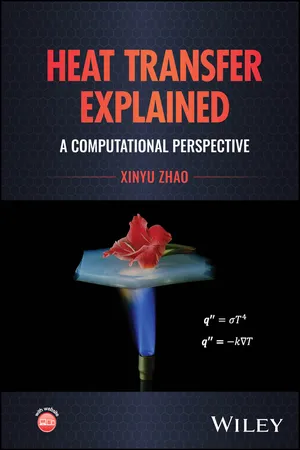
PROVIDES A CONCISE COMPUTATIONAL APPROACH TO HEAT TRANSFER FUNDAMENTALS WITH PYTHON-BASED PROBLEM-SOLVING APPLICATIONS
Heat transfer is a foundational topic in engineering, bridging theory and application across fields such as mechanical, aerospace, chemical, electrical, and fire engineering. Yet students often find it challenging due to its heavy mathematical content and abstract concepts. Heat Transfer Explained: A Computational Perspective meets this challenge by introducing heat transfer through a clear, structured approach that integrates traditional fundamentals with accessible computational methods. Designed to align with the typical heat transfer course syllabus, this textbook systematically covers conduction, convection, and radiation.
Each chapter integrates Python code presented in pseudocode notation, providing reusable "recipes" to solve modern heat transfer problems. This approach makes the content accessible for those with limited programming experience while still offering rigor for advanced learners. Application-based examples and learning objectives guide students through each concept, supported by a final chapter with multi-modal case studies that illustrate the integration of different heat transfer modes. The textbook encourages active learning throughout, bridging prerequisite knowledge with new material to equip students with both theoretical and computational skills.
- Explains heat transfer fundamentals through a computational lens to improve conceptual understanding
- Covers essential topics including conduction, forced convection, natural convection, phase change, and radiation through surface-to-surface exchange and participating media
- Includes examples of practical engineering applications for each mode of heat transfer
- Offers an online companion site with Jupyter Notebook files
- Aligns with standard heat transfer course syllabi for undergraduate and graduate engineering programs
Heat Transfer Explained: A Computational Perspective is designed for undergraduate and graduate students in Heat Transfer, Computational Methods for Heat Transfer, and related courses in mechanical, aerospace, and chemical engineering programs. It is also an excellent reference for early-career engineers and professionals in industry who need to strengthen their computational skills in solving heat transfer problems.