As the culture of commercial capitalism came to dominate nineteenth-century New England, it changed people’s ideas about how the world functioned, the nature of their work, their relationships to one another, and even the way they conceived of themselves as separate individuals. Drawing on the work of the last twenty years in New England social history, Mary Cayton argues that Ralph Waldo Emerson’s work and career, when seen in the context of the momentous changes in the culture and economics of the region, reveal many of the tensions and contradictions inherent in the new capitalist social order. In exploring the genesis of liberal humanism as a calling in the United States, this case study implicitly poses questions about its assumptions, its aspirations, and its failings.
Cayton traces the ways in which the social circumstances of Emerson’s Boston gave rise to his philosophy of natural organicism, his search for an appropriate definition of the intellectual’s role within society, and his exhortations to individuals to distrust the norms and practices of the mass culture that was emerging. She addresses the historical context of Emerson’s emergence as a writer and orator and undertakes to describe the Federalism and Unitarianism in which Emerson grew up, explaining why he eventually rejected them in favor of romantic transcendentalism.
Cayton demonstrates how Emerson’s thought was affected by the social pressures and ideological constructs that launched the new cultural discourse of individualism. A work of intellectual history and American studies, this book explores through Emerson’s example the ways in which intellectuals both make their cultures and are made by them.
eBook - ePub
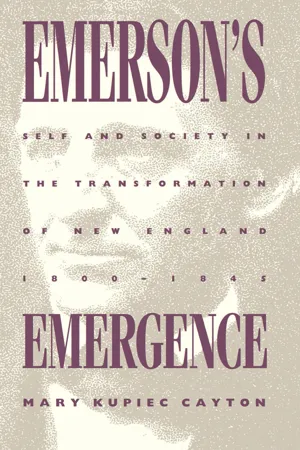
Emerson's Emergence
Self and Society in the Transformation of New England, 1800-1845
- 322 pages
- English
- ePUB (mobile friendly)
- Available on iOS & Android
eBook - ePub
Emerson's Emergence
Self and Society in the Transformation of New England, 1800-1845
About this book
Information
Table of contents
- Cover Page
- Title Page
- Copyright Page
- Contents
- Preface
- Part I: Organicism
- Part 2: Vocation
- Part 3: The Discovery of Self
- Afterword: Emerson and the Culture of Bourgeois Individualism
- Notes
- Bibliographic Essay
- Index
Trusted by 375,005 students
Access to over 1.5 million titles for a fair monthly price.
Study more efficiently using our study tools.
Frequently asked questions
Yes, you can cancel anytime from the Subscription tab in your account settings on the Perlego website. Your subscription will stay active until the end of your current billing period. Learn how to cancel your subscription
No, books cannot be downloaded as external files, such as PDFs, for use outside of Perlego. However, you can download books within the Perlego app for offline reading on mobile or tablet. Learn how to download books offline
Perlego offers two plans: Essential and Complete
- Essential is ideal for learners and professionals who enjoy exploring a wide range of subjects. Access the Essential Library with 800,000+ trusted titles and best-sellers across business, personal growth, and the humanities. Includes unlimited reading time and Standard Read Aloud voice.
- Complete: Perfect for advanced learners and researchers needing full, unrestricted access. Unlock 1.5M+ books across hundreds of subjects, including academic and specialized titles. The Complete Plan also includes advanced features like Premium Read Aloud and Research Assistant.
We are an online textbook subscription service, where you can get access to an entire online library for less than the price of a single book per month. With over 1.5 million books across 990+ topics, we’ve got you covered! Learn about our mission
Look out for the read-aloud symbol on your next book to see if you can listen to it. The read-aloud tool reads text aloud for you, highlighting the text as it is being read. You can pause it, speed it up and slow it down. Learn more about Read Aloud
Yes! You can use the Perlego app on both iOS and Android devices to read anytime, anywhere — even offline. Perfect for commutes or when you’re on the go.
Please note we cannot support devices running on iOS 13 and Android 7 or earlier. Learn more about using the app
Please note we cannot support devices running on iOS 13 and Android 7 or earlier. Learn more about using the app
Yes, you can access Emerson's Emergence by Mary Kupiec Cayton in PDF and/or ePUB format, as well as other popular books in History & North American History. We have over 1.5 million books available in our catalogue for you to explore.