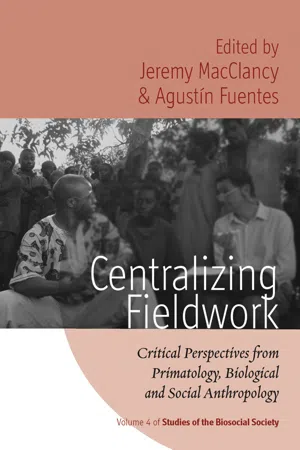
Centralizing Fieldwork
Critical Perspectives from Primatology, Biological and Social Anthropology
- 310 pages
- English
- ePUB (mobile friendly)
- Available on iOS & Android
Centralizing Fieldwork
Critical Perspectives from Primatology, Biological and Social Anthropology
About this book
Fieldwork is a central method of research throughout anthropology, a much-valued, much-vaunted mode of generating information. But its nature and process have been seriously understudied in biological anthropology and primatology. This book is the first ever comparative investigation, across primatology, biological anthropology, and social anthropology, to look critically at this key research practice. It is also an innovative way to further the comparative project within a broadly conceived anthropology, because it does not focus on common theory but on a common method. The questions asked by contributors are: what in the pursuit of fieldwork is common to all three disciplines, what is unique to each, how much is contingent, how much necessary? Can we generate well-grounded cross-disciplinary generalizations about this mutual research method, and are there are any telling differences? Co-edited by a social anthropologist and a primatologist, the book includes a list of distinguished and well-established contributors from primatology and biological anthropology.
Tools to learn more effectively

Saving Books

Keyword Search

Annotating Text

Listen to it instead
Information
Table of contents
- Cover
- Half title
- Title
- Copyright
- Contents
- List of Figures and Tables
- Acknowledgements
- 1. Centralizing Fieldwork
- 2. The Dos and Don’ts of Fieldwork
- 3. The Anthropologist as a Primatologist: Mental Journeys of a Fieldworker
- 4. Primate Fieldwork and its Human Contexts in Southern Madagascar
- 5. Problem Animals or Problem People? Ethics, Politics and Practice or Conflict between Community Perspectives and Fieldwork on Conservation
- 6. Ecological Anthropology and Primatology: Fieldwork Practices and Mutual Benefits
- 7. Lost in Translation: Field Primatology, Culture, and Interdisciplinary Approaches
- 8. Measuring Meaning and Understanding in Primatological and Biological Anthropology Fieldwork: Context and Practice
- 9. Fieldwork as Research Process and Community Engagement: Experiences from the Gambia and Afghanistan
- 10. Framing the Quantitative within the Qualitative: Why Biological Anthropologists do Fieldwork
- 11. Considerations on Field Methods Used to Assess Nonhuman Primate Feeding Behaviour and Human Food Intake in Terms of Nutritional Requirements
- 12. Anthropobiological Surveys in the Field: Reflections on the Bioethics of Human Medical and DNA Surveys
- 13. Field Schools in Central America: Playing a Pivotal Role in the Formation of Modern Field Primatologists
- 14. The Narrator’s Stance: Story-telling and Science at Berenty Reserve
- 15. Natural Homes: Primate Fieldwork and the Anthropological Method
- 16. Popularizing Fieldwork: Examples from Primatology and Biological Anthropology
- Index
Frequently asked questions
- Essential is ideal for learners and professionals who enjoy exploring a wide range of subjects. Access the Essential Library with 800,000+ trusted titles and best-sellers across business, personal growth, and the humanities. Includes unlimited reading time and Standard Read Aloud voice.
- Complete: Perfect for advanced learners and researchers needing full, unrestricted access. Unlock 1.4M+ books across hundreds of subjects, including academic and specialized titles. The Complete Plan also includes advanced features like Premium Read Aloud and Research Assistant.
Please note we cannot support devices running on iOS 13 and Android 7 or earlier. Learn more about using the app