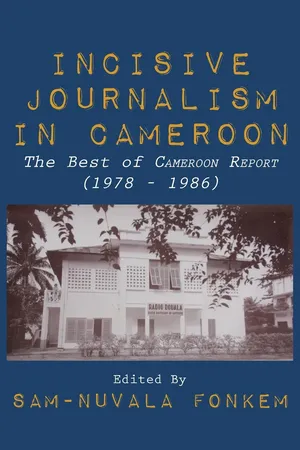
Working for Cameroon state-owned Radio in the 1970s and 80s meant toeing the official line and learning not to sing out of tune. While the rather scanty private press that existed at the time was subject to prior censorship, a different kind of censorship self-censorship prevailed at the Radio where topics for commentaries were vetted by the Minister of Information or his delegate. But for Anglophones working in a predominantly francophone environment, once topics were approved, the authorities could not be sure which direction commentaries were going to take as the journalists applied the tactics of bite and blow, sometimes giving full expression of their Anglo-Saxon spirit of debate and critical analysis as evidenced in this selection of commentaries from the Sunday morning commentary programme, Cameroon Report (now Cameroon Calling) of the late 1970s up till 1986. It is a showcase of the irrepressible seed of freedom of expression that Anglophone journalists were imbued with and demonstrated at a time when subjects related to coups dtat, human rights and governance were considered taboo. It was and shall remain the indelible input of the Anglophone character that has had a positive influence on Cameroons media landscape.
eBook - PDF
Incisive Journalism in Cameroon
The Best of ��Cameroon Report�� (1978 � 1986)
- 278 pages
- English
- PDF
- Available on iOS & Android
eBook - PDF
About this book
Trusted by 375,005 students
Access to over 1.5 million titles for a fair monthly price.
Study more efficiently using our study tools.
Information
Table of contents
- Cover
- Title page
- Copyright page
- The Editor
- Contributors
- Dedication
- Contents
- Preface
- Introduction
- Editor’s Note
- The Prologue
- 1. Cameroon Report 1/9/78: The C.N.U: Twelve Years After
- 2. Cameroon Report 18/1/81: Wum Farmer - Grazier Problem
- 3. Cameroon Report 28/3/1982: A chaotic Highway Transporters Union
- 4. Cameroon Report 5/4/81: Inhuman prison conditions
- 5. Cameroon Report 5/4/1981: Lay Private Education
- 6. Cameroon Report 5/4/1981: Health for all by year 2000
- 7. Cameroon Report 22/11/81: Catering for disabled persons
- 8. Cameroon Report 17/1/1982: Cameroon Nigeria Reconciliation
- 9. Cameroon Report 02/2/1982: The Role of our Parliamentarians
- 10. Cameroon Report 06/6/1982: Wastage and Mismanagement in Public Health Services
- 11. Cameroon Report 01/10/1982: Crackdown on Customs Fraud
- 12. Cameroon Report 24/10/1982, FONADER: Not yet the Farmer’s Bank
- 13. Cameroon Report 24/10/1982: Mount Cameroon Erupts
- 14. Cameroon Report 7/11/1982: President Ahmadou Ahidjo’s Dramatic Resignation
- 15. Cameroon Report 7/11/1982: The Task Ahead for President Paul Biya
- 16. Cameroon Report 28/11/1982: Biya and the Housing Crisis
- 17. Cameroon Report 9/7/1983: Our Ailing Parastatal Corporations
- 18. Cameroon Report 6/8/1983: The University as Brain Trust
- 19. Cameroon Report 31/3/1984: Biya on Housing and Road Construction
- 20. Cameroon Report 15/4/1984: April 6 Coup Attempt: An Appraisal
- 21. Cameroon Report 15/4/1984: In the Dawn of the Abortive Coup
- 22. Cameroon Report 21/5/1984: Reflection on May 20
- 23. Cameroon Report 9/6/1984: Parastatal Corporations Revisited
- 24. Cameroon Report 01/1/1985, Chasing Files: A Product of Centralisation
- 25. Cameroon Report 20/01/85: The Plight of our Farmers
- 26. Cameroon Report 22/4/85: The One-shift and Two-shift Working systems
- 27. Cameroon Report 25/4/1985: Decentralisation versus Decongestion
- 28. Cameroon Report 15/5/1985: 13th Anniversary of the Unitary State
- 29. Cameroon Report 25/5/1985: The Role of Development Committees
- 30. Cameroon Report 01/6/1985: 1985 Budgetary Session
- 31. Cameroon Report 30/6/1985: MUNA on Bilingualism
- 32. Cameroon Report 14/7/1985: The Concept of Development Journalism
- 33. Cameroon Report 08/8/1985: The Question of Certificate Equivalence
- 34. Cameroon Report 18/8/1985: Harmonising Our Two Legal Systems
- 35. Cameroon Report 06/10/85: The First October Story
- 36. Cameroon Report 20/5/1986, May 20th: Our Dream of a New and Great Cameroon
- 37. Cameroon Report 01/6/1986: The CPDM and Civil Liberties
- 38. News talk 24/6/86: Enemies of Democracy
- African & World Affairs
- 39. Cameroon Report 22/7/1980: Towards a New World Information Order
- 40. Cameroon Report 12/04/1981: Africa’s Five Million Refugees
- 41. Cameroon Report 07/7/1981: Boycotting sporting links with Racist South African
- 42. Cameroon Report 23/08/1981: The Proposed Senegambian confederation
- 43. Cameroon Report 04/10/1981: The I.M.F. Tightens policy towards Third World
- 44. Cameroon Report 11/10/1981: The Assassination of SADAT: Consequences on Egyptian Politics
- 45. Cameroon Report 26/10/1981: The North-South Dialogue
- 46. Cameroon Report 13/12/1981, Ciskei Homeland: Another stride for Apartheid
- 47. Cameroon Report 17/01/1982: Palestinian Autonomy
- 48. Cameroon Report 21/03/82: Cameroon’s Position on SADR’S Admission into the O.A.U
- 49. Cameroon Report 07/07/1982: The 9th Franco-African Summit
- 50. Cameroon Report 08/08/1982: OAU Deadlock over Western Sahara
- 51. Cameroon Report 03/11/1982: Foiled OAU Summit Reconvened
- 52. Cameroon Report 13/01/1985: Checking the African Dependency Syndrome
- 53. Cameroon Report 02/02/85: The O.A.U. Drought Fund
- 54. Cameroon Report 03/03/85: The Western Sahara Ten Years After
- 55. Cameroon Report 21/04/85: South Africa: Botha’s Lame Reforms
- 56. Cameroon Report 16/06/85: African Leaders in Europe
- 57. Cameroon Report 23/6/1985: South Africa’s puppet Government in Namibia
- 58. Cameroon Report 14/7/1985: Africa’s Troubled Politics
- 59. Cameroon Report 18/8/1985: Pope John Paul II in Africa
- 60. Cameroon Report 03/11/1985: Leadership Succession in Africa
- 61. Cameroon Report 11/11/1985: Reagan-Gorbachev Summit
- 62. Cameroon Report 16/11/1985: Africa and its Elections
- Back cover
Frequently asked questions
Yes, you can cancel anytime from the Subscription tab in your account settings on the Perlego website. Your subscription will stay active until the end of your current billing period. Learn how to cancel your subscription
No, books cannot be downloaded as external files, such as PDFs, for use outside of Perlego. However, you can download books within the Perlego app for offline reading on mobile or tablet. Learn how to download books offline
Perlego offers two plans: Essential and Complete
- Essential is ideal for learners and professionals who enjoy exploring a wide range of subjects. Access the Essential Library with 800,000+ trusted titles and best-sellers across business, personal growth, and the humanities. Includes unlimited reading time and Standard Read Aloud voice.
- Complete: Perfect for advanced learners and researchers needing full, unrestricted access. Unlock 1.5M+ books across hundreds of subjects, including academic and specialized titles. The Complete Plan also includes advanced features like Premium Read Aloud and Research Assistant.
We are an online textbook subscription service, where you can get access to an entire online library for less than the price of a single book per month. With over 1.5 million books across 990+ topics, we’ve got you covered! Learn about our mission
Look out for the read-aloud symbol on your next book to see if you can listen to it. The read-aloud tool reads text aloud for you, highlighting the text as it is being read. You can pause it, speed it up and slow it down. Learn more about Read Aloud
Yes! You can use the Perlego app on both iOS and Android devices to read anytime, anywhere — even offline. Perfect for commutes or when you’re on the go.
Please note we cannot support devices running on iOS 13 and Android 7 or earlier. Learn more about using the app
Please note we cannot support devices running on iOS 13 and Android 7 or earlier. Learn more about using the app
Yes, you can access Incisive Journalism in Cameroon by Sam-Nuvala Fonkem in PDF and/or ePUB format, as well as other popular books in Languages & Linguistics & Journalism. We have over 1.5 million books available in our catalogue for you to explore.