eBook - PDF
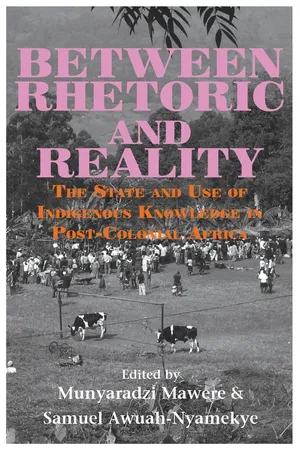
Between Rhetoric and Reality
The State and Use of Indigenous Knowledge in Post-Colonial Africa
- 330 pages
- English
- PDF
- Available on iOS & Android
eBook - PDF
Between Rhetoric and Reality
The State and Use of Indigenous Knowledge in Post-Colonial Africa
About this book
Since time immemorial, indigenous peoples around the world have developed knowledge systems to ensure their continued survival in their respective territories. These knowledge systems have always been dynamic such that they could meet new challenges. Yet, since the so-called enlightenment period, these knowledges have been supplanted by the Western enlightenment science or colonial science hegemony and arrogance such that in many cases they were relegated to the periphery. Some Euro-centric scholars even viewed indigenous knowledge as superstitious, irrational and anti-development. This erroneous view has, since the colonial period, spread like veld fire to the extent of being internalised by some political elites and Euro-centric academics of Africa and elsewhere. However, for some time now, the potential role that indigenous peoples and their knowledge can play in addressing some of the global problems haunting humanity across the world is increasingly emerging as part of international discourse. This book presents an interesting and insightful discourse on the state and role that indigenous knowledge can play in addressing a tapestry of problems of the world and the challenges connected with the application of indigenous knowledge in enlightenment science-dominated contexts. The book is not only useful to academics and students in the fields of indigenous studies and anthropology, but also those in other fields such as environmental science, social and political ecology, development studies, policy studies, economic history, and African studies.
Information
Table of contents
- Cover
- Title page
- Copyright page
- Dedication
- List of Contributors
- Contents
- Chapter 1 - Rethinking African Indigenous Knowledges and World Civilisations: Pasts, presents and the Futures
- Chapter 2 - Indigenous Knowledge for Disaster Risk Management in Africa: Some showcases from Zimbabwe
- Chapter 3 - An Evaluation of African Traditional Scientific Knowledge and Technological Devices
- Chapter 4 - Indigenous Knowledge, Conflation and Post-colonial Translation: Lessons from Fieldwork in Contemporary Rural Zimbabwe
- Chapter 5 - Traditional Healers and Medicine in South Africa: A Quest for Legal and Scientific Recognition
- Chapter 6 - A History of Pre-colonial and Colonial Wildlife Conservation in Ghana
- Chapter 7 - ‘Sheep in Sheep’s Clothing or Wolves in Sheep’s Clothing?’ Interventions by Non-state Actors in a Changing Climatic Environment in Rural Zimbabwe
- Chapter 8 - Religion and the Restoration of Health in Africa: A Case Study of the Traditional Akan People of Ghana
- Chapter 9 - Indigenous Knowledge and the Management of Ecological Resources for Africa’s Development
- Chapter 10 - The Role of Indigenous Shona Cultural Beliefs and Practices in the Conservation of the Environment
- Chapter 11 - Indigenous Knowledge Systems and Dispute Resolutions: The Yoruba Example
- Chapter 12 - The Role and Efficacy of Indigenous Knowledge in Fostering Sustainable Development in Africa: A Case Study of Zimbabwe
- Chapter 13 - Promoting Indigenous Knowledge for Sustainable Development in Africa: A Case Study of Ghana
- Back cover
Trusted by 375,005 students
Access to over 1.5 million titles for a fair monthly price.
Study more efficiently using our study tools.
Frequently asked questions
Yes, you can cancel anytime from the Subscription tab in your account settings on the Perlego website. Your subscription will stay active until the end of your current billing period. Learn how to cancel your subscription
No, books cannot be downloaded as external files, such as PDFs, for use outside of Perlego. However, you can download books within the Perlego app for offline reading on mobile or tablet. Learn how to download books offline
Perlego offers two plans: Essential and Complete
- Essential is ideal for learners and professionals who enjoy exploring a wide range of subjects. Access the Essential Library with 800,000+ trusted titles and best-sellers across business, personal growth, and the humanities. Includes unlimited reading time and Standard Read Aloud voice.
- Complete: Perfect for advanced learners and researchers needing full, unrestricted access. Unlock 1.5M+ books across hundreds of subjects, including academic and specialized titles. The Complete Plan also includes advanced features like Premium Read Aloud and Research Assistant.
We are an online textbook subscription service, where you can get access to an entire online library for less than the price of a single book per month. With over 1.5 million books across 990+ topics, we’ve got you covered! Learn about our mission
Look out for the read-aloud symbol on your next book to see if you can listen to it. The read-aloud tool reads text aloud for you, highlighting the text as it is being read. You can pause it, speed it up and slow it down. Learn more about Read Aloud
Yes! You can use the Perlego app on both iOS and Android devices to read anytime, anywhere — even offline. Perfect for commutes or when you’re on the go.
Please note we cannot support devices running on iOS 13 and Android 7 or earlier. Learn more about using the app
Please note we cannot support devices running on iOS 13 and Android 7 or earlier. Learn more about using the app
Yes, you can access Between Rhetoric and Reality by Munyaradzi Mawere, Samuel Awuah-Nyamekye, Munyaradzi Mawere,Samuel Awuah-Nyamekye in PDF and/or ePUB format, as well as other popular books in Social Sciences & Cultural & Social Anthropology. We have over 1.5 million books available in our catalogue for you to explore.