- 329 pages
- English
- PDF
- Available on iOS & Android
eBook - PDF
About this book
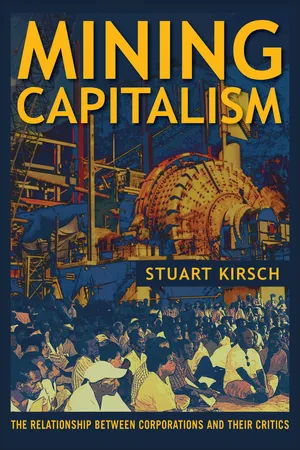
Corporations are among the most powerful institutions of our time, but they are also responsible for a wide range of harmful social and environmental impacts. Consequently, political movements and nongovernmental organizations increasingly contest the risks that corporations pose to people and nature. Mining Capitalism examines the strategies through which corporations manage their relationships with these critics and adversaries. By focusing on the conflict over the Ok Tedi copper and gold mine in Papua New Guinea, Stuart Kirsch tells the story of a slow-moving environmental disaster and the international network of indigenous peoples, advocacy groups, and lawyers that sought to protect local rivers and rain forests. Along the way, he analyzes how corporations promote their interests by manipulating science and invoking the discourses of sustainability and social responsibility. Based on two decades of anthropological research, this book is comparative in scope, showing readers how similar dynamics operate in other industries around the world.
Trusted by 375,005 students
Access to over 1 million titles for a fair monthly price.
Study more efficiently using our study tools.
Information
Publisher
University of California PressYear
2014Print ISBN
9780520281707
Edition
1eBook ISBN
9780520957596
Table of contents
- Cover
- Contents
- List of Illustrations
- Acknowledgments
- Introduction
- 1. Colliding Ecologies
- 2. The Politics of Space
- 3. Down by Law
- 4. Corporate Science
- 5. Industry Strikes Back
- 6. New Politics of Time
- Conclusion
- Epilogue
- Appendix: Timeline
- Notes
- References
- Index
Frequently asked questions
Yes, you can cancel anytime from the Subscription tab in your account settings on the Perlego website. Your subscription will stay active until the end of your current billing period. Learn how to cancel your subscription
No, books cannot be downloaded as external files, such as PDFs, for use outside of Perlego. However, you can download books within the Perlego app for offline reading on mobile or tablet. Learn how to download books offline
Perlego offers two plans: Essential and Complete
- Essential is ideal for learners and professionals who enjoy exploring a wide range of subjects. Access the Essential Library with 800,000+ trusted titles and best-sellers across business, personal growth, and the humanities. Includes unlimited reading time and Standard Read Aloud voice.
- Complete: Perfect for advanced learners and researchers needing full, unrestricted access. Unlock 1.4M+ books across hundreds of subjects, including academic and specialized titles. The Complete Plan also includes advanced features like Premium Read Aloud and Research Assistant.
We are an online textbook subscription service, where you can get access to an entire online library for less than the price of a single book per month. With over 1 million books across 990+ topics, we’ve got you covered! Learn about our mission
Look out for the read-aloud symbol on your next book to see if you can listen to it. The read-aloud tool reads text aloud for you, highlighting the text as it is being read. You can pause it, speed it up and slow it down. Learn more about Read Aloud
Yes! You can use the Perlego app on both iOS and Android devices to read anytime, anywhere — even offline. Perfect for commutes or when you’re on the go.
Please note we cannot support devices running on iOS 13 and Android 7 or earlier. Learn more about using the app
Please note we cannot support devices running on iOS 13 and Android 7 or earlier. Learn more about using the app
Yes, you can access Mining Capitalism by Stuart Kirsch in PDF and/or ePUB format, as well as other popular books in Social Sciences & Labour Economics. We have over one million books available in our catalogue for you to explore.