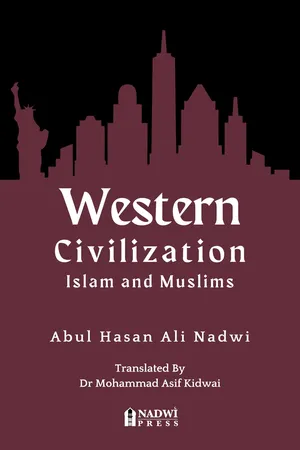
The confrontation between Islamic civilization and the West is one of the defining intellectual problems of the modern era. It has generated an enormous literature, much of it polarized, polemical, or shaped by the particular urgencies of the moment in which it was written. What makes Western Civilization: Islam and Muslims exceptional — and what accounts for its continued relevance more than six decades after Abul Hasan Ali Nadwi completed the Arabic original — is its capacity to hold both the historical and the principled dimensions of the question simultaneously without collapsing either into the other.
Nadwi began writing what would become this book in the early 1960s, a moment when the question of how Muslim societies should relate to Western civilization was being answered, in country after country, through force rather than deliberation. The Kemalist transformation of Turkey had by then been consolidated over four decades. Gamal Abdel Nasser's Egypt was pursuing an aggressively secular nationalist program. Habib Bourguiba in Tunisia was challenging the canonical authority of the fast of Ramadan from the floor of public discourse. Syria and Iraq were falling under the influence of the secular Ba'th movement. Indonesia was navigating the pressures of postcolonial nation-building. Each of these cases represented, in Nadwi's reading, a different expression of a single underlying crisis: the inability of Muslim societies to distinguish between what Western civilization offered that was genuinely universal — scientific method, empirical inquiry, certain principles of rational governance — and what was particular and contingent, rooted in the specific historical and theological experience of post-Enlightenment Europe, and not only unnecessary for Muslim societies to adopt but actively corrosive of the values on which they depended.
The book's first chapter establishes the terms of the analysis by examining the failure of the opposite extreme — the policy of wholesale rejection and isolation that countries like Afghanistan and Yemen had pursued. Nadwi's argument here is not polemical. He documents, through contemporary sources including travel accounts and official interviews, how complete isolation had produced not a preserved Islamic civilization but a vacuum — an intellectual and material backwardness that left these societies more, not less, vulnerable to eventual cultural capture by the West. The lesson he draws is that rejection of Western civilization in toto is not a Muslim option. Islam itself, he argues, commands the pursuit of knowledge wherever it is found, and the Prophet's example demonstrated a willingness to adopt useful practices from other peoples — the trench warfare of the Persians, the administrative structures of the early caliphate — without compromising the spiritual foundations of the community.
The second chapter is the book's intellectual centerpiece and its most historically detailed section. Nadwi traces the movement for Westernization across the Muslim world with the patience and precision of a trained historian. His analysis of Turkey is particularly illuminating. He distinguishes carefully between the theoretical positions of Namik Kemal — who advocated a measured, selective appropriation of Western institutional forms while preserving Islamic moral and legal foundations — and Ziya Gokalp, whose more radical claim that Western civilization was itself a natural continuation of older Mediterranean traditions became the intellectual scaffolding for Ataturk's project of wholesale cultural transformation. The extended treatment of Ataturk that follows is not a polemic but a psychological and historical study, drawing on the writings of Ataturk's own biographers — including Irfan and Margaret Orga and H.C. Armstrong — to document the sources of his hostility to Islam and his vision of Western civilization as a kind of secular faith.
The India section is equally detailed, tracing the divergent responses of the Ulema — whose strategy of institutional consolidation produced Deoband and other seminaries — and the Aligarh school of Sir Syed Ahmad Khan, whose selective Westernism was motivated by a genuine concern for Muslim welfare in post-1857 British India but produced, in Nadwi's assessment, a mode of intellectual accommodation that left Muslims without the tools to evaluate Western civilization critically. The extended treatment of Allama Iqbal is particularly searching: Nadwi recognizes Iqbal as an irreplaceable voice for Islamic intellectual renewal while also noting the tensions within Iqbal's project, particularly his attempt to give philosophical reinterpretation to transcendental truths. The chapter then moves across Egypt, tracking the careers of Syed Jamaluddin Afghani, Mohammad Abduh, and the Orientalist-influenced Egyptian intellectuals who followed them, before surveying Syria, Iraq, Iran, Indonesia, Tunisia, and Algeria in turn.
The third chapter turns to structural causes — the educational systems established by Western colonial powers across Muslim territories, the influence of Western Orientalism on the self-image of Muslim intellectuals, and the specific challenge of ijtihad: the principled reconstruction of Islamic jurisprudence in response to new circumstances. Nadwi's treatment of Orientalism is measured rather than adversarial; he documents its influence on Muslim thought with concern but without the rhetorical energy of polemic. His interest is diagnostic rather than accusatory.
The fourth chapter and the epilogue constitute Nadwi's affirmative statement — the intellectual and spiritual vision toward which the entire preceding analysis has been building. The Muslim world is summoned not merely to resist Westernization but to undertake something more demanding: to learn from the West what is genuinely universal — its empirical sciences, certain aspects of its political organization, its material technologies — while subordinating these acquisitions to the purposes Islam has always held as foundational. The sciences, Nadwi argues, are neither Western nor Eastern; they are the common property of humanity, and Islam itself commands their pursuit. What the Muslim world must refuse is not science but the philosophy of life that has accumulated around Western science — the materialism, the reduction of human existence to economic and biological categories, the severance of knowledge from moral and spiritual purpose.
The epilogue is one of the most sobering passages in the book. Nadwi writes from a position of clear-eyed recognition of the Muslim world's weakness — its intellectual servility, its political dependence, its susceptibility to cultural capture — without despair and without false consolation. The path forward, he argues, is not a romantic return to an idealized past but a creative synthesis: the kind of engagement with modernity that Japan has approximated in the material sphere, but which the Muslim world — with a faith and civilization of universal rather than merely national scope — has the potential to accomplish at a far deeper and more consequential level.
Western Civilization: Islam and Muslims is a text for Islamic studies curricula, for courses in comparative civilizational history, and for any serious reader who wants to understand the interior logic of Muslim responses to modernity from one of the tradition's most perceptive twentieth-century voices.