Catherine Malabou's elaboration of the concept of plasticity has made her one of the most innovative philosophers working today. Formations collects eighteen of Malabou's early writings, spanning 1986 to 2003, within which her initial articulations of plasticity take shape.
Though Malabou might be most famous for bringing neurobiological discourse into conversation with continental philosophy, she has always maintained, as the essays in Formation make clear, that "plasticity" circulates dynamically within the history of philosophy. Across readings of Hegel, Marx, Derrida, Rousseau, Heidegger, Ricoeur, Plato, Aristotle, and many others, these essays highlight the deep entrenchment of plasticity within the history of philosophy.
Formations puts on full display Malabou's associations with deconstruction, her negotiations with structuralism, her interdisciplinary investments in philosophical calibrations of literature, and the unique form of dialectics that will shape her later thought. A critical introduction by Adrian Johnston situates these essays within the contexts of French Hegelianism and Marxism, showing both the continuity of these early essays with Malabou's later work as well as their singular contributions to the development of these still-relevant critical fields. An afterword by Malabou herself offers a biographical and bibliographic retrospective to these essays.
Never just an archive of precursory traces of a later project, Formations exhibits the plastic metamorphosis of Malabou's own thought by revealing any oeuvre, including any translation or editorial arrangement of that oeuvre, to be a product constituted by its ongoing formations. In this sense, the title reflects one of the most enduring features of Malabou's thought: "formation" stands doubly for the rigidity of an identity and the processes by which that identity changes and takes shape.
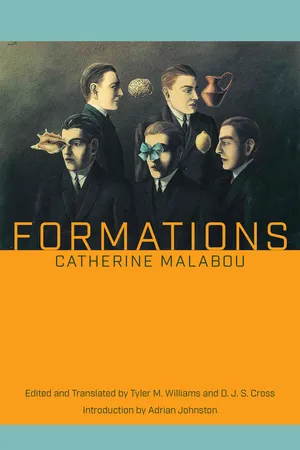
- 281 pages
- English
- PDF
- Available on iOS & Android
eBook - PDF
Formations
About this book
Information
Publisher
Fordham University PressYear
2026Print ISBN
9781531513764
9781531513757
eBook ISBN
9781531513788
Table of contents
- Cover
- Title Page
- Copyright
- Contents
- Preface: In the Usual Order of Things
- Introduction: The Taking Shape of Malabou
- 1. The Duplicity of Memory: Hegel and Proust
- 2. Images of the Elsewhere in Rousseau’s Political Philosophy
- 3. Literary Time and the Thought of Time: Proust, Reader of Ricoeur
- 4. To Paint the Sea with Another Sense of Direction: Proust and Elstir
- 5. Photocopies of Consciousness: Hegel, Copyright, and the Right of the Author
- 6. Speculative Plastique
- 7. Economy of Violence, Violence of Economy: Derrida and Marx
- 8. Hegel’s Science of Logic: Translator’s Foreword to the Preface to the Second Edition (1831)
- 9. The Times of Experience: Aristotle’s Style
- 10 .What Good Is It to Be Sparing of Life When There Is Almost None Left
- 11. From Pascal to Heidegger: Vincent Carraud’s Pascal et la philosophie
- 12 .Writing the End of Love: Proust, or Genre Put Away
- 13. Derrida’s Way: Noblesse oblige
- 14. Negatives of Dialectic: Between Hegel and Heidegger’s Hegel (Hyppolite, Koyré, Kojève)
- 15. The Metamorphosis of Constancy: A Reading of Nietzsche and the Shadow of God
- 16. Gré
- 17. The Ungraspable in Question, or Take to Dying
- 18. Dialectical Negativity and Transcendental Pain: Heidegger’s Reading of Hegel in Volume 68 of the Gesamtausgabe
- Afterword
- Notes
- Works Cited
- Index
- About the Author
Trusted by 375,005 students
Access to over 1.5 million titles for a fair monthly price.
Study more efficiently using our study tools.
Frequently asked questions
Yes, you can cancel anytime from the Subscription tab in your account settings on the Perlego website. Your subscription will stay active until the end of your current billing period. Learn how to cancel your subscription
No, books cannot be downloaded as external files, such as PDFs, for use outside of Perlego. However, you can download books within the Perlego app for offline reading on mobile or tablet. Learn how to download books offline
Perlego offers two plans: Essential and Complete
- Essential is ideal for learners and professionals who enjoy exploring a wide range of subjects. Access the Essential Library with 800,000+ trusted titles and best-sellers across business, personal growth, and the humanities. Includes unlimited reading time and Standard Read Aloud voice.
- Complete: Perfect for advanced learners and researchers needing full, unrestricted access. Unlock 1.5M+ books across hundreds of subjects, including academic and specialized titles. The Complete Plan also includes advanced features like Premium Read Aloud and Research Assistant.
We are an online textbook subscription service, where you can get access to an entire online library for less than the price of a single book per month. With over 1.5 million books across 990+ topics, we’ve got you covered! Learn about our mission
Look out for the read-aloud symbol on your next book to see if you can listen to it. The read-aloud tool reads text aloud for you, highlighting the text as it is being read. You can pause it, speed it up and slow it down. Learn more about Read Aloud
Yes! You can use the Perlego app on both iOS and Android devices to read anytime, anywhere — even offline. Perfect for commutes or when you’re on the go.
Please note we cannot support devices running on iOS 13 and Android 7 or earlier. Learn more about using the app
Please note we cannot support devices running on iOS 13 and Android 7 or earlier. Learn more about using the app
Yes, you can access Formations by Catherine Malabou, Tyler M. Williams,D. J. S. Cross in PDF and/or ePUB format, as well as other popular books in Philosophy & Literary Criticism Theory. We have over 1.5 million books available in our catalogue for you to explore.