- 224 pages
- English
- ePUB (mobile friendly)
- Available on iOS & Android
eBook - ePub
About this book
Author Todd Duncan challenges the status quo in search of a better, smarter way to work and live. Rejecting how-to formulas claiming to know the perfect balance between work and life, he argues that such a holy grail does not exist. Instead, he offers readers a solution of purposeful imbalance: the process of purposefully leaning toward work without sacrificing life and purposefully leaning toward life without damaging your career. Like the art of tightrope walking, the key to not falling is taking things one step at a time.You've always believed that when you're at work, you should work hard, and when you're at home, you should play hard. That's easy to say, but for a lot of people, it's hard to do. Life on the Wire clears up the myth about the balanced life and shows readers how to rejoice in their imbalance. Featuring profiles of an entrepreneur, a bartender, and an accountant, among others, you'll gain insights from people who struck out to find "balance" and had to overcome innumerable challenges. This book, endorsed by bestselling author and radio host Dave Ramsey, provides lessons that will help you live out a fulfilling career and work toward a satisfying life. Work-life balance may be a myth. But that doesn't have to be a bad thing. Life on the Wire explains that imbalance is natural--the key is to make it purposeful.
Tools to learn more effectively

Saving Books

Keyword Search

Annotating Text

Listen to it instead
Information
FIRST TENSION POINT “I Have To” vs. “I Really Want To”
One of the things I’ve learned . . . is to first ask myself, “Do I philosophically believe in what I’m doing?” . . . But I also have to ask, “Do I get warm fuzzies from what I’m doing?” When I asked myself that question my answer was, “No, with this stuff I don’t.” That was a real eye-opener.
—Jason Lacy
J ason Lacy has a strong foundation for success. Raised by an entrepreneur mother and a famous motivator father, he grew up surrounded by tools of inspiration. After putting his self-proclaimed “idiot years” behind him, he naturally set his sights on starting a groundbreaking business. Admirable as that vision was, it had to marinate in the bittersweet broth of experience before finally coming to life. Today Jason sums up the lessons of his last eight years as a “constant challenge to answer the question, Am I pursuing the right objective?
“I am still always asking, Is this for the money? Or for the prestige of being a successful entrepreneur? Or for something I really believe in? ” Now Jason can answer these questions with a measure of confidence— though there was a time when his answers didn’t come so easily. He struggled with the tension common to creative and entrepreneurial types that develops when job requirements compete with a passion for work that is emotionally rewarding.
At twenty-two, Jason was clearing six figures as a broker for a small financial services firm in Carmel Valley, California, when a brainstorm began one day during a conversation with a friend. The two of them discovered an underused tax advantage in the lucrative life insurance industry and then composed a plan for creating and marketing new software that would help policyholders utilize it. After raising private funds, both quit their steady jobs and ventured out. You may have considered the same move as you slog through the mire of mundane workdays. The few who take action are those of a rare mind-set, willing to experiment before firming their feet in a job or career. Jason embraced this experimental thinking wholeheartedly.
“It was a great idea,” Jason explained of their venture, “but we quickly discovered our product was hard to describe. We kept hearing things like, ‘It sounds great but I just don’t understand how it works’ and ‘Why hasn’t my financial advisor told me about this?’” After a season of frustration— and nearing the end of their funding—Jason and his business partner morphed their product into something more marketable.
The revised concept was broader in scope and easier to describe, and the adjustments proved lucrative. A large southeastern firm saw the new software’s potential and offered to fund its overhead and marketing in exchange for a share of ownership. “From a financial standpoint, it made perfect sense,” Jason admitted. “The unspoken reality was that we needed it to happen if we wanted to keep paying our bills.”
What Jason didn’t immediately see was how the merger would squeeze the vigor out of the venture. Partnering with the large company was a step toward financial stability but away from what he loved about his workdays as an entrepreneur. Jason was unknowingly entering a common tangle.
Most of us reach a point where our initial efforts to land a stable job transition into the desire for an inspiring one. The quest for satisfying, emotionally rewarding workdays generates a natural tension we must harmonize in order to meet our simultaneous needs for job stability and meaningful achievement.
Jason is seeking a rudimentary need in maintaining a steady job while also striving for personal achievement higher up the pyramid.
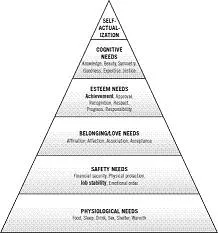
Here we see the two points of tension. Jason is both seeking a rudimentary need in maintaining a steady job while striving for personal achievement.
The Value of Your Work
Lack of job stability is not only a strain on your well-being but also on the health of your relationships. I’ve seen it take marriages to the brink of divorce. On the other hand, the consequences of a dreary day’s work that never excites you can be just as detrimental. It’s hard to say which deficit is more serious. Wrestling with these two needs— stability and meaningful achievement—defined the next year of Jason’s journey.
The tension became evident when the larger firm asked Jason and his partner to move to Florida and assume broader, company-wide responsibilities. Jason knew this meant he could no longer focus day-to-day on the venture he’d nurtured so intensely. Though he didn’t have to accept the offer, it promised a steady, sizable paycheck, and his recent marriage made the prospect of stability suddenly attractive. He and his bride packed up and headed east.
It didn’t take long for him to feel out of place.
“I quickly saw that I had sacrificed job enjoyment for job stability,” Jason admitted. “It didn’t feel like a big sacrifice until I really got to know my new position. When I realized I had become a sales manager with responsibilities that didn’t excite me, I started to rethink the trade.”
Yet having moved twenty-five hundred miles to take his new position, Jason was motivated to make it work. “I honestly didn’t feel like turning around and going right back home. And the truth was that our venture was still moving forward. I felt that if the venture turned out to be successful, it would all be worth it . . . Still, things were moving a lot slower than I wanted.”
Through the experience, Jason was discovering what he valued most about a job: not stability, but seeing his ideas flourish. His work/life tension peaked when he realized his daily responsibilities no longer included pursuing his dream. His workdays fed job stability but starved job gratification.
Jason set a decision deadline. “I told myself I’d stay one year and make the best of it. I knew if I still felt the same after being here a year, I had to make a change—even though I didn’t have a clue what that would be.”
For months Jason gutted it out in hopes the software venture would bloom under the umbrella of the larger company and his workdays would regain the flexibility, independence, and inspiration he craved. Unfortunately, a few weeks from his anniversary there, he saw but little progress. It was at this point—when doing what was required kept him from doing what was rewarding—that we first spoke to Jason. He was candid about his missteps and the lessons he was still learning. His insights will illuminate the tools for harmonizing your tension in the same area.
A Question of Objectives
“One of the things I’ve learned about my work pursuits from now on,” Jason explained, “is to first ask myself, Do I philosophically believe in what I am doing? It’s critical to know that, at the end of the day, I actually think what I’m doing is ethical and useful. It makes no sense to spend time doing something you are philosophically at odds with. When I asked myself if I philosophically believed in what I was doing here, my answer was yes. Life insurance is a useful product I can get behind.
“But I’ve learned that is only half the equation. I also have to ask myself, Do I get warm fuzzies from what I’m doing? When I asked myself that question, my answer was, No, with this particular job I don’t. I can be motivated to do it from a moneymaking standpoint, but ultimately the daily tasks don’t inspire me at my core . . . Seeing that was a real eye-opener.”
Ultimately, Jason discovered the tension he felt was a result of a misalignment between his work requirements and his work objectives. If that tension point hits home with you, you’re probably struggling with the same conflict.
The relationship between your work requirements and work objectives plays a major role in whether you feel tension. If the two are aligned, there is little room for tension—because the end justifies the means. If there is misalignment between them, there’s a high potential for tension— because the end does not justify the means.
The various seasons of life lead you to take jobs for different reasons. As long as the requirements of the job promote your work objectives, you’re not likely to feel any serious tension. If your current objective is to maintain a predictable schedule and paycheck, you’re less likely to feel tension from a lackluster job because it doesn’t keep you from reaching your main goal. During another season, however, your primary objective might be emotional gratification, in which case you’d be less willing to accept the same lackluster job because it would be out of alignment with that “higher” (according to Maslow’s pyramid) objective.
The first step toward decreasing misalignment and harmonizing the tension between your job requirements and job objectives is to figure out what type of job best fits you and your current circumstances. For the most part, there are two types of jobs: comfortable ones and inspirational ones.
The Comfortable Job
Advantages of a comfortable job include stability, predictability, and a clear path to advancement. Certain seasons of life are ideal for a comfortable job:
• Graduating from college, when your most desirable career path is not yet clear
• Entering a new industry, when you don’t yet know if there is philosophical alignment
• Moving to a new city, when you don’t yet know if the location suits your and/or your family’s needs
• Completing a post-graduate program, when you have large debts to pay off
• Reentering the workforce after having children, while you are navigating h...
Table of contents
- Cover Page
- Title Page
- Copyright Page
- Dedication
- Contents
- Foreword
- Introduction: The Art of Purposeful Imbalance
- First Tension Point: “I Have To” vs. “I Really Want To”
- Second Tension Point: Making Money vs. Making Memories
- Third Tension Point: Taking Risks vs. Taking Responsibility
- Fourth Tension Point: Moving Up vs. Moving On
- Fifth Tension Point: Being Noticed vs. Being Esteemed
- Sixth Tension Point: Growing Professionally vs. Growing Personally
- Seventh Tension Point: Helping Yourself vs. Helping Others
- Eighth Tension Point: Getting Serious vs. Having Fun
- Ninth Tension Point: Working Hard vs. Staying Healthy
- Tenth Tension Point: Making Your Mark vs. Leaving a Legacy
- The Summit: Making Good Decisions vs. Managing Decisions Already Made
- Notes
- Acknowledgments
Frequently asked questions
Yes, you can cancel anytime from the Subscription tab in your account settings on the Perlego website. Your subscription will stay active until the end of your current billing period. Learn how to cancel your subscription
No, books cannot be downloaded as external files, such as PDFs, for use outside of Perlego. However, you can download books within the Perlego app for offline reading on mobile or tablet. Learn how to download books offline
Perlego offers two plans: Essential and Complete
- Essential is ideal for learners and professionals who enjoy exploring a wide range of subjects. Access the Essential Library with 800,000+ trusted titles and best-sellers across business, personal growth, and the humanities. Includes unlimited reading time and Standard Read Aloud voice.
- Complete: Perfect for advanced learners and researchers needing full, unrestricted access. Unlock 1.4M+ books across hundreds of subjects, including academic and specialized titles. The Complete Plan also includes advanced features like Premium Read Aloud and Research Assistant.
We are an online textbook subscription service, where you can get access to an entire online library for less than the price of a single book per month. With over 1 million books across 990+ topics, we’ve got you covered! Learn about our mission
Look out for the read-aloud symbol on your next book to see if you can listen to it. The read-aloud tool reads text aloud for you, highlighting the text as it is being read. You can pause it, speed it up and slow it down. Learn more about Read Aloud
Yes! You can use the Perlego app on both iOS and Android devices to read anytime, anywhere — even offline. Perfect for commutes or when you’re on the go.
Please note we cannot support devices running on iOS 13 and Android 7 or earlier. Learn more about using the app
Please note we cannot support devices running on iOS 13 and Android 7 or earlier. Learn more about using the app
Yes, you can access Life on the Wire by Todd Duncan in PDF and/or ePUB format, as well as other popular books in Personal Development & Careers. We have over one million books available in our catalogue for you to explore.