Many today find the Old Testament a closed book. The cultural issues seem insurmountable and we are easily baffled by that which seems obscure. Furthermore, without knowledge of the ancient culture we can easily impose our own culture on the text, potentially distorting it. This series invites you to enter the Old Testament with a company of guides, experts that will give new insights into these cherished writings. Features include • Over 2000 photographs, drawings, maps, diagrams and charts provide a visual feast that breathes fresh life into the text. • Passage-by-passage commentary presents archaeological findings, historical explanations, geographic insights, notes on manners and customs, and more. • Analysis into the literature of the ancient Near East will open your eyes to new depths of understanding both familiar and unfamiliar passages. • Written by an international team of 30 specialists, all top scholars in background studies.
- 176 pages
- English
- ePUB (mobile friendly)
- Available on iOS & Android
eBook - ePub
Ezekiel and Daniel
About this book
Trusted by 375,005 students
Access to over 1.5 million titles for a fair monthly price.
Study more efficiently using our study tools.
Information
Ezekiel
by Daniel Bodi
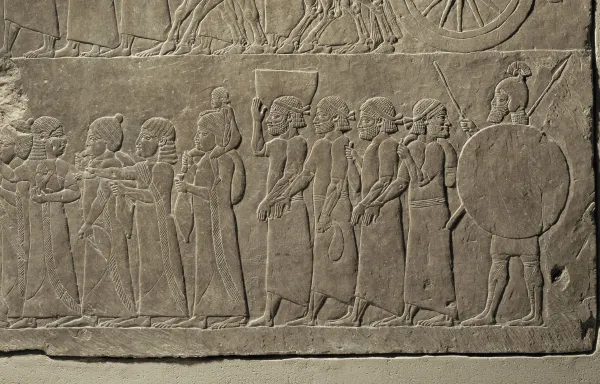
Elamite captives led away by Ashurbanipal’s soldiers
Erich Lessing/Art Resource, NY
Introduction
The book of Ezekiel’s testimony unequivocally presents itself as having been delivered in exile during the Babylonian captivity. Based on the dating formulas in 1:2 and 40:1, Ezekiel’s prophecies extend for approximately twenty years, from 593 to 571 B.C. The prophet himself, however, was in Babylonia since 597, the date of the first deportation of the Jerusalem elite into exile. Ezekiel considers himself part of the community-in-exile. He views events in Judah from afar, described only by way of numerous visions and probably from personal memory of the last days of the Davidic dynasty. In 33:21, in the twelfth year of his exile, he receives news of the fall of Jerusalem from a fugitive.
Ezekiel went into exile with the eight thousand nobility, craftspeople, priests, and religious personnel who were sent to Babylonia with the king Jehoiachin during the first deportation (2 Kings 24:14–16). He was a victim of a common policy of the Assyrians and the Babylonians: the practice of selective deportations. By removing political, spiritual, and economic leadership, the Babylonians aimed to break down national resistance, prevent any possibility of revolt, and bolster the economy and military machine of the conqueror’s homeland.1
The Aramaic language was increasingly becoming the lingua franca of the last days of the Babylonian empire in the sixth century B.C. Concerning the Late Babylonian language spoken at that time, the foremost Akkadian grammarian W. von Soden describes it as a Mischsprache or a mixture of Akkadian and Aramaic.2 Ezekiel’s extended stay in Babylonian exile accounts for the unusually high proportion of Aramaic and Akkadian words in his book and the numerous images and themes that have their background in his land of exile. Ezekiel is truly a product of his time and of his environment. As attested many times in the past, the literati and intellectual leadership of any age succeed in finding common meeting grounds despite political, social, or religious pressures intended to keep them separate. It is therefore conceivable that Ezekiel was able to converse with Babylonian scribes and religious leaders in Aramaic, acquiring knowledge of Akkadian literature, or at least its main themes, motifs, and metaphors.3

Ezekiel worked out his material carefully, sometimes laboriously writing like a scholar. Replete with obscure references, images, metaphors, and difficulties in text and meaning, both Judaism and Christianity have had problems in understanding this book. Judaism almost decided to exclude Ezekiel from its canon. By the end of the first century A.D. rabbi Hananiah ben Hezekiah, working numerous nights and having spent three hundred jars of oil for his lamp, was finally able to explain the passages in chapters 40–48 that seemed to be out of keeping with the teaching of the Torah or the Pentateuch and salvage the book from being excluded from the canon of the Hebrew Bible.
But even with the work of Hananiah, all the difficulties were not solved. Regarding passages such as Ezekiel 44:31; 45:18, the Talmudic tractate Menahot 45a states that the problems will be solved only by Elijah when he makes known all truth in preparation for the messianic age. In the fourth century A.D., Jerome, whom the pope sent to Bethlehem to study Hebrew with the rabbis and revise the Latin translation of the Vulgate, despaired of ever understanding this profound work. He likened the study of it to walking through the catacombs of Rome where light seldom breaks through (Epistola 53 ad Paulinum).4 Calvin never finished his commentary on Ezekiel and Luther put forth no major effort toward its interpretation.
The recovery of the Akkadian background of Ezekiel can increase our understanding of a number of expressions, themes, and motifs that have been misunderstood, gratuitously emended, completely overlooked, or termed “obscure.” For example, Ezekiel 16 and 23 represent the two most difficult chapters in the Bible on account of the graphic and detailed description of the lewd behavior of two sisters Oholah and Oholibah, symbols of Jerusalem and Samaria. In chapter 16, however, the description of the willful abuse of a female body as a metaphor of Jerusalem’s straying from God has caused its censorship by different religious communities and readerships. The famous psychiatrist and philosopher Karl Jaspers found in it ample material to show that Ezekiel was schizophrenic. According to him, the hallmark of Ezekiel’s pathology is his belaboring of sexual imagery in order to depict religious unfaithfulness and his lingering on scabrous details, even in an age less prejudiced than ours on such matters.5
To see pornography in Ezekiel 16, as modern readers suggest,6 is the exact opposite of what the prophet is attempting to accomplish. As his goal of Ezekiel 16 and 23, the prophet is trying to provoke revulsion and disgust. These chapters contain some extremely daring images, and bringing the comparative material to the forefront makes them even more poignant. The method of interpretation adopted in this commentary heightens the force of the intended outrage contained in the prophet’s message that aims at provoking utter disgust toward idolatry.
The above negative judgments are excessive and erroneous. It is almost impossible to understand the startling images contained in chapters 16 and 23 if we do not place them in the cultural and religious context of the prophet’s land of exile. More than any other chapters in this book, these two are time-, place-, and culture-bound, and unless this is recognized, misunderstandings are bound to occur. It appears that the biblical writer has woven into his creation images, terms, and idioms taken from the contemporary religious, legal, social, and political reality. As I will try to show, Ezekiel’s description contains a reminiscence of the Mesopotamian Ishtar festival. Exiled in Babylonia, Ezekiel cannot have failed to be confronted with the grandiose and in many respects obscene Ishtar festival. Shocked by the practices he discovers in Mesopotamia, he draws heavily on the Ishtar cult as the epitome of idolatrous and religious straying of the nation.
Ezekiel’s Initial Vision and Call (1:1–3:27)
Kebar River (1:1). Ezekiel and his compatriots in exile have settled in the vicinity of the Kebar Canal. Hebrew nehar kebār is the equivalent of Akkadian nār kabari (“Kabaru Canal”). The fifth-century B.C. archives of the Murashu family of bankers who lived in Nippur mention it several times. It corresponds to present-day Nuffer, a city sixty miles southeast of Babylon (the site of the latter is situated about two hundred miles south of present-day Baghdad).7
Table of contents
- Cover
- Title Page
- Copyright Page
- Table of Contents
- How to Use This eBook
- Acknowledgments
- Methodology: An Introductory Essay
- General Bibliography
- Abbreviations
- Ezekiel
- Daniel
- Picture Index
- The New International Version Appendix
Frequently asked questions
Yes, you can cancel anytime from the Subscription tab in your account settings on the Perlego website. Your subscription will stay active until the end of your current billing period. Learn how to cancel your subscription
No, books cannot be downloaded as external files, such as PDFs, for use outside of Perlego. However, you can download books within the Perlego app for offline reading on mobile or tablet. Learn how to download books offline
Perlego offers two plans: Essential and Complete
- Essential is ideal for learners and professionals who enjoy exploring a wide range of subjects. Access the Essential Library with 800,000+ trusted titles and best-sellers across business, personal growth, and the humanities. Includes unlimited reading time and Standard Read Aloud voice.
- Complete: Perfect for advanced learners and researchers needing full, unrestricted access. Unlock 1.5M+ books across hundreds of subjects, including academic and specialized titles. The Complete Plan also includes advanced features like Premium Read Aloud and Research Assistant.
We are an online textbook subscription service, where you can get access to an entire online library for less than the price of a single book per month. With over 1.5 million books across 990+ topics, we’ve got you covered! Learn about our mission
Look out for the read-aloud symbol on your next book to see if you can listen to it. The read-aloud tool reads text aloud for you, highlighting the text as it is being read. You can pause it, speed it up and slow it down. Learn more about Read Aloud
Yes! You can use the Perlego app on both iOS and Android devices to read anytime, anywhere — even offline. Perfect for commutes or when you’re on the go.
Please note we cannot support devices running on iOS 13 and Android 7 or earlier. Learn more about using the app
Please note we cannot support devices running on iOS 13 and Android 7 or earlier. Learn more about using the app
Yes, you can access Ezekiel and Daniel by Daniel Bodi,Ernest C. Lucas, John H. Walton in PDF and/or ePUB format, as well as other popular books in Theology & Religion & Biblical Criticism & Interpretation. We have over 1.5 million books available in our catalogue for you to explore.