Faulkner and Formalism: Returns of the Text collects eleven essays presented at the Thirty-fifth Annual Faulkner and Yoknapatawpha Conference sponsored by the University of Mississippi in Oxford on July 20-24, 2008. Contributors query the status of Faulkner's literary text in contemporary criticism and scholarship. How do scholars today approach Faulkner's texts? For some, including Arthur F. Kinney and James B. Carothers, "returns of the text" is a phrase that raises questions of aesthetics, poetics, and authority. For others, the phrase serves as an invitation to return to Faulkner's language, to writing and the letter itself. Serena Blount, Owen Robinson, James Harding, and Taylor Hagood interpret "returns of the text" in the sense in which Roland Barthes characterizes this shift his seminal essay "From Work to Text."
For Barthes, the text "is not to be thought of as an object . . . but as a methodological field," a notion quite different from the New Critical understanding of the work as a unified construct with intrinsic aesthetic value. Faulkner's language itself is under close scrutiny in some of the readings that emphasize a deconstructive or a semiological approach to his writing. Historical and cultural contexts continue to play significant roles, however, in many of the essays. The contributions by Thadious Davis, Ted Atkinson, Martyn Bone, and Ethel Young-Minor by no means ignore the cultural contexts, but instead of approaching the literary text as a reflection, a representation of that context, whether historical, economic, political, or social, these readings stress the role of the text as a challenge to the power of external ideological systems. By retaining a bond with new historicist analysis and cultural studies, these essays are illustrative of a kind of analysis that carefully preserves attention to Faulkner's sociopolitical environment. The concluding essay by Theresa Towner issues an invitation to return to Faulkner's less well-known short stories for critical exposure and the pleasure of reading.
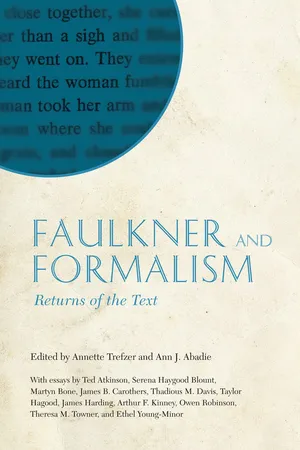
eBook - PDF
Faulkner and Formalism
Returns of the Text
- 228 pages
- English
- PDF
- Available on iOS & Android
eBook - PDF
Faulkner and Formalism
Returns of the Text
About this book
Trusted by 375,005 students
Access to over 1.5 million titles for a fair monthly price.
Study more efficiently using our study tools.
Information
Publisher
University Press of MississippiYear
2012Print ISBN
9781628460650
9781617032561
eBook ISBN
9781617032578
Table of contents
- Cover
- Contents
- Introduction
- Note on the Conference
- Flags in the Dust and the Birth of a Poetics
- “In Conflict with Itself”: The Nobel Prize Address in Faulknerian Contexts
- Faulkner’s Figures: Speech, Writing, and The Marionettes
- “That City Foreign and Paradoxical”: William Faulkner and the Texts of New Orleans
- Sanctuary’s Reversible Bodies
- The Secret Machinery of Textuality, Or, What Is Benjy Compson Really Thinking?
- Visualizing Light in August: Text, Author, Textuality, Authority
- The Impenetrable Lightness of Being: Miscegenation Imagery and the Anxiety of Whiteness in Go Down, Moses
- Intertextual Geographies of Migration and Biracial Identity: Light in August and Nella Larsen’s Quicksand
- “I Sees De Light, En I Sees De Word”: Black Female Transcendence of Racial and Gendered Boundaries in The Sound and the Fury and “That Evening Sun”
- The Weird Stuff: Textual and Sexual Anomalies in Faulkner’s Fiction
- Contributors
- Index
Frequently asked questions
Yes, you can cancel anytime from the Subscription tab in your account settings on the Perlego website. Your subscription will stay active until the end of your current billing period. Learn how to cancel your subscription
No, books cannot be downloaded as external files, such as PDFs, for use outside of Perlego. However, you can download books within the Perlego app for offline reading on mobile or tablet. Learn how to download books offline
Perlego offers two plans: Essential and Complete
- Essential is ideal for learners and professionals who enjoy exploring a wide range of subjects. Access the Essential Library with 800,000+ trusted titles and best-sellers across business, personal growth, and the humanities. Includes unlimited reading time and Standard Read Aloud voice.
- Complete: Perfect for advanced learners and researchers needing full, unrestricted access. Unlock 1.5M+ books across hundreds of subjects, including academic and specialized titles. The Complete Plan also includes advanced features like Premium Read Aloud and Research Assistant.
We are an online textbook subscription service, where you can get access to an entire online library for less than the price of a single book per month. With over 1.5 million books across 990+ topics, we’ve got you covered! Learn about our mission
Look out for the read-aloud symbol on your next book to see if you can listen to it. The read-aloud tool reads text aloud for you, highlighting the text as it is being read. You can pause it, speed it up and slow it down. Learn more about Read Aloud
Yes! You can use the Perlego app on both iOS and Android devices to read anytime, anywhere — even offline. Perfect for commutes or when you’re on the go.
Please note we cannot support devices running on iOS 13 and Android 7 or earlier. Learn more about using the app
Please note we cannot support devices running on iOS 13 and Android 7 or earlier. Learn more about using the app
Yes, you can access Faulkner and Formalism by Annette Trefzer, Ann J. Abadie, Annette Trefzer,Ann J. Abadie in PDF and/or ePUB format, as well as other popular books in Literature & Literary Essays. We have over 1.5 million books available in our catalogue for you to explore.