Discover the real Ezra in this in-depth study of the Biblical figure that separates historical facts from cultural legends.
The historical Ezra was sent to Jerusalem as an emissary of the Persian monarch. What was his task? According to the Bible, the Persian king sent Ezra to bring the Torah, the five books of the Laws of Moses, to the Jews. Modern scholars have claimed not only that Ezra brought the Torah to Jerusalem, but also that he actually wrote it, and in so doing Ezra created Judaism. Without Ezra, they say, Judaism would not exist.
In
Ezra and the Law in History and Tradition, Lisbeth S. Fried separates historical fact from biblical legend. Drawing on inscriptions from the Achaemenid Empire, she presents the historical Ezra in the context of authentic Persian administrative practices and concludes that Ezra, the Persian official, neither wrote nor edited the Torah, nor would he even have known it. The origin of Judaism, so often associated with Ezra by modern scholars, must be sought elsewhere.
After discussing the historical Ezra, Fried examines ancient, medieval, and modern views of him, explaining how each originated, and why. She relates the stories told about Ezra by medieval Christians to explain why their Greek Old Testament differs from the Hebrew Bible, as well as the explanations offered by medieval Samaritans concerning how their Samaritan Bible varies from the one the Jews use. Church Fathers as well as medieval Samaritan writers explained the differences by claiming that Ezra falsified the Bible when he rewrote it, so that in effect, it is not the book that Moses wrote but something else. Moslem scholars also maintain that Ezra falsified the Old Testament, since Mohammed, the last judgment, and Heaven and Hell are revealed in it. In contrast Jewish Talmudic writers viewed Ezra both as a second Moses and as the prophet Malachi.
In the process of describing ancient, medieval, and modern views of Ezra, Fried brings out various understandings of God, God's law, and God's plan for our salvation.
"A responsible yet memorable journey into the life and afterlife of Ezra as a key personality in the history, literature and reflection of religious and scholarly communities over the past 2,500 years. A worthwhile and informative read!" —Mark J. Boda, professor of Old Testament, McMaster Divinity College, professor of theology, McMaster University
- 272 pages
- English
- ePUB (mobile friendly)
- Available on iOS & Android
eBook - ePub
Ezra & the Law in History and Tradition
About this book
Trusted by 375,005 students
Access to over 1.5 million titles for a fair monthly price.
Study more efficiently using our study tools.
Information
Topic
Teologia e religioneSubtopic
Biografie in ambito biblico1
Introduction to the Continuing Story of Ezra, Scribe, and Priest
The biblical character of Ezra appears in only six chapters in the entire Bible, yet he has sparked the interest and concern of writers for more than two thousand years. He has been labeled a “second Moses” by the authors of the Talmud and a falsifier of the biblical text by Samaritan, Christian, and Muslim medieval scholars. Modern commentators have claimed he created Judaism, and without him Judaism would not exist. This book attempts to describe and to understand these conflicting images as well as to find the historical Ezra buried in the biblical text.
Ezra’s activities are described in chapters 7–10 of the book of Ezra and in chapter 8 and 12 of the book of Nehemiah. These two books, Ezra and Nehemiah, are the only narrative books of the Bible that deal with the period of the return of Judeans to Judah after the Babylonian exile. In 586 B.C.E. Judah was conquered by Nebuchadnezzar, king of Babylon. In the process, the temple was destroyed and the bulk of the population deported to Babylon or killed—either in the ensuing battles or by starvation and illness during the sieges of the cities.1 In October 539 B.C.E., however, Cyrus the Great of Persia conquered Babylon, and that spring, in 538 B.C.E., he issued an edict permitting the Judeans to return home to Judah and to rebuild their cities and their temple (Ezra 1:1–4).2 The books of Ezra and Nehemiah tell the story of the Judean return to Judah and of their rebuilding their temple and their city. If it were not for these two books we would know nothing about this important period of history.
The Story of the Return—Ezra Chapters 1–6
The book of Ezra is not all of a piece, however. In fact it is pretty much a hodgepodge. The first six chapters tell the story of the return to Judah and Jerusalem and of the rebuilding of the temple there, but they also tell of a squabble between the returnees and a second group of people, perhaps Samaritans (Ezra 4). Having been excluded from participating in the building of the temple, this second group writes a complaint to the Persian king Artaxerxes about the returnees. That king then puts a stop to the building process, which lasts until the reign of Darius.
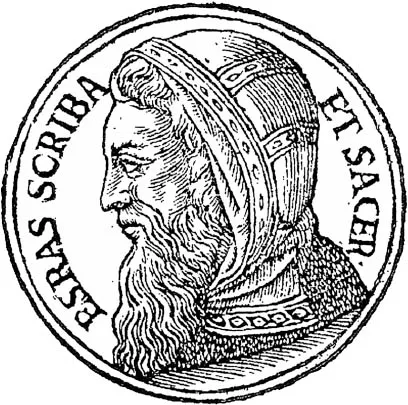
Ezra Scribe and Priest. From Promptuarii Iconum Insigniorum a Seculo Hominum, published by Guillaume Rouillé, 1553.
These first six chapters of the book of Ezra have led to much confusion. There are five Persian kings named Artaxerxes and three kings named Darius. (For the list of Persian kings, see Appendix 1). Most people think that the Darius under whom the temple was completed and dedicated was Darius I (522–486 B.C.E.), but no king named Artaxerxes ruled before him. Only Cyrus and his son, Cambyses, ruled before Darius. This has caused some researchers to contend that the temple was not completed until Darius II (424–405), who ruled after Artaxerxes I,3 but this seems too late a date for the second temple’s dedication, and it leads to other difficulties.4 Those who contend that the temple was dedicated in the time of Darius I, however, have to explain the apparent intrusion into the temple-building story of a letter to a later king.5 Ezra himself does not appear until chapter 7 of the book named for him; the story of the return ends before the story of Ezra begins.
The Story of Ezra in Ezra Chapters 7–10, Nehemiah Chapter 8
Ezra arrives in Judah in the seventh year of a king Artaxerxes, and at this point the temple has already been built and dedicated. Scholars are divided over which Persian King Artaxerxes is meant of the five who bore that name (again, see Appendix 1). The debate is primarily between Artaxerxes I (465–424 B.C.E.) and Artaxerxes II (405–359 B.C.E.). If Ezra arrived in the seventh year of Artaxerxes I, then he preceded Nehemiah (who arrived in 445 B.C.E., the twentieth year of that king). If he arrived in the seventh year of Artaxerxes II, then he followed him. The date of Ezra’s arrival is explored in the following chapter on the historical Ezra. It is concluded there that the reign of Artaxerxes II is most plausible. This means that, contrary to the order of the presentation in the biblical text, Ezra followed Nehemiah by almost half a century.
Ezra is presented to the reader of Ezra chapter 7 as both a scribe and a priest. According to the biblical text, he arrives in Judah and Jerusalem thinking only of teaching Torah (the laws of Moses) there. Apparently he comes with a mandate from Artaxerxes to do so, as well as a command from him to inspect Jerusalem according to the law of God, which he has in his hand, and to appoint judges and magistrates to enforce these laws. This relationship with the Torah is Ezra’s most important and most enduring characteristic and the reason why Ezra appears in postbiblical Jewish, Christian, Samaritan, and Islamic texts. It also is the reason why biblical scholars have attributed to Ezra the origin of Judaism.
Soon after Ezra’s arrival, officials approach him, complaining about the treachery of the many intermarriages between the people Israel and the “peoples of the lands” (Ezra 9:1–2). Although it is not explicitly stated, it is apparently on the basis of the laws of Moses that Ezra has brought with him that the officials complain to him about the intermarriages. Ezra reacts to the news with shock—he tears his hair and beard, rends his clothes, and fasts until evening. He is afraid to pray to God, stating that he is too ashamed and embarrassed to lift his face to him. “Our iniquities have risen higher than our head,” he says. Ezra argues that we had been driven off our land because of our sins and have only now returned, and we are again provoking God with this treachery. After Ezra warns the people that these intermarriages might cause them to be driven off their land again, the people agree to a mass divorce. This story is told in Ezra 9–10.
Scholars wonder how the officials who complained to Ezra about the intermarriages would know that this was a “treachery” against God since Ezra had not yet taught them the law. In fact, we do not read of him preaching the law to the assembled populace until the book of Nehemiah (Nehemiah 8). According to the biblical timeline, Ezra arrives in the seventh year of Artaxerxes; only thirteen years later, when Nehemiah arrives, is Ezra shown reading the law. Some scholars want to rearrange the chapters, therefore, so that the story of Ezra’s law reading is told in the book of Ezra immediately after the story of his arrival. They argue that originally it had actually been placed between Ezra chapter 8 (Ezra’s arrival) and chapter 9 (when the officials complain),6 but there is no external evidence for this.
These stories provide a basis of what can be known about Ezra. Combining their content with what is known of Persian administrative practices, scholars try to disentangle the historical Ezra from the person presented in the biblical text. My efforts in this regard are in chapter 2, while chapter 3 discusses Ezra as he was seen by the biblical writers.
First Esdras—The Law Triumphant
The story of Ezra is told again in the Apocrypha, a set of books written in Greek by Jews, probably in Alexandria, Egypt, and probably in the early Ptolemaic period (323–200 B.C.E.). Because this rewritten Ezra7 was placed before our canonical Ezra-Nehemiah in the new Greek translation (called the Septuagint), it came to be known as 1 Esdras, or Esdras α. First Esdras overlaps in the gist (but not necessarily in every detail) with the last two chapters of 2 Chronicles, with the book of Ezra, and with the story in Nehemiah of Ezra reading the law. It also adds a story about three bodyguards of King Darius, one of whom is Zerubbabel, the Davidic heir and a Persian governor of Yehud (as this Persian province was known).8 Josephus (writing between 70 and 95 C.E.) uses the text of 1 Esdras for this portion of his history of the Jews, rather than the canonical Ezra-Nehemiah, no doubt because the order of the chapters in 1 Esdras makes better sense.
First Esdras stresses that it is because of the sins of the people and their wickedness that the kingdom fell to Babylon. As in the canonical book, Ezra returns to Judah immediately after the temple’s rebuilding and dedication. He quickly learns of the perfidy of the people in their intermarriages and, as in canonical Ezra, he prays and mourns. As in canonical Ezra, the people undergo a mass divorce, but, in contrast to the canonical books, in 1 Esdras the narrative moves immediately to Ezra’s reading the law. The entire story of Nehemiah is omitted. There is nothing in it about Nehemiah’s building the wall or about any of his reforms. The only section included from the book of Nehemiah in 1 Esdras is the story of Ezra reading the law, and with this triumphant story the book ends. First Esdras as well as Josephus’s use of it is discussed in chapter 4.
Fourth Ezra, the Ezra Apocalypse
First Esdras leaves us with the world apparently perfected through Torah, but all goes horribly wrong again when the second temple is destroyed—this time by Rome. Although it purports to be about the fall of the first temple to Babylon, 4 Ezra is actually a Jewish response to this new horror. Fourth Ezra begins with Ezra in Babylon lamenting the destruction of the temple and the exile of his people. He asks how God could have allowed this to happen to his own people, the people whom he loves of all the earth. How could he have turned his beloved over to the people of Babylon who do not know him and do not know his covenant? The Babylonians are not better than the Judeans; they are not freer from sin. Ezra asks about God’s sense of justice: “Are the deeds of those who inhabit Babylon any better? Is that why it has gained dominion over Zion? For when I came here [to Babylon] I saw ungodly deeds without number, and my soul has seen many sinners during these thirty years. And my heart failed me, because I have seen how you endure those who sin, and have spared those who act wickedly, and how you have destroyed your people, and protected your enemies, and have not shown to anyone how your way may be comprehended” (4 Ezra 3:28–31).
This has been the Jewish lament over the ensuing two thousand years of Jewish history. I say two thousand years and not twenty-five hundred, because it can be discerned from the text of 4 Ezra itself that it was written not after the destruction of the first temple by Babylon in 586 B.C.E. but after the destruction of the second temple by Rome in 70 C.E. Where Babylon is read in this story, Rome must be substituted. So Ezra, like Job, asks where God’s justice is, and like the book of Job it provides various answers, none of which are particularly helpful. During the course of his questioning, Ezra sees visions of the end time and the ultimate triumph of good over evil, but even these visions fail to satisfy. After being shown how the world will end and the disasters that will be meted out to those who fail to follow God’s commands, Ezra asks to be imbued with the spirit of holiness that he might write down the law, God’s Torah. The Book of the Law was burned in the conflagration that destroyed the temple, and without it people will not know what God is asking of them. Ezra wants “people to be able to find the path, so that those who want to live in the last days may do so” (4 Ezra 14:22).
Ezra is granted his desire and is given a magic potion to drink; after he drinks it, his heart pours forth understanding, and wisdom increases in his breast, and his spirit retains its memory (4 Ezra 14:40). During the ensuing forty days and forty nights Ezra dictates not only the twenty-four books [of the Bible] that are to be made public but also the seventy books that are to be given only to the “wise among your people, for in them is the spring of understanding, the fountain of wisdom, and the river of knowledge” (4 Ezra 14:47). Ezra is thus granted this one ability to save his people, for if survival depends upon following God’s law, then the only recourse is to read that law, to learn what it is, and to follow it. I discuss this apocalyptic story of Ezra in chapter 5.
Translations of 4 Ezra
Fourth Ezra struck the imagination of later Christian writers, and translations were continually being made of it, up through the Middle Ages and later. It was translated by Christians first from Hebrew into Greek, then into Latin, and from there into Syriac, Ethiopic, Armenian, and three separate independent Arabic translations. These various translations are discussed in Appendix 2.
Christian Additions to 4 Ezra
Not only were many translations made of 4 Ezra, but early Christian writers appropriated this Jewish text by adding two chapters to the beginning (called 5 Ezra) and two chapters at the end (called 6 Ezra). These three sections (5 Ezra, 4 Ezra, and 6 Ezra) are referred to together as II Esdras. According to 5 Ezra especially, the people whom God loves are no longer the Jewish people but the Christian. Faith in the Risen Christ is the solution to Roman persecution, not Torah. These Christian additions are discussed in chapter 6.
Ezra’s Tours of Hell
The apocalyptic nature of 4 Ezra and the visions in it of the end time initiated great elaborations of the story among medieval Christian writers. In these stories, Ezra tours hell, sees the horrific tortures that the sinners undergo there, and begs God to forgive them. In most of these stories, God refuses to relent since these sinners had ample time to repent of their sins while they were yet alive. After death, the die has been cast. These apocalypses, assuredly the forerunners of Dante’s Inferno, are discussed in chapter 7.
Ezra in Medieval Islamic, Samaritan, Christian, and Jewish Scholarship
In 4 Ezra, the point is clearly made that the original Torah of Moses, which had lain protected in the Jerusalem temple, had been destroyed in the conflagration that destroyed the city. Because of Ezra’s faith and his merit before God, God provides a potion that enables Ezra to dictate to “ready scribes” the twenty-four books of the Bible that he is to make public, as well as the seventy secret texts that are to be revealed only to the wise. The twenty-four biblical books include, of course, the five books of Moses, the Torah. Samaritan and Islamic medieval scholars, as well as several of the Church Fathers, have argued that Ezra falsified the Torah when he rewrote it and that the Torah we have now could not be the text that Moses wrote. These Church Fathers claimed that if we had the original Torah of Moses, Jesus’s coming and resurrection would have been more clearly revealed than it is now; Muslim scholars claim that had we the original Torah of Moses, Mohammed would surely have been revealed i...
Table of contents
- Cover
- Title
- Copyright
- Dedication
- Contents
- Illustrations
- Series Editor’s Preface
- Preface
- 1 Introduction to the Continuing Story of Ezra, Scribe and Priest
- 2 The Historical Ezra
- 3 Ezra in the Hebrew Bible
- 4 First, or Greek, Esdras—The Law Triumphant
- 5 Fourth Ezra—The Ezra Apocalypse
- 6 The Christian Additions to the Ezra Apocalypse
- 7 Ezra Ascends to Heaven and Goes to Hell
- 8 Ezra among Christians, Samaritans, Muslims, and Jews of Late Antiquity
- 9 Ezra in Modern Scholarship
- Postscript: Reflections on Ezra and the Law
- Appendix 1: Chronology
- Appendix 2: Versions and Translations of 4 Ezra
- Notes
- Bibliography
- Index of Ancient Sources
- Index of Modern Authors
- Subject Index
Frequently asked questions
Yes, you can cancel anytime from the Subscription tab in your account settings on the Perlego website. Your subscription will stay active until the end of your current billing period. Learn how to cancel your subscription
No, books cannot be downloaded as external files, such as PDFs, for use outside of Perlego. However, you can download books within the Perlego app for offline reading on mobile or tablet. Learn how to download books offline
Perlego offers two plans: Essential and Complete
- Essential is ideal for learners and professionals who enjoy exploring a wide range of subjects. Access the Essential Library with 800,000+ trusted titles and best-sellers across business, personal growth, and the humanities. Includes unlimited reading time and Standard Read Aloud voice.
- Complete: Perfect for advanced learners and researchers needing full, unrestricted access. Unlock 1.5M+ books across hundreds of subjects, including academic and specialized titles. The Complete Plan also includes advanced features like Premium Read Aloud and Research Assistant.
We are an online textbook subscription service, where you can get access to an entire online library for less than the price of a single book per month. With over 1.5 million books across 990+ topics, we’ve got you covered! Learn about our mission
Look out for the read-aloud symbol on your next book to see if you can listen to it. The read-aloud tool reads text aloud for you, highlighting the text as it is being read. You can pause it, speed it up and slow it down. Learn more about Read Aloud
Yes! You can use the Perlego app on both iOS and Android devices to read anytime, anywhere — even offline. Perfect for commutes or when you’re on the go.
Please note we cannot support devices running on iOS 13 and Android 7 or earlier. Learn more about using the app
Please note we cannot support devices running on iOS 13 and Android 7 or earlier. Learn more about using the app
Yes, you can access Ezra & the Law in History and Tradition by Lisbeth S. Fried, James L. Crenshaw in PDF and/or ePUB format, as well as other popular books in Teologia e religione & Biografie in ambito biblico. We have over 1.5 million books available in our catalogue for you to explore.