![]()
Step 1
Scope the Problem
If the only tool you have is a hammer, you tend to see every problem as a nail.
— Abraham Maslow, Psychologist
When an incident occurs the first thing you need to do is scope the problem. Scoping the problem is the initial information gathering stage of cause analysis. You are going to rely on the material that you acquire during this stage for the rest of your analysis; so be specific.
To properly scope a problem, use the following investigation techniques:
1.Document the problem statement which gives a concise reason for the investigation resembling a newspaper headline.
2.Build on the problem statement, using a problem description which includes information about the incident’s time and location, related equipment, involved personnel, consequences, and significance.
3.Use a difference map to illustrate where the problem is and is not.
4.Conduct an extent of condition review to determine whether the current problem exists in other activities, processes, programs, organizations, or elsewhere in the business and whether prompt correction is needed.
In this section, you will see why and when you should use each of these tools/techniques. Each technique can enhance your knowledge of what happened, when it happened, where it happened, and who was involved.
Basics of Cause Analysis for Step 1
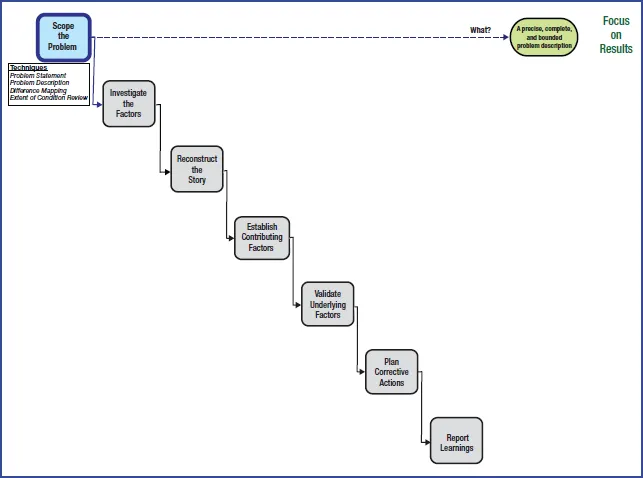
Many organizations document adverse conditions and incidents on some type of problem or condition report that will be the starting point for your investigation. Sometimes organizational management will provide you with a written charter that defines the investigation and the depth to which your evaluation should go. After you have been assigned to perform an incident investigation, use the condition report and charter (if provided) to start to understand the specific problem and to determine the extent of that problem (see Figure 1-1). Once Step 1, Scope the Problem, has been completed, you should have in writing a precise, complete, and bounded problem description.
Figure 1-1. Step 1 Scope the Problem
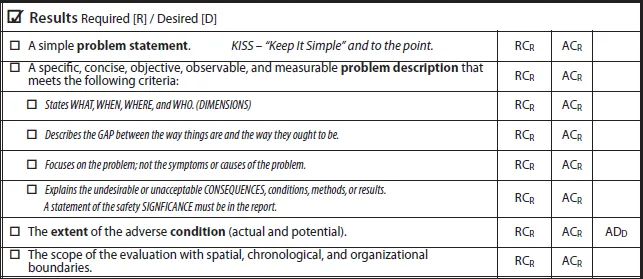
Use Table 1-1 as a checklist to guide you through Step 1 of the investigation. Table 1-1 has two main parts: the behaviors (actions/tasks) needed and the results that should be achieved by the end of Step 1. Most behaviors listed need to be performed; however, some behaviors may not be appropriate for a particular type of problem. For example, if you are not working on a problem involving a piece of equipment, you would not need to “Verify an equipment performance evaluation has been initiated.” For some of the behaviors listed, the following techniques (listed by section number) will help you complete checklist Step 1:
1.1Problem Statement
1.2Problem Description
1.3Difference Map
1.4Extent of Condition Review
Significant problems are generally put through the most rigorous type of evaluation called root cause analysis (RC) and all tasks on the checklist should be completed. This manual is set up so you can complete all the tasks needed to complete the root cause analysis of the most significant problems of your business.
However, other business problems are less significant. These problems are still very important to the business and viewed as high value learning opportunities; so the problems are put through a type of evaluation called apparent cause analysis (AC). During Step 1 of root cause analysis and apparent cause analysis, you should complete all the items on Table 1-1. Minor problems are generally labeled as adverse (AD) with only minimal analysis required. Your supervision or management will determine what depth of analysis a problem needs (RC, AC, or AD). Generally, fewer evaluation tasks are required for apparent cause analysis (AC) than for root cause analysis (RC). Likewise, fewer evaluation tasks are required for minor or adverse (AD) conditions than for apparent cause analysis (AC).
In Table 1-1, a required result is designated with the subscript “R” and needs to be completed. A desired result is designated with the subscript “D” and is generally only completed if the result can be achieved easily (with a minimal amount of effort and in a short time).
Table 1-1. Step 1 Jump Start Checklist
1.1 Problem Statement
What is it?
A problem statement concisely describes the item you are concerned about and the item’s deviation or malfunction for which you want to find the cause. A problem statement provides factual information to identify what has gone wrong (defect/deviation) with what (object). A good problem statement is brief, precise, and based on what can be observed.
Why is it useful?
The problem statement provides a starting point for problem-solving by identifying the specific person, place, or thing observed and what is substandard about the observed performance. Later, it helps all readers and listeners concentrate on the core problem − the reason for this invest...