- 308 pages
- English
- PDF
- Available on iOS & Android
About this book
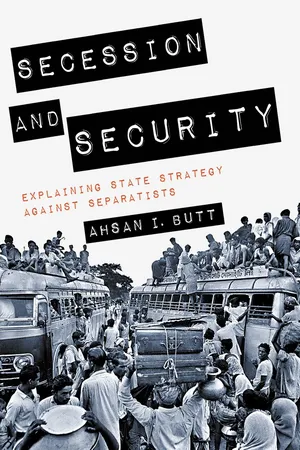
In Secession and Security, Ahsan I. Butt argues that states rather than separatists determine whether a secessionist struggle will be peaceful, violent, or genocidal. He investigates the strategies, ranging from negotiated concessions to large-scale repression, adopted by states in response to separatist movements. Variations in the external security environment, Butt argues, influenced the leaders of the Ottoman Empire to use peaceful concessions against Armenians in 1908 but escalated to genocide against the same community in 1915; caused Israel to reject a Palestinian state in the 1990s; and shaped peaceful splits in Czechoslovakia in 1993 and the Norway-Sweden union in 1905.
Butt focuses on two main cases—Pakistani reactions to Bengali and Baloch demands for independence in the 1970s and India's responses to secessionist movements in Kashmir, Punjab, and Assam in the 1980s and 1990s. Butt's deep historical approach to his subject will appeal to policymakers and observers interested in the last five decades of geopolitics in South Asia, the contemporary Israeli-Palestinian conflict, and ethno-national conflict, separatism, and nationalism more generally.
Tools to learn more effectively

Saving Books

Keyword Search

Annotating Text

Listen to it instead
Information
Table of contents
- Secession and Security
Frequently asked questions
- Essential is ideal for learners and professionals who enjoy exploring a wide range of subjects. Access the Essential Library with 800,000+ trusted titles and best-sellers across business, personal growth, and the humanities. Includes unlimited reading time and Standard Read Aloud voice.
- Complete: Perfect for advanced learners and researchers needing full, unrestricted access. Unlock 1.4M+ books across hundreds of subjects, including academic and specialized titles. The Complete Plan also includes advanced features like Premium Read Aloud and Research Assistant.
Please note we cannot support devices running on iOS 13 and Android 7 or earlier. Learn more about using the app