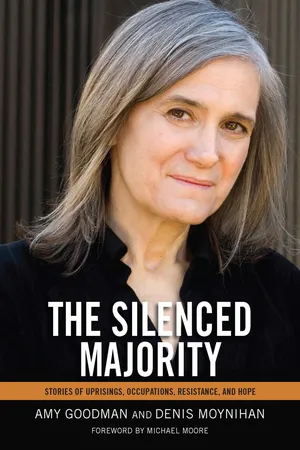
Now a New York Times Best Seller! "Amy Goodman has taken investigative journalism to new heights of exciting, informative, and probing analysis." --Noam ChomskyAmy Goodman and Denis Moynihan began writing a weekly column, "Breaking the Sound Barrier," for King Features Syndicate in 2006. This timely new sequel to Goodman's New York Times bestseller of the same name gives voice to the many ordinary people standing up to corporate and government power-and refusing to be silent. The Silenced Majority pulls back the veil of corporate media reporting to dig deep into the politics of "climate apartheid," the implications of the Fukushima nuclear disaster, the movement to halt the execution of Troy Anthony Davis, and the globalization of dissent "From Tahrir Square to Liberty Plaza." Throughout Goodman and Moynihan show the work of ordinary people to change their media--and change the world. Amy Goodman is a multiple New York Times best-selling author and the host and executive producer of Democracy Now! a daily independent news program airing on more than one thousand television and radio stations. Time named Democracy Now! its "Pick of the Podcasts," along with NBC's Meet the Press. Goodman is the first journalist to receive the Right Livelihood Award, widely known as the "Alternative Nobel Prize." Denis Moynihan, since helping co-found Democracy Now! as an independent production company in 2002, has participated in the organization's growth, focusing primarily on distribution, infrastructure development, and coordinating complex live broadcasts from all continents (save Antarctica). He lives in Denver, Colorado.
eBook - ePub
The Silenced Majority
Stories of Uprisings, Occupations, Resistance, and Hope
- 380 pages
- English
- ePUB (mobile friendly)
- Available on iOS & Android
eBook - ePub
The Silenced Majority
Stories of Uprisings, Occupations, Resistance, and Hope
About this book
Trusted by 375,005 students
Access to over 1.5 million titles for a fair monthly price.
Study more efficiently using our study tools.
Information
WikiLeaks and the Crackdown on Dissent
May 31, 2012
WikiLeaks, War Crimes, and the Pinochet Principle
WikiLeaks founder Julian Assange’s protracted effort to fight extradition to Sweden suffered a body blow this week. Britain’s Supreme Court upheld the arrest warrant, issued in December 2010. After the court announced its split 5–2 decision, the justices surprised many legal observers by granting Assange’s lawyers an opportunity to challenge their decision—the first such reconsideration since the high-profile British extradition case from more than a decade ago against former Chilean dictator Augusto Pinochet. The decision came almost two years to the day after Pvt. Bradley Manning was arrested in Iraq for allegedly leaking hundreds of thousands of classified U.S. government documents to WikiLeaks. The cases remind us that all too often whistle-blowers suffer, while war criminals walk.
Assange has not been charged with any crime, yet he has been under house arrest in England for close to two years, ever since a “European Arrest Warrant” was issued by Sweden (importantly, by a prosecutor, not by a judge). Hoping to question Assange, the prosecutor issued the warrant for suspicion of rape, unlawful coercion, and sexual molestation. Assange offered to meet the Swedish authorities in their embassy in London, or in Scotland Yard, but was refused.
Assange and his supporters allege that the warrant is part of an attempt by the U.S. government to imprison him, or even execute him, and to shut down WikiLeaks. In April 2010, WikiLeaks released a U.S. military video that it named “Collateral Murder,” with graphic video showing an Apache helicopter unit killing of at least twelve Iraqi civilians, including a Reuters cameraman and his driver. In July 2010, WikiLeaks released the Afghan War Logs, tens of thousands of secret U.S. military communications that laid out the official record of the violent occupation of Afghanistan, the scale of civilian deaths and likely war crimes. The Swedish arrest warrant followed just weeks later.
So many public figures have called for Assange’s assassination that a website was created to catalog the threats. Former Arkansas governor, presidential candidate and Fox News commentator Mike Huckabee said, “Anything less than execution is too kind a penalty.” Prominent conservative Bill Kristol said, “Why can’t we use our various assets to harass, snatch or neutralize Julian Assange and his collaborators, wherever they are?”
Death threats from right-wing ideologues are one thing. The main concern with an extradition to Sweden is that Assange will then be extradited to the United States. In another prominent document release by WikiLeaks, called the Global Intelligence Files, a portion of up to 5 million emails were released from a private, global intelligence firm called Stratfor, based in Austin, Texas. The firm’s vice president for intelligence, Fred Burton, wrote in a January 26, 2011, email: “Not for Pub—We have a sealed indictment on Assange. Pls protect.” If an indictment has been issued in secret, then Assange could find himself in U.S. custody shortly after landing in Sweden. He could be charged with espionage (the Obama administration has already invoked the law more than all previous U.S. administrations combined), and could be imprisoned for life or executed.
The United Kingdom carefully considers extradition requests, as famously demonstrated when crusading Spanish Judge Baltasar Garzón hoped to prosecute former Chilean dictator Pinochet for torture committed under his rule from 1973 to 1990. Based on Garzón’s indictment, Pinochet was arrested in 1998 while traveling in London. After sixteen months of hearings, the British courts finally decided that Pinochet could be extradited to Spain. The British government intervened, overruling the court, and allowed him to return to Chile.
Garzón is known for taking on global human-rights cases under the doctrine of universal jurisdiction, indicting Osama bin Laden for the 9/11 attacks, and probing the abuse of U.S. prisoners at Guantánamo Bay. When he began investigating abuses under the fascist government of General Francisco Franco, who ruled Spain for forty years, Garzón became the target of the right in Spain and was disbarred in early 2012, effectively ending his legal career.
Judge Garzón and Julian Assange have taken on entrenched power, whether government, military, or corporate. Bradley Manning stands accused of the same. In differing degrees, their lives have forever changed, their careers, their freedoms, and their reputations threatened or destroyed. This week, Hillary Clinton will be making the first official trip to Sweden in years. Why? What role is the U.S. government playing in Assange’s case? This week’s developments bear crucially on the public’s right to know, and why whistle-blowers must be protected.
December 21, 2011
Bradley Manning and the Fog of War
Accused whistle-blower Pvt. Bradley Manning turned twenty-four Saturday. He spent his birthday in a pretrial military hearing that could ultimately lead to a sentence of life . . . or death. Manning stands accused of causing the largest leak of government secrets in United States history.
More on Manning shortly. First, a reminder of what he is accused of leaking. In April 2010, the whistle-blower website WikiLeaks released a video called “Collateral Murder.” It was a classified U.S. military video from July 2007, from an Apache attack helicopter over Baghdad. The video shows a group of men walking, then the systematic killing of them in a barrage of high-powered automatic fire from the helicopter. Soldiers’ radio transmissions narrate the carnage, varying from cold and methodical to cruel and enthusiastic. Two of those killed were employees of the international news agency Reuters: Namir Noor-Eldeen, a photojournalist, and Saeed Chmagh, his driver.
Renowned whistle-blower Daniel Ellsberg, who released the Pentagon Papers that helped end the war in Vietnam and who himself is a Marine veteran who trained soldiers on the laws of war, told me: “Helicopter gunners hunting down and shooting an unarmed man in civilian clothes, clearly wounded . . . that shooting was murder. It was a war crime. Not all killing in war is murder, but a lot of it is. And this was.”
The WikiLeaks release of the Afghan War Logs followed months later, with tens of thousands of military field reports. Then came the Iraq War Diaries, with close to 400,000 military records of the U.S. war in Iraq. Next was Cablegate, WikiLeaks’ rolling release (with prominent print-media partners, including the New York Times and the Guardian in Britain) of classified U.S. State Department cables, more than a quarter-million of them, dating from as far back as 1966 up to early 2010. The contents of these cables proved highly embarrassing to the U.S. government and sent shock waves around the world.
Among the diplomatic cables released were those detailing U.S. support for the corrupt Tunisian regime, which helped fuel the uprising there. Noting that Time magazine named “The Protester,” generically, as Person of the Year, Ellsberg said Manning should be the face of that protester, since the leaks for which he is accused, following their impact in Tunisia, “in turn sparked the uprising in Egypt . . . which stimulated Occupy Wall Street and the other occupations in the Middle East and elsewhere. So, one of those ‘persons of the year’ is now sitting in a courthouse.”
Another recently revealed Cablegate release exposed details of an alleged 2006 massacre by U.S. troops in the Iraqi town of Ishaqi, north of Baghdad. Eleven people were killed, and the cable described eyewitness accounts in which the group, including five children and four women, was handcuffed, then executed with bullets to the head. The U.S. military then bombed the house, allegedly to cover up the incident. Citing attacks like these, the Iraqi government said it would no longer grant immunity to U.S. soldiers in Iraq. President Barack Obama responded by announcing he would pull the troops out of Iraq. Like a modern-day Ellsberg, if Manning is guilty of what the Pentagon claims, he helped end the war in Iraq.
Back in the Fort Meade, Maryland, hearing room, defense attorneys painted a picture of a chaotic forward operating base with little to no supervision, no controls whatsoever on soldiers’ access to classified data, and a young man in uniform struggling with his sexual identity in the era of “Don’t Ask, Don’t Tell.” Manning repeatedly flew into rages, throwing furniture and once even punching a superior in the face, without punishment. His peers at the base said he should not be in a war zone. Yet he stayed, until his arrest eighteen months ago.
Since his arrest, Manning has been in solitary confinement, for much of the time in Quantico, Virginia, under conditions so harsh that the U.N. special rapporteur on torture is investigating. Many believe the U.S. government is trying to break Manning in order to use him in its expected case of espionage against WikiLeaks founder Julian Assange. It also sends a dramatic message to any potential whistle-blower: “We will destroy you.”
For now, Manning sits attentively, reports say, facing possible death for “aiding the enemy.” The prosecution offered words Manning allegedly wrote to Assange as evidence of his guilt. In the email, Manning described the leak as “one of the more significant documents of our time, removing the fog of war and revealing the true nature of 21st century asymmetrical warfare.” History will no doubt use the same words as irrefutable proof of Manning’s courage.
October 7, 2009
Watch What You Tweet
A social worker from New York City was arrested last week while in Pittsburgh for the G-20 protests, then subjected to an FBI raid this week at home—all for using Twitter. Elliot Madison faces charges of hindering apprehension or prosecution, criminal use of a communication facility, and possession of instruments of crime. He was posting to a Twitter feed (or tweeting, as it is called) publicly available information about police activities around the G-20 protests, including information about where police had issued orders to disperse.
While alerting people to public information may not seem to be an arrestable offense, be forewarned: Many people have been arrested for the same “crime”—in Iran, that is.
Last June 20, as Iranians protested against the conduct and results of their national election, President Barack Obama said in a statement, “The universal rights to assembly and free speech must be respected, and the United States stands with all who seek to exercise those rights.”
His statement was released in English, Farsi, and Arabic and posted on the White House’s very own Twitter feed. His tweet read, “We call on the Iranian government to stop all violent and unjust actions against its own people.”
U.S. Sens. Charles Schumer, D-N.Y., and Lindsey Graham, R-S.C., wrote to Secretary of State Hillary Clinton, urging her to pressure European nations to restrict sales of eavesdropping technology to Iran. They wrote: “Following recent elections, the Iranian government has used a new communications monitoring center to interfere with and suppress Internet and cell phone communications as part of efforts to crackdown on Iranian citizens peacefully demonstrating . . . including voice calls, email, text messaging, instant messages, and Web traffic, as well as posts to social networking sites such as Twitter, MySpace and Facebook.”
The U.S. State Department, impressed with the importance of Twitter to Iranian protests, asked Twitter to delay system maintenance that might have interrupted the service during the Iranian protests.
While Madison optimistically mused, “I’m expecting the State Department will come out and support us also,” his lawyer, respected civil rights attorney Martin Stolar, said: “This is just unbelievable. It is the thinnest, silliest case that I’ve ever seen. It tends to criminalize support services for people who are involved in lawful protest activity. And it’s just shocking that somebody could be arrested for essentially walking next to somebody and saying: ‘Hey, don’t go down that street, because the police have issued an order to disperse. Stay away from there.’”
Madison, his wife, and housemates were roused from sleep during the weekend when the Joint Terrorism Task Force swept into their house, handcuffing them for hours, searching the house and removing computers and other property from everyone in the house. Madison said the FBI “for 16 hours, proceeded to take everything, from plush toys to kitchen magnets and lots of books . . . they took Curious George stuffed animals.”
Rather than encourage and support the use of distributed, decentralized social networks to strengthen our democracy and dissent (remember, the Obama campaign itself relied extensively on these online and mobile tools), the government seems headed in the opposite direction. Los Angeles Chief of Police William Bratton recently won acclaim at the annual meeting of the Major Cities Chiefs Association, a professional organization of police executives representing sixty-three of the largest cities in the United States and Canada. Bratton has launched “iWatchLA,” described as “a community awareness program created to educate the public about behaviors and activities that may have a connection to terrorism.” The iWatch program, despite Bratton’s assertion otherwise, is about spying on your neighbors and turning them in to the police.
One Iranian tweeter for the virtual news hub Tehran Bureau recalled the June protests in an essay: “An officer spoke to us through a loud speaker: ‘Disperse: This is your last warning.’ The sight of them made my knees tremble, but the wave pushed on and so I went along.” He was beaten, bloodied, arrested, and held for twenty days. While Elliot Madison was not physically harmed, his legal battles are just beginning, and his case could prove central to the future of free speech in the mobile, digital age.
November 25, 2009
Books, Not Bombs
California campuses have been rocked by protests this past week, provoked by massive student fee increases voted on by the University of California Board of Regents. After a year of sequential budget cuts, faculty and staff dismissals and furloughs, and the elimination of entire academic departments, the 32 percent fee increase proved to be the trigger for statewide actions of an unprecedented scale. With President Barack Obama’s Afghanistan war strategy—which, accordi...
Table of contents
- Cover
- Contents
- Acknowledgments
- Foreword by Michael Moore
- Introduction: Occupy the Media - Journalism for (and by) the 99 Percent
- Obama's Wars: A Tragedy in Three Acts Act I: The Wars Abroad
- Obama’s Wars: A Tragedy in Three Acts Act II: The War on Veterans and Soldiers
- Obama’s Wars: A Tragedy in Three Acts Act III: The War on the Public Treasury
- Money in Politics
- Climate Change
- Dirty Energy
- Race, Racism,and the Myth of Post-Racial America
- Capital Punishment: The Machinery of Death
- WikiLeaks and the Crackdown on Dissent
- Uprisings: From the Arab Spring to Occupy Wall Street
- When Corporations Rule
- Undoing the Coups, from Haiti to Honduras
- More News from the Unreported World
- Luminaries
- Stop the Violence
- About Democracy Now!
- About the authors
- About Haymarket Books
- Also from Haymarket Books
Frequently asked questions
Yes, you can cancel anytime from the Subscription tab in your account settings on the Perlego website. Your subscription will stay active until the end of your current billing period. Learn how to cancel your subscription
No, books cannot be downloaded as external files, such as PDFs, for use outside of Perlego. However, you can download books within the Perlego app for offline reading on mobile or tablet. Learn how to download books offline
Perlego offers two plans: Essential and Complete
- Essential is ideal for learners and professionals who enjoy exploring a wide range of subjects. Access the Essential Library with 800,000+ trusted titles and best-sellers across business, personal growth, and the humanities. Includes unlimited reading time and Standard Read Aloud voice.
- Complete: Perfect for advanced learners and researchers needing full, unrestricted access. Unlock 1.5M+ books across hundreds of subjects, including academic and specialized titles. The Complete Plan also includes advanced features like Premium Read Aloud and Research Assistant.
We are an online textbook subscription service, where you can get access to an entire online library for less than the price of a single book per month. With over 1.5 million books across 990+ topics, we’ve got you covered! Learn about our mission
Look out for the read-aloud symbol on your next book to see if you can listen to it. The read-aloud tool reads text aloud for you, highlighting the text as it is being read. You can pause it, speed it up and slow it down. Learn more about Read Aloud
Yes! You can use the Perlego app on both iOS and Android devices to read anytime, anywhere — even offline. Perfect for commutes or when you’re on the go.
Please note we cannot support devices running on iOS 13 and Android 7 or earlier. Learn more about using the app
Please note we cannot support devices running on iOS 13 and Android 7 or earlier. Learn more about using the app
Yes, you can access The Silenced Majority by Amy Goodman, Denis Moynihan in PDF and/or ePUB format, as well as other popular books in Social Sciences & Media Studies. We have over 1.5 million books available in our catalogue for you to explore.