![]()
1
What is Microhydro?
Introducing Electricity and Hydraulics
THIS BOOK IS ABOUT MAKING ELECTRICITY FROM WATER POWER. Thus you do need to know something about how electricity works, and a bit about how water behaves. Luckily, the engineering has been done long ago, and so you just need to know enough to make informed choices.
If you feel you already have a grasp of the fundamentals, skip this part and go directly to the next chapter on assessing your site and your requirements.
About DC
Direct current (DC) was the original kind of electricity. Although alternating current (AC) is the most commonly used form of electricity today, DC is still found everywhere in modern life. Any time power is to be stored, or used without a connection to the power grid, chances are that it is DC.
Batteries are the most common source of DC. A battery is like a storage tank of electricity. The power comes out one side or pole of the battery and flows to the other side. These poles are called positive and negative. Your watch, your laptop, the starter on your car, and a multitude of other technologies in everyday life use DC.
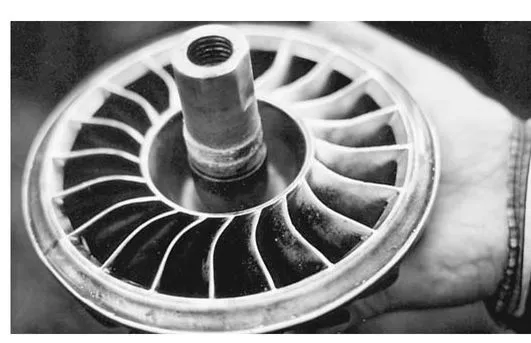
A Turgo microhydro turbine.
Credit: Ann Cavanagh.
dp n="23" folio="4" ?There are other ways in which DC is different from the plug-in AC power that we are all used to as well. Most DC applications are lower voltage, such as 12 or 24 volts, while AC voltages in common use are 120 or 240 volts, or even higher.
DC has many uses, but it is not the same as the power that comes out of your plug-ins. Many things that you want to plug in cannot be plugged directly into batteries.
There are many special appliances adapted for DC. However, the best and cheapest equipment runs on 120-volt AC sine wave current — just like the standard North American current.
About AC
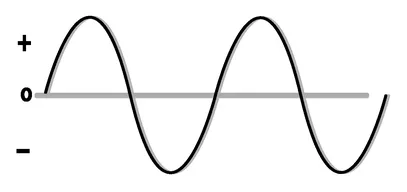
AC is the kind of electricity that comes out of your wall outlets. AC means “alternating current,” which means that it changes direction. An important feature about changing direction is how fast it changes direction, which is measured as “frequency.” North American power has a frequency of 60 cycles per second. In some other parts of the world, the AC frequency may be 50 cycles per second.
The sine wave graphs the way alternating current changes direction.
Credit: Corri Loschuck.
AC voltages are higher than DC voltages. Electricity comes out of outlets in North America at 120 volts or thereabouts, and 240-volt circuits are used in homes for large loads such as heaters.
The process of changing DC into AC is called “inverting” and the device that does it is called an “inverter.” Converting 120 - volt AC into 12-volt DC is a relatively easy process electronically. The transformer to bring the AC to 12 volts and the rectifiers to make the AC into DC by flowing only one way is old technology, and has been widely used for years. However, changing battery power into AC that looks like it came from an outlet is a real trick. One of the reasons that microhydro isn’t everywhere is that inverters were only perfected in the late 1980s. They were available earlier, but they were unreliable and expensive. Since they were expensive, they were often on the small side for the jobs asked of them. As a result, they were routinely overloaded, and their reliability suffered.
Moving Power
Power needs to get from where it is generated to where it is used, and losses due to resistance are inevitable. As with frictional losses in pipes, which can be corrected through use of larger pipes, electrical losses are reduced by using a larger conductor. And in both cases, a cost effective solution balances losses and cost.
Electricity and Water
If you keep your sense of humor about it, electricity is “like” water, in many ways. For example, the flow of water is like electrical current. Where the flow of water is measured in gallons per minute, electrical current is measured in “amperes” or “amps” for short. Amperes are abbreviated as “A”.
Now to carry the analogy further, consider water pressure. Water pressure is “like” electrical voltage. The unit of voltage is the volt (V). The amount of pressure you read on your gauge is also a direct measure of the height or head of water above it. Pressure is measured in pounds per square inch and is described as “feet of head.”
The pressure in a pipe is highest when no water is flowing. This is called the static pressure or static head. As water begins to flow in a pipe, friction takes its toll and some of the pressure is lost to friction. The more water flows, the more pressure is lost. Since pressure and head are the same, pressure loss can also legitimately be called “head loss.” The pressure that remains from the static head when frictional losses are subtracted is called the “net” pressure or net head.
Electrical resistance, measured in ohms, works very much the same way as pipe friction. As current flows, potential is lost to resistance. The more current flows, the more is lost. This is called “voltage drop.”
dp n="25" folio="6" ? Calculating Electrical Characteristics
Current, voltage, and resistance are all related to each other in a pretty simple way — current equals voltage divided by resistance. Thus, you can calculate any value, as long as you have the other two. For example, voltage equals the current times the resistance.
Water power is the product of flow and pressure, and electrical power is the product of amperage and voltage. Just as horsepower would be the unit of shaft power, the watt (W) is the unit of electrical power. A kilowatt is 1,000 watts. We pay our electrical bills by the kilowatt hour, which is 1,000 watts used for an hour.
Hydroelectricity
Water power has been used to power equipment for tasks such as milling grain and pumping water for many hundreds of years. Slow moving waterwheels are ideal for some kinds of jobs, and there are many traditional designs.
Generating electricity is the kind of job for which traditional waterwheels are less suitable. Generally, making electricity requires rotating machinery at many hundreds of rpm, while water wheels may typically have rotational rates of a dozen rpm or less. During the nineteenth century, the traditional waterwheel was made more efficient. The Poncelet wheel, with a vertical spindle and a runner with a curved blade, evolved into the Francis turbine which is in very common use today as a hydroelectric turbine.
In 1866, a ten-year-old Nikola Tesla had a “vision” of harnessing the power of Niagara Falls with “some kind of wheel.” In the 1880s, the first hydroelectric power systems were developed.
Focus on Microhydro
Here, the focus is on sites that are big enough to power a household, or a few households, in the North American manner. In order to provide a bit of perspective on just how much power North Americans use, we have also included a case study from a remote village in the Philippines.
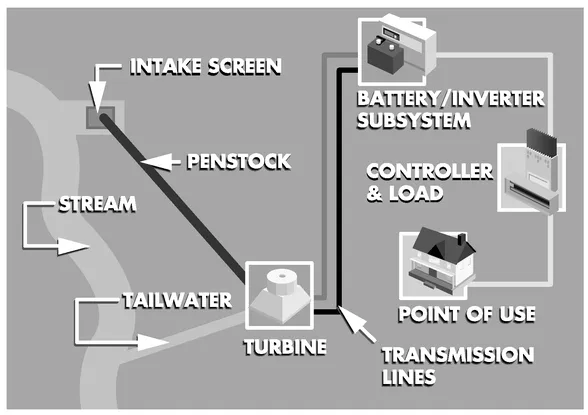
dp n="26" folio="7" ? A typical system.
Credit: Corri Loschuck.
Microhydro uses the same kinds of turbines which are used in larger systems. Improvements in microhydro practice have not been driven by innovations in turbine design, but rather by improvements in two areas of balance of system components — electronic load controllers for AC systems, and inverters for battery charging systems.
Prior to the 1980’s, the flow of water was controlled to keep the alternator speed steady by activating a needle nozzle. This combination worked well, but was expensive to purchase and operate; the arrival of electronic load controlling meant that power was used where required. In a typical household, if a light is turned off, then the hot water tank or space heating is exactly that much hotter; all power produced goes somewhere useful. The development of this technology has contributed significantly to the spread of microhydro technology.
Additionally, battery charging systems and small sources of power in general were hampered by early inverters, which were expensive, fragile, noisy acoustically and electrically, and not very powerful. Dramatic improvements in modern inverters means that the number of sites that are practical to develop have increased accordingly, considering that there are many more sites that can produce a few dozen or hundred watts of DC charging power than those that can produce a few kilowatts of AC.
Microhydro technology will likely continue to improve over time. As the technology advances and more efficient appliances and light sources continue to be developed, microhydro promises to continue to offer more for less.
In a typical system, water leaves a stream through an intake ditch or canal. Water is brought to the forebay, where intake screens remove debris that could clog the jets of the turbines. Water flows from the intake through the penstock to the turbine and generator unit, where power is generated. The power is transmitted to a battery/inverter subsystem near the point of use.
Good News, Bad News
As explained, microhydro is a reliable, well worked out technology, but it does have advantages and disadvantages.
First, the good news: If you have a site, microhydro can deliver the best bang per buck when it comes to providing electrical service from renewable energy. Significant power can be generated with flows of two gallons per minute, or from drops as small as two feet, and power can be delivered, in a cost effective fashion, a mile or more from where it is generated to where it is being used.
Microhydro power is continuous power, unlike the sun, which goes down at night, south for the winter, and can go behind a cloud at any time; or the wind, which blows at some times and not others. Sites can easily be winterized to provide for the winter months when the solar resource may be almost non-existent.
Additionally, existing pipelines, such as those delivering gravity domestic water to a house, can often be used as penstocks to generate electricity.
Taking all this into account, a small microhydro system can be developed for as little as $650 (Cdn$1,000). With the help of this book, you will be able to do the much of the installation yourself (most microhydro systems are owner installed), which naturally contributes to the low cost.
If you are connected to the utility grid, in some Canadian provinces and in 35 American states, you can either offset your own electrical consumption (net metering) or be an independent power-producer without too many barriers.
There are, however, some disadvantages to microhydro.
Although low cost microhydro is possible, certain flow, head, and output characteristics are required. More conventional systems in more usual circumstances require considerable balance of system components, including pipeline, transmission line, controller, batteries, and inverter. A more typical whole system cost would be about $1,900 – $9,700 (Cdn$3000 – $15,000), about the same as a motorcycle or a used pickup truck.
Not all sites where there is potential energy available will allow microhydro to be developed in a cost-effective ...