![]()
Living Sustainably
Anne Hansen
Eco-economics in the Classroom by Susan Santone Measuring Your School’s Ecological Footprint by Julie Sawchuk and Tim Cameron Choosing Our Future by Jan Cincera Linking Trade, Human Rights and the Environment by Tricia Jane Edgar Planet Transit Game: Profit or Survival? by Georgi Marshall Global Morning: A Consumer Awareness Activity by Mary Gale Smith The Debate About Hemp: A Role Play by Sara Francis Teaching About Biodiesel by Richard Lawrence Making Biodiesel from Waste Vegetable Oil by Alison K. Varty and Shane C. Lishawa Small-scale Science by Alan Slater Green Driving Lessons by Tim Altieri ![]()
Eco-economics in the Classroom
Ecological economics offers teachers and students opportunities to explore such vital and timely topics as consumption, population, climate change and development
Illustrations by Tom Goldsmith
by Susan Santone
Subject areas: social studies, economics, environmental studies
Key concepts: carrying capacity, resource use, waste production/assimilation, product lifecycles, incentives, subsidies, externalities, price versus cost, indicators and measurement
Skills: analyzing and interpreting data, generating and investigating questions, connecting cause and effect, developing reasoned positions, making informed decisions, communicating information, conducting community research
Location: classroom with optional research in the community
Time: 3–5 class sessions and time for research out of class
Materials: global environmental data and information about economic policies at the local, national or global levels; for simulation activity, see page 101
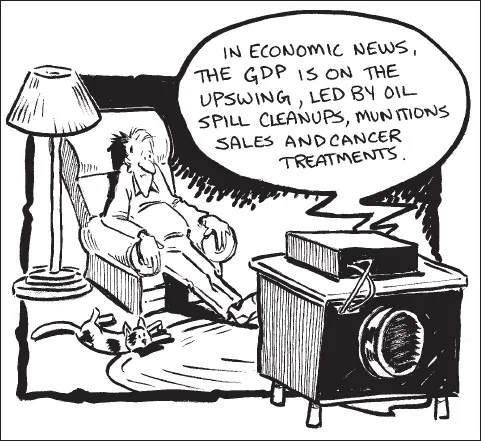
Oil spills are good for us!” declares a high school student to an audience of parents and civic leaders. “And so are crime and divorce!” The girl’s provocative statements elicit uneasy laughter from the crowd as they realize that she is right: oil spills, divorce and crime are good news when measured by the purely monetary terms of the Gross Domestic Product, the “character” played by the girl in a thought-provoking skit. The student’s presentation followed a series of lessons on ecological economics, an approach to the economy that is gaining support from environmentalists and business leaders alike. When tested against the science of ecology, conventional market ideas often fall short. From the narrow focus on profits to the belief that unfettered growth is both desirable and possible, some of the most basic economic assumptions simply cannot be reconciled with nature’s fundamental laws of limits, interdependence and balance.
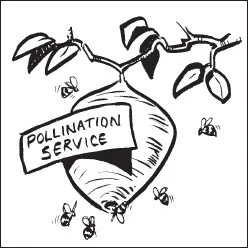
Take, for example, the Gross Domestic Product (GDP). As the student’s skit made clear, the GDP counts as positive any activity in which money is spent. When it comes to clear cuts, oil spills, divorce and crime, the GDP sees only the financial “upside” — the timber sales, clean-up costs, legal fees and other dollars spent. The negative impacts of these activities, such as resource degradation and social decay, are ignored. Moreover, the GDP ignores the many life-sustaining services provided by nature, such as pollination, erosion control and carbon dioxide absorption. Thanks to this selective accounting, decision-makers cheer each rise in the GDP while simultaneously ignoring the erosion of the environmental and social capital on which the economy ultimately depends.
As an instructional approach, ecological economics (“eco-eco”) offers teachers an opportunity to explore such vital and timely topics as consumption, carrying capacity, climate change and development. Students grapple with issues through an integrated social-scientific perspective, just as they will need to do as citizens and workers. Because ecological economics exposes the environmental and social impacts of economic choices, it offers a systematic, thorough paradigm that is ultimately more useful than traditional economics for understanding and solving interconnected problems.
Ecological economics enables students to acquire, integrate and apply meaningful knowledge across several disciplines. Given the potential complexity, it’s wise to teach major ideas in a sequence that helps students construct a layered understanding. The following is an introduction to several essential ideas of ecological economics and a description of sample activities that high school teachers can use to teach them.
Essential Idea 1: The economy exists within a larger ecosystem
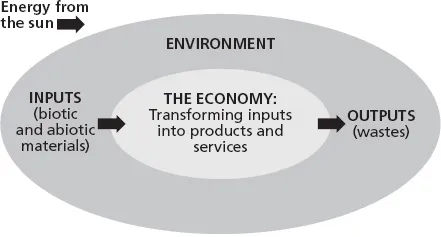
Ecological economics rests upon a fundamental assumption: that human activity, including economic activity, exists within larger ecosystems. As the diagram shows, all human activity (including the economy) requires drawing materials from an ecosystem and putting wastes back into it. (Note: The placement of the economy in the center reflects the fact that it is contained by the larger biosphere. This is not meant to suggest that humans are the most important species or that the natural world exists for their needs only. It is important to clarify these ideas with students.)
An investigation of human–environment interdependence can easily start with students’ everyday lives. For example, you can give students a category such as transportation and ask them to list all forms of transportation they have used in the past few days (e.g., bus, car, walking, bike). For each form of transportation, students should state the energy source, try to trace it to its origin, and identify where the wastes will go. For example, gas in a car could be traced to oil, which could have come from the Middle East, Venezuela or another country. The wastes (emissions) will go into the atmosphere and then possibly be absorbed by trees or other carbon “sinks.” The same approach can be taken with electronics (What is your cell phone made of? Where did those components come from?) or food (What did you eat yesterday? Where did the ingredients come from? Where will it go when you dispose of it?) Depending on your students’ prior knowledge, it’s likely that they will not know the answers to the questions; thus, the activity can be used as an introduction to raise awareness, fill gaps in knowledge and generate further questions for exploration.
The economy is contained within the environment
Adapted from Herman Daly
As a next step, students can examine the concept of the ecological footprint, a measurement of the amount of land required to provide all the resources needed to sustain a population’s (or individual’s) consumption and to absorb all the waste. Using an online calculator (e.g., <www.myfootprint.org>), students can take a quiz to measure their own f...