No matter where you are in your career, you've probably dealt with some form of organizational change. Change can be a frightening prospect, and if you do not handle it correctly, it can lead to derailment. To be a successful leader, you must learn to adapt to a wide variety of situations, opportunities, and environments. This guidebook will show you how change affects you, your thoughts, and your emotions. It will give you tools and strategies that will allow you to take action not just to survive change, but to thrive in it.
- 31 pages
- English
- ePUB (mobile friendly)
- Available on iOS & Android
eBook - ePub
About this book
Information
The Neutral Zone

The second stage of transition that you must recognize and experience is the neutral zone—the space between the old reality and the new. It’s the time when the old way is gone, but the new way is still unfamiliar and perhaps even uncomfortable. To successfully adapt to organizational change in the neutral zone, recognize the uncertainty associated with change and experience the thoughts and feelings associated with that uncertainty.

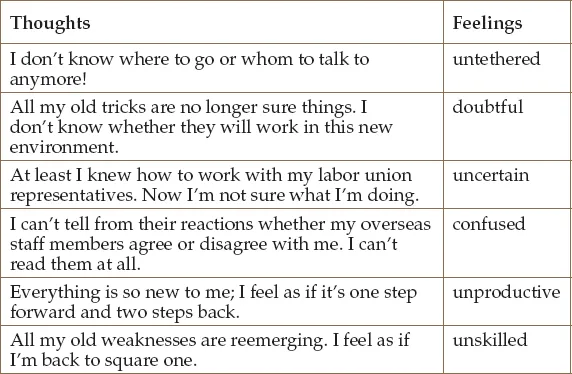
Consider this example of a change: You work as an executive in a manufacturing concern that produces products in five US plants. The company has decided to close all but one plant and consolidate production in an overseas facility. You retain your leadership role, but in a changed entity with new customs, relationships, and bureaucracies that are completely unfamiliar to you. To adapt to change and continue your transition, recognize the neutral zone you are in and experience the thoughts and feelings associated with it. What do you feel, and what thoughts are associated with these feelings? Do you feel doubtful or uncertain? Are you confused or unproductive?
If you were the executive in this example, you may have experienced feelings and thoughts such as those indicated in Figure 3, Thoughts and Feelings about the Neutral Zone.
Figure 3: Thoughts and Feelings about the Neutral Zone
Moving through the neutral zone is possibly the most uncomfortable transition stage, but focusing on the thoughts and feelings of this stage can assist you in the move from reacting to change toward successfully managing the transition. To accomplish this move, adopt the following strategies:
• Accept. Realize that uncertainty is an integral stage between an ending and a new beginning. Don’t expect to know everything or to be perfect.
• Plan. Set short-term goals to move through uncertainty and advance toward a new beginning. Take stock of what you need to accomplish those goals and identify opportunities that will help you move forward.
• Balance. Keep your feet. Look backward to the ending and acknowledge what you had. Look forward to the beginning and the possibilities it could create.
• Anchor. Connect to your values. When you feel uncertain and confused, feelings characteristic of the neutral zone, your personal values can remind you of how you got where you are and can provide direction.
Although accepting, planning, and balancing are all effective strategies, the anchoring strategy can be particularly useful in helping you navigate the neutral zone. When negotiating the neutral zone using the anchoring strategy, take stock of your personal values so that you can better understand what you have lost and what you might gain. This will allow you to envision the benefits that change might bring, put aside the negative or uncertain feelings that are an integral part of this stage, and make way for a more positive outlook in the new beginning stage. When taking stock of your personal values, keep in mind that these values are your anchor because they remain with you despite the changes happening around you. These core beliefs that you hold true are reflected in your behavior; they are about what is important in your life and are deep-seated and pervasive standards that influence nearly every aspect of your actions.
By taking stock of your personal values, you can project the values that are most important for you and the benefits that would be most beneficial for you to gain.
By taking stock of your personal values, you can project the values that are most important for you and the benefits that would be most beneficial for you to gain from the corporate change. Although many people espouse values as important, they sometimes behave in ways that don’t support those beliefs. For example, if you select healt...
Table of contents
- Cover
- Copyright
- Title Page
- Table of Contents
- Change and Transition
- The Ending Stage
- The Neutral Zone
- The New Beginning Stage
- The Process of Transition
- A Look to Culture
- Background
- Suggested Resources
Trusted by 375,005 students
Access to over 1.5 million titles for a fair monthly price.
Study more efficiently using our study tools.
Frequently asked questions
Yes, you can cancel anytime from the Subscription tab in your account settings on the Perlego website. Your subscription will stay active until the end of your current billing period. Learn how to cancel your subscription
No, books cannot be downloaded as external files, such as PDFs, for use outside of Perlego. However, you can download books within the Perlego app for offline reading on mobile or tablet. Learn how to download books offline
Perlego offers two plans: Essential and Complete
- Essential is ideal for learners and professionals who enjoy exploring a wide range of subjects. Access the Essential Library with 800,000+ trusted titles and best-sellers across business, personal growth, and the humanities. Includes unlimited reading time and Standard Read Aloud voice.
- Complete: Perfect for advanced learners and researchers needing full, unrestricted access. Unlock 1.5M+ books across hundreds of subjects, including academic and specialized titles. The Complete Plan also includes advanced features like Premium Read Aloud and Research Assistant.
We are an online textbook subscription service, where you can get access to an entire online library for less than the price of a single book per month. With over 1.5 million books across 990+ topics, we’ve got you covered! Learn about our mission
Look out for the read-aloud symbol on your next book to see if you can listen to it. The read-aloud tool reads text aloud for you, highlighting the text as it is being read. You can pause it, speed it up and slow it down. Learn more about Read Aloud
Yes! You can use the Perlego app on both iOS and Android devices to read anytime, anywhere — even offline. Perfect for commutes or when you’re on the go.
Please note we cannot support devices running on iOS 13 and Android 7 or earlier. Learn more about using the app
Please note we cannot support devices running on iOS 13 and Android 7 or earlier. Learn more about using the app
Yes, you can access Adapting to Organizational Change by Dinwoodie, Marshall, McCallian, Sereno, Shields, Zhao in PDF and/or ePUB format, as well as other popular books in Business & Leadership. We have over 1.5 million books available in our catalogue for you to explore.