The Little Book of Dyslexia
eBook - ePub

The Little Book of Dyslexia

Both Sides of the Classroom

  1. 128 pages
  2. English
  3. ePUB (mobile friendly)
  4. Available on iOS & Android
eBook - ePub

The Little Book of Dyslexia

Both Sides of the Classroom

About this book

A book for teachers that shares Joe Beech's story but, more importantly, is full of practical ideas that can be used by students with dyslexia and by teachers teaching children with dyslexia.The Little Book of Dyslexia references both personal experience and current research and findings in order to highlight issues faced by people with dyslexia. It looks at a number of strategies which can be used both inside and outside the classroom to help students with dyslexia. It also lists various resources which can be used alongside these strategies to create a successful learning environment for those with dyslexia.The book progresses through the various challenges that are faced at different age ranges, starting with the youngest, including some of the early signs you may see with dyslexia, moving up through primary and secondary school and finally onto university and being a student teacher.An outstanding guide for students, teachers and parents.

Frequently asked questions

Yes, you can cancel anytime from the Subscription tab in your account settings on the Perlego website. Your subscription will stay active until the end of your current billing period. Learn how to cancel your subscription.
At the moment all of our mobile-responsive ePub books are available to download via the app. Most of our PDFs are also available to download and we're working on making the final remaining ones downloadable now. Learn more here.
Perlego offers two plans: Essential and Complete
  • Essential is ideal for learners and professionals who enjoy exploring a wide range of subjects. Access the Essential Library with 800,000+ trusted titles and best-sellers across business, personal growth, and the humanities. Includes unlimited reading time and Standard Read Aloud voice.
  • Complete: Perfect for advanced learners and researchers needing full, unrestricted access. Unlock 1.4M+ books across hundreds of subjects, including academic and specialized titles. The Complete Plan also includes advanced features like Premium Read Aloud and Research Assistant.
Both plans are available with monthly, semester, or annual billing cycles.
We are an online textbook subscription service, where you can get access to an entire online library for less than the price of a single book per month. With over 1 million books across 1000+ topics, we’ve got you covered! Learn more here.
Look out for the read-aloud symbol on your next book to see if you can listen to it. The read-aloud tool reads text aloud for you, highlighting the text as it is being read. You can pause it, speed it up and slow it down. Learn more here.
Yes! You can use the Perlego app on both iOS or Android devices to read anytime, anywhere — even offline. Perfect for commutes or when you’re on the go.
Please note we cannot support devices running on iOS 13 and Android 7 or earlier. Learn more about using the app.
Yes, you can access The Little Book of Dyslexia by Joe Beech, Ian Gilbert in PDF and/or ePUB format, as well as other popular books in Education & Education General. We have over one million books available in our catalogue for you to explore.

Information

Chapter 1

Introduction

There are two things I would like to introduce before we continue: the first is myself, because a lot of this book is based on my personal experience, and the second is this book. First things first: I am currently a student studying a Secondary Physical Education teaching degree (QTS) at the University of Chichester. At age 8 I was diagnosed with dyslexia and dyspraxia. Dyslexia is generally associated with having difficulty learning to read and decoding language although it is far from limited to this. Dyspraxia, on the other hand, is a motor learning difficulty that affects coordination and movements. The two conditions are associated and can often develop together but are not the same.
I progressed through the education system with varied levels of success and support. There were many times when I felt angry and frustrated with my situation and there have been other times when, thanks to the support I received, I managed to achieve things I didn’t think would be possible at one stage. Ultimately, for better or for worse, and thanks to the education system and every teacher I have ever had (both good and bad), that is why I have written this book – in the hope that my experience might benefit others. My aim is to try to optimise the educational opportunities and understanding that people with dyslexia receive during their schooling.
This book will grow with age. I start by looking at some of the early signs of dyslexia before progressing through the UK education system and finally on into higher education and what it is like to be on the other side of the classroom. Along the way, drawing on my own experience, I assess what the research tells us and what support is available. I also include some of my own personal hints and tips that you might find useful. Although this book is primarily aimed at teachers, hopefully it will support students and parents alike.
The important thing to bear in mind when approaching dyslexia is that individuals don’t either have or not have dyslexia; rather it works on a continuum, and not a simple lateral one at that. People have different severities in different areas and must always be treated as individuals and never tarred with the brush of ‘having a condition’. Teaching is incredibly difficult, and if you find it easy then you are a cheat, a liar or in the words of Sir John Jones ‘a weaver of magic’!1 It is so important not to make assumptions and jump to conclusions about your students, and yet often we have a limited amount of information to work with and the ‘reality’ of dealing with what lies in front of us kicks in. To help you take reality and kick it out of the classroom where it belongs, at the end of each chapter I include a ‘teacher tips’ section which will give you some practical solutions to draw on. My aim is to help you with your ‘ACBs’, but I don’t mean teaching you to read and write. The ‘ACBs’ I am referring to are these:
A – Assessment
Looking at assessment on a number of levels: assessing for dyslexia, Assessment for Learning in the classroom and how to deal with formal and informal assessments.
C – Classroom practice
Practical and useful strategies to pull out and give a try – and, with a bit of luck, adapt and improve on! This section is at the heart of good quality teaching and learning and will hopefully give you some ideas to help you reflect on your practice, experiment with ideas, take a few risks and above all have fun. These strategies will benefit all young people, not just those with dyslexia.
B – Behaviour
Dyslexia can manifest itself in challenging behaviour, often boredom and the inability to engage with school life, which can then lead to bad behaviour. This section aims to help you spot problems before they get out of hand.
Dyslexia is always there but hopefully these tips will give you a better idea of how to deal with scenarios should they arise. Even while writing this and using a spell-checker, I still needed other people to read and check my work a number of times. Here’s an example of some of my most common mistakes:
alt
Where and were – both good words when used in the right place but with different meanings.
alt
Definitely – when spell-checked this came out as defiantly, giving a totally different meaning.
alt
Anachronisms and acronyms are two very different things.
alt
Is it instead of it is – two little words, one is a question and the other a statement. Spell-checkers don’t identify errors like these.
alt
Their/they’re.
alt
Your/you’re.
There were a whole host more but I lose track after a while. My favourite mistake however was writing defecate rather than deficit! You have to be able to laugh at yourself, sometimes dyslexia is funny!

Notes

1. J. Jones, The Magic-Weaving Business: Finding the Heart of Learning and Teaching. London: Leannta Publishing, 2009.
Chapter 2

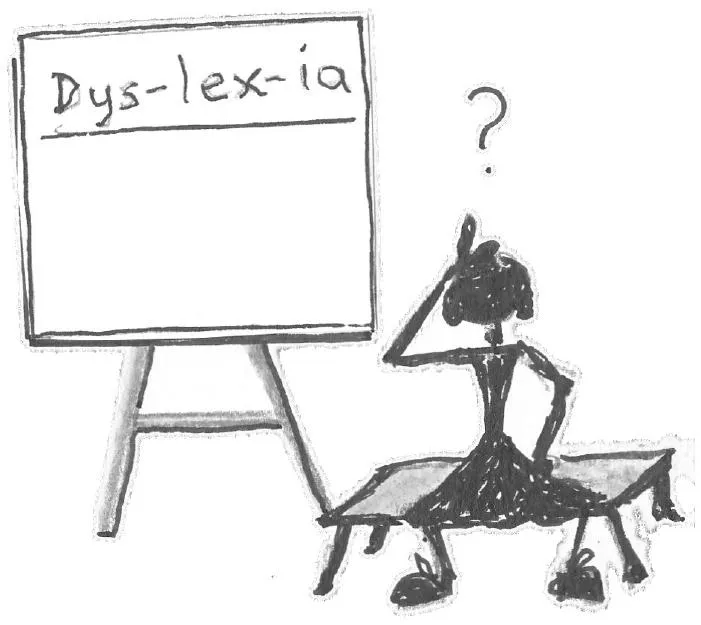
Dys-lex-ia

Writing about dyslexia presents a bit of a challenge. As someone with dyslexia I have the personal experience, but how can I ensure that this comes across in the written word? Conversely...

Table of contents

  1. Cover
  2. Praise
  3. Title Page
  4. Dedication
  5. Contents
  6. Acknowledgements
  7. Foreword
  8. Chapter 1: Introduction
  9. Chapter 2: Dys-lex-ia
  10. Chapter 3: The Early Years
  11. Chapter 4: Primary School
  12. Chapter 5: Secondary School
  13. Chapter 6: Technology
  14. Chapter 7: Exams and Qualifications
  15. Chapter 8: Higher Education
  16. Chapter 9: Teaching
  17. Bibliography
  18. Copyright