This Much I Know about Love Over Fear is a compelling account of leading a values-driven school where people matter above all else. Weaving autobiography with an account of his experience of headship, John Tomsett explains how, in an increasingly pressurised education system, he creates the conditions in which staff and students can thrive. Too many of our state schools have become scared, soulless places. John Tomsett draws on his extensive experience and knowledge and calls for all those involved in education to find the courage to develop a leadership-wisdom which emphasises love over fear. Creating a truly great school takes patience. Ultimately, truly great schools don't suddenly exist. You grow great teachers first, who, in turn, grow a truly great school. There is a huge fork in the road for head teachers: one route leads to executive headship across a number of schools and the other takes head teachers back into the classroom to be the head teacher. John strongly believes that if the head teacher is not teaching, or engaged in helping others to improve their teaching, in their school, then they are missing the point. The only thing head teachers need obsess themselves with is improving the quality of teaching, both their colleagues' and their own. This Much I Know about Love Over Fear is an authentic personal narrative of teaching, leadership and discovering what really matters. It gets to the heart of what is valuable in education and offers advice for those working in schools.
eBook - ePub
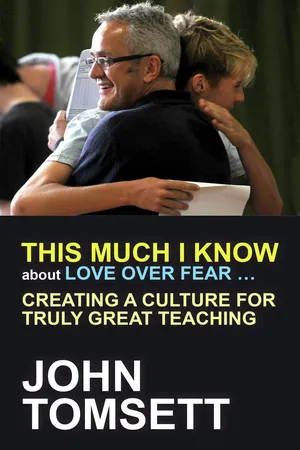
This Much I Know About Love Over Fear ...
Creating a culture for truly great teaching
- 224 pages
- English
- ePUB (mobile friendly)
- Available on iOS & Android
eBook - ePub
About this book
Trusted by 375,005 students
Access to over 1.5 million titles for a fair monthly price.
Study more efficiently using our study tools.
Information
Topic
EducationSubtopic
Education GeneralChapter 1
Truly great teaching
My first teacher
A garden is a grand teacher. It teaches patience and careful watchfulness; it teaches industry and thrift; above all it teaches entire trust.
Gertrude Jekyll
When I began my teaching career at Eastbourne Sixth Form College one of my biggest influences was Kate Darwin. We were appointed on the same day but she was nearly twenty years older than me. Kate is a truly great teacher and one of the wisest people I know.
We shared the driving from Brighton to Eastbourne and within the confines of our cars we swapped stories. Kate’s dad had been to Cambridge and won a university prize which her husband-to-be, Chris, was awarded a generation later. Kate’s dad was a head teacher. He died suddenly when Kate was only 18 years old. He had written with the same ink pen for the whole of his life; the story of her dad and his Waterman is best told in a sonnet I wrote for Kate:
Different Strokes
His choice of pen remained the same
From undergraduate Cambridge days
To signing his headmaster’s name –
A Waterman in mottled beige.
The cursive blacksmith’s art had honed
The ink-filled gold into a tool
For use by him and him alone –
His hand made them inseparable.
Gold outlasts all. The pen was left
A legacy, bequeathed to her
Whose writing pleased the family most:
But straining through the unknown curves
It snapped, to leave the nib’s new host
Mourning afresh, doubly bereft.
And whilst not educated like Kate’s father, my dad was a teacher in many ways too. Apart from learning how to play golf with him, he taught me a lot about the countryside. He’d grown up four miles from his school and had to walk there and back every day through the Sussex fields. He taught me how to strip a sapling for a bow and arrow, how to predict the weather, how to catch a fish. I can remember as a 6-year-old watching him stalk a trout in an eddied pool on a Sussex stream for nearly an hour before he caught it. He was a study in patient persistence.
I hadn’t realised quite what a teacher he was until my eldest sister, Bev, who knew him that much longer than I did, wrote to me nearly thirty years after he’d died:
Dad was always there for each of us as we grew up. He took Dave [my eldest brother] and me for long walks in the country and knew everything about nature. He helped me with my stoolball, helped me ice and decorate my Xmas cake, and even tried to teach me how to hit a golf ball!
Luckily for all of us his job did not interfere with home life. Once he clocked off he’d finished until the alarm went off the next morning. He was able to enjoy his post round out in the countryside, and was a valuable member of that community. He helped feed the lambs at the farm, took an old lady flowers and eggs, posted her letters and was the only human contact that she had.
Every March he would pick the first primroses of the year and send them to Auntie Nancy. He was out in the fresh air every day, observing all four seasons, not confined to four brick walls like the majority of us are.
I see dad in his own way as a teacher. He was not well-educated – through no fault of his own – but he taught us right from wrong. He showed us how to respect the countryside, kindness, honesty, stoicism, love and gratitude. Above all he was able to give each of us his time, a gift more precious than status or money. He was a very wise man.
After I’d wiped the tears away, one thing that struck me about Bev’s words was the first three things she cites which dad showed us: how to respect the countryside, kindness and honesty. They are the exact same values of our school: respect, honesty and kindness.
Dad tended roses with pure artistry. He died three years from retirement and the chance to lie in his own bed of roses forever. And just as Kate was chosen to receive her dad’s pen, I became the depository for all my dad’s possessions. Mother still sends me odd artefacts she finds, like his National Service discharge documents – he was conscripted into the navy for two years.
His glasses were a shock when I opened the case; they are half-rimmed ones and the way he used to look over the top of them and grin seemed encased with them. Mother sent me this letter which is now framed on my office wall:
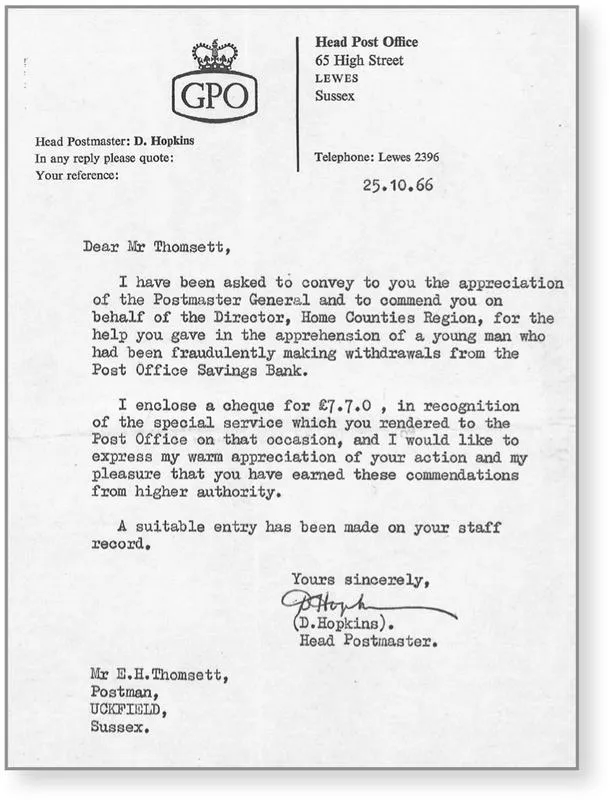
In the event of a fire this is the first thing I would grab. The letter captures perfectly dad’s honesty which Bev had so sharply observed, and I love the way the class system – which pervaded mid-1960s Britain – is clearly evident in the letter’s tone. Worth noting too that in 1966, £7.7.0 was a week’s wages to a postie.
Truly great teaching
The fundamental purpose of school is learning, not teaching.
Richard DuFour
Before we go any further, it’s important to explore the core business of any school: teaching. And it’s worth emphasising that we are trying to focus upon teaching not teachers. Professor Chris Husbands explained beautifully why it is worth making this subtle distinction in a blog post where he pointed out, ‘We can all teach well and we can all teach badly … more generally, we can all teach better: teaching changes and develops. Skills improve. Ideas change. Practice alters. It’s teaching, not teachers.’1 This is a helpful distinction because it depersonalises pedagogy so that we can at least begin to talk about improving teaching without being critical of the individual person who is doing the teaching – something which is generally so hard to achieve.
The more I read about teaching, the more difficult it is to define teaching, let alone truly great teaching. If you read Graham Nuthall’s The Hidden Lives of Learners,2 or Daniel Willingham’s Why Don’t Students Like School?3 or Paul Hirst’s ‘What is Teaching?’,4 you’ll understand why anyone could feel confused about what truly great teaching looks and sounds like.
Hirst says, ‘Successful teaching would seem to be simply teaching which does in fact bring about the desired learning.’5 Within that seemingly simple statement lies the complex relationship between teacher and student, something quite delicate but crucial to successful teaching and learning. And when Biesta writes, ‘it is not within the power of the teacher to give this gift [of teaching], but depends on the fragile interplay between the teacher and the student. Teachers can at most try and hope, but they cannot force the gift [of teaching] upon their students,’6 what ...
Table of contents
- Cover
- Praise
- Title Page
- Dedication
- Epigraph
- Gratitudes
- Contents
- A family portrait
- Why this book?
- Chapter 1: Truly great teaching
- Chapter 2: You can always be that little bit better
- Chapter 3: Why I teach
- Chapter 4: Why writing matters
- Chapter 5: The team to lead teacher learning
- Chapter 6: Why we all have to teach
- Chapter 7: Teaching the tough classes
- Chapter 8: Explanations
- Chapter 9: Lessons
- Chapter 10: Creating the conditions for growth
- Chapter 11: Developing a growth mindset environment
- Chapter 12: You can’t just wish to be better …
- Chapter 13: Developing not managing people
- Chapter 14: It’s not about the money
- Chapter 15: Experience
- Chapter 16: Making the time
- Chapter 17: Becoming an evidence-based profession
- Chapter 18: Tending your colleagues
- Endnote: The real enemy of promise
- Select bibliography
- Copyright
Frequently asked questions
Yes, you can cancel anytime from the Subscription tab in your account settings on the Perlego website. Your subscription will stay active until the end of your current billing period. Learn how to cancel your subscription
No, books cannot be downloaded as external files, such as PDFs, for use outside of Perlego. However, you can download books within the Perlego app for offline reading on mobile or tablet. Learn how to download books offline
Perlego offers two plans: Essential and Complete
- Essential is ideal for learners and professionals who enjoy exploring a wide range of subjects. Access the Essential Library with 800,000+ trusted titles and best-sellers across business, personal growth, and the humanities. Includes unlimited reading time and Standard Read Aloud voice.
- Complete: Perfect for advanced learners and researchers needing full, unrestricted access. Unlock 1.5M+ books across hundreds of subjects, including academic and specialized titles. The Complete Plan also includes advanced features like Premium Read Aloud and Research Assistant.
We are an online textbook subscription service, where you can get access to an entire online library for less than the price of a single book per month. With over 1.5 million books across 990+ topics, we’ve got you covered! Learn about our mission
Look out for the read-aloud symbol on your next book to see if you can listen to it. The read-aloud tool reads text aloud for you, highlighting the text as it is being read. You can pause it, speed it up and slow it down. Learn more about Read Aloud
Yes! You can use the Perlego app on both iOS and Android devices to read anytime, anywhere — even offline. Perfect for commutes or when you’re on the go.
Please note we cannot support devices running on iOS 13 and Android 7 or earlier. Learn more about using the app
Please note we cannot support devices running on iOS 13 and Android 7 or earlier. Learn more about using the app
Yes, you can access This Much I Know About Love Over Fear ... by John Tomsett in PDF and/or ePUB format, as well as other popular books in Education & Education General. We have over 1.5 million books available in our catalogue for you to explore.